Chemistry · Ch 10 — Biomolecules
Polysaccharides
Polysaccharides
Polysaccharides
Polysaccharides are built from a very large number of monosaccharide units, all linked together by glycosidic linkages. They are the carbohydrates encountered most commonly in nature, and their biological role is almost always one of two things: acting as food-storage material or acting as structural material.
(i) Starch
Starch is the principal storage polysaccharide of plants and, correspondingly, the single most important dietary source of carbohydrate for human beings. It is present in high concentration in cereals, roots, tubers and a number of vegetables. Chemically, starch is a polymer built entirely of -glucose units, and it is made up of two distinct components:
- Amylose — the water-soluble component, making up roughly 15–20% of starch. It is a long, unbranched chain of 200–1000 -D-(+)-glucose units, all held together by C1–C4 glycosidic linkages.
- Amylopectin — the water-insoluble component, making up roughly 80–85% of starch. It is a branched-chain polymer of -D-glucose units: the main chains are formed by C1–C4 glycosidic linkages exactly as in amylose, but branch points are introduced by additional C1–C6 glycosidic linkages.
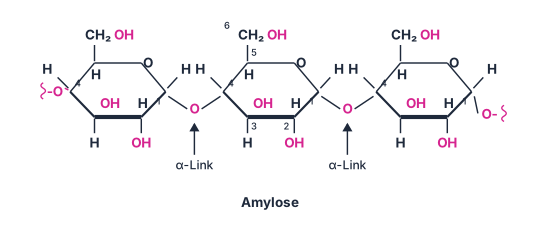
Drawn by us to help you understand the concept clearly, and verified to make sure it's accurate. For exams, practice from your textbook's own diagram.
Redrawn from the NCERT page with the structures, printed labels (-O, O-) and reagent placement exactly as the textbook prints them. Every element of this display was checked against the printed page during the sweep's blind-judge verification pass, so what …
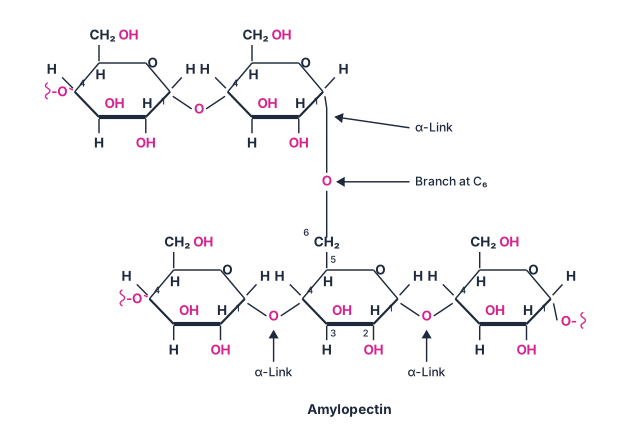
Drawn by us to help you understand the concept clearly, and verified to make sure it's accurate. For exams, practice from your textbook's own diagram.
Redrawn from the NCERT page with the structures, printed labels (-O, α-Link, Branch at C6, O-) and reagent placement exactly as the textbook prints them. Every element of this display was checked against the printed page during the sweep's blind-judge verification pass, so w …
(ii) Cellulose
Cellulose occurs exclusively in the plant kingdom, where it is the most abundant organic substance of all — it is the predominant constituent of the plant cell wall. Structurally it is a straight, unbranched chain polysaccharide composed only of -D-glucose units, joined by a glycosidic linkage between C1 of one glucose unit and C4 of the next.
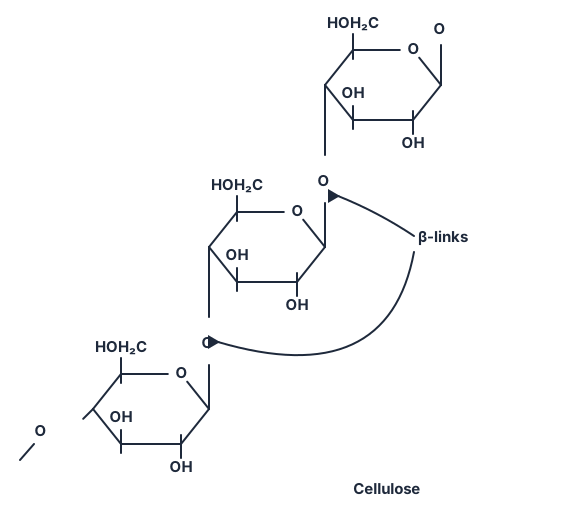
Drawn by us to help you understand the concept clearly, and verified to make sure it's accurate. For exams, practice from your textbook's own diagram.
Redrawn from the NCERT page with the structures, printed labels (β-links) and reagent placement exactly as the textbook prints them. Every element of this display was checked against the printed page during the sweep's blind-judge verification pass, so what …
Starch and cellulose are both glucose polymers linked C1 to C4 — the entire difference between them is the anomeric configuration of that link: starch's glucose units are joined by -glycosidic linkages, cellulose's by -glycosidic linkages. This single difference in bond geometry is why the two behave so differently once eaten: the digestive enzymes that break down starch in the human body are built to cleave -linkages, so starch is digestible, while cellulose's -linkages pass through the human gut unbroken.