Q.Allyl chloride is hydrolysed more readily than n-propyl chloride. Why?
You're viewing a preview — the full solution, concept, methods & PYQ mapping are locked.
Start your 14-day free trial to unlock the full solution →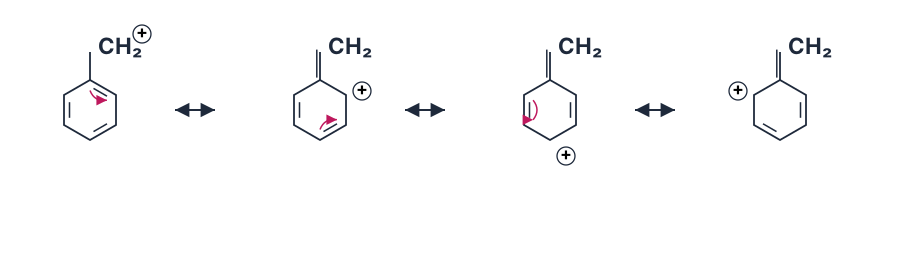
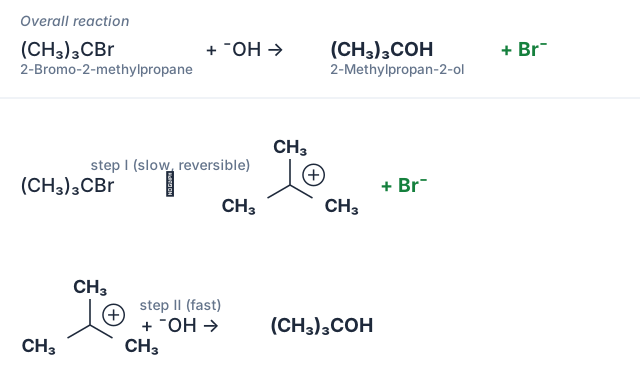
Allyl chloride undergoes hydrolysis faster than n-propyl chloride because its carbocation intermediate is stabilised by resonance with the adjacent C=C double bond, dramatically lowering the activation energy for the SN1 pathway.
The key to this question lies in the stability of the intermediate carbocation formed during hydrolysis. Both allyl chloride and n-propyl chloride are primary alkyl halides, so you might expect them to react similarly. But allyl chloride is special — the double bond right next to the chlorine atom changes everything.
Let’s walk through the reasoning step by step.
-
Identify the reaction type. Hydrolysis of an alkyl halide (with water or aqueous base) typically follows either an SN1 or SN2 mechanism. For a primary halide like n-propyl chloride, SN2 is the usual path. But allyl chloride is an exception: it can react via SN1 even though it’s primary, because the carbocation formed is unusually stable.
-
Draw the carbocation intermediates.
- For n-propyl chloride, if it were to ionise, you’d get a primary carbocation: This is highly unstable — no resonance stabilisation, only weak hyperconjugation from three C–H bonds.
- For allyl chloride, ionisation gives the allyl carbocation: Here, the positive charge is not stuck on one carbon. The electrons of the double bond can delocalise into the empty p orbital, spreading the charge over two carbons.
-
Resonance stabilisation is the game-changer.
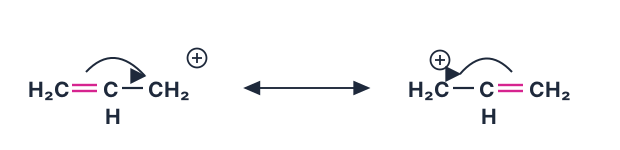
The allyl carbocation has two equivalent resonance structures:
This delocalisation lowers the energy of the carbocation significantly. In contrast, the n-propyl carbocation has no such resonance — it’s just a high-energy, localised positive charge.
The allyl carbocation is stabilised by resonance:
- Connect stability to reaction rate.
In an SN1 reaction, the rate-determining step is the formation of the carbocation. The more stable the carbocation, the lower the activation energy for that step, and the faster the reaction.
- Allyl chloride forms a resonance-stabilised carbocation → low → fast hydrolysis. …
Unlock everything free for 14 days
- Full step-by-step solutions
- Concept-first explanations
- Methods, shortcuts & mistakes
- PYQ mapping + timed mock tests
Full access for 14 days. No credit card required.