AC Through a Capacitor — From Intuition to the Exact Statement
Imagine a capacitor as a tiny, two-plate storage tank for charge. When you connect it to a DC battery, it charges up quickly and then blocks any further current — that's why a capacitor is an open circuit for steady DC. But AC is different: the voltage keeps reversing, so the capacitor never gets a chance to settle. It is constantly being charged, discharged, charged the other way, discharged again — and that motion of charge is an alternating current.
The key intuition: current flows because the voltage is changing. If the voltage were steady, no current would flow. The faster the voltage changes, the larger the current. This is the opposite of a resistor, where current depends on the voltage itself, not its rate of change.
The Mathematical Link
For a capacitor, the charge stored is Q=CV. Current is the rate of flow of charge: I=dQ/dt. So:
I=CdtdV
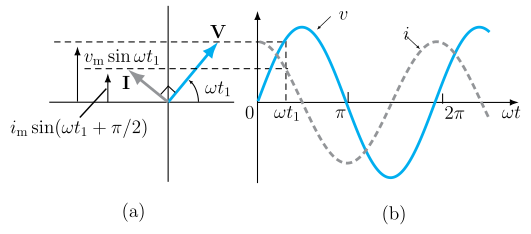
This single equation is the whole story. If the applied voltage is sinusoidal, say V=V0sin(ωt), then:
I=Cdtd[V0sin(ωt)]=CV0ωcos(ωt)
Now compare the two waveforms:
- Voltage: V0sin(ωt) — starts at zero, rises to peak.
- Current: CV0ωcos(ωt) — starts at its maximum value, then falls.
A cosine is a sine shifted forward by 90∘ (or π/2 radians). So the current reaches its peak a quarter-cycle before the voltage does. That is the famous result: in a purely capacitive circuit, current leads voltage by 90∘.
The phase relation: I leads V by 90∘ in a pure capacitor. Equivalently, V lags I by 90∘.
Why "Leads" and Not "Lags"?
Think physically. At the instant you first apply the AC voltage, the voltage is zero but rising fastest (the slope of sin is maximum at zero). A fast-changing voltage means a large current. So the current is already at its peak while the voltage is still near zero. That is the meaning of "leading" — the current's peak comes first.
Later, when the voltage reaches its peak, it is momentarily not changing (slope = 0), so the current drops to zero. The current is always ahead of the voltage by exactly one quarter-cycle.
The Limiting Factor: Capacitive Reactance
From the current expression above, the peak current is:
I0=ωCV0
This looks like Ohm's law if we define an effective resistance-like quantity:
XC=I0V0=ωC1
This XC is called capacitive reactance. It has units of ohms, but it is not a resistance — it does not dissipate energy. It merely limits the current by the capacitor's opposition to changes in voltage.
XC=ωC1=2πfC1
Key points about XC:
- It is inversely proportional to frequency. At high f, the voltage changes rapidly, so the current is large — low reactance. At low f, the voltage changes slowly, so the current is small — high reactance. At DC (f=0), XC→∞, which is the open-circuit behaviour you already know.
- It is also inversely proportional to capacitance C. A larger capacitor stores more charge per volt, so for the same voltage change it pushes more current — lower reactance.
The Complete Picture in One Table
| Property | Resistor | Capacitor |
|---|
| Relation | V=IR | I=CdV/dt |