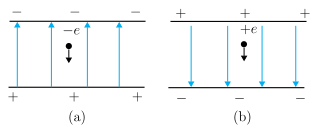
Q.An electron falls through a distance of 1.5cm in a uniform electric field of magnitude 2.0×10⁴N C−1 [Fig. 1.10(a)]. The direction of the field is reversed keeping its magnitude unchanged and a proton falls through the same distance [Fig. 1.10(b)]. Compute the time of fall in each case. Contrast the situation with that of 'free fall under gravity'.
Concept understanding — Charge To Mass Ratio
Charge to Mass Ratio: The First Meeting
Imagine you have two identical-looking balls. One is made of cork, the other of lead. If you blow on them with the same fan, the cork ball flies away easily, while the lead ball barely moves. The difference isn't in the force you applied — it's in how much mass each ball has. Now imagine that instead of blowing air, you're using an electric field to push a charged particle. The same idea applies: the particle's response depends on both its charge (how strongly the field pushes it) and its mass (how much inertia it has to overcome).
The charge to mass ratio (e/m for an electron, often written as q/m in general) is simply the charge of a particle divided by its mass. It tells you how much "electric responsiveness" a particle has per unit of its inertia.
Why This Ratio Matters
Two particles can have the same charge but very different masses. A proton and a positron both have charge +e, but the proton is about 1836 times heavier. If you put them in the same electric field, the positron accelerates 1836 times more. The charge-to-mass ratio captures this difference in a single number.
For an electron:
mee≈1.76×10¹¹C/kg
For a proton:
mpe≈9.58×10⁷C/kg
The electron's ratio is nearly 2000 times larger. That's why electrons are so much more mobile in circuits and beams — they respond far more dramatically to electric and magnetic fields.
The Precise Definition
mq=mass of the particlecharge of the particle
Its SI unit is coulombs per kilogram (C/kg). For any charged particle, this ratio determines:
- How much it accelerates in an electric field: a=mqE
- How tightly it curves in a magnetic field: radius r=qBmv
- The frequency of its circular motion: ω=mqB
How It Was Discovered
J.J. Thomson measured this ratio for cathode rays in 1897. He didn't know what the particles were — he just knew they were charged and had mass. By balancing electric and magnetic forces, he found that the ratio was over a thousand times larger than for any known ion. This told him the particles (which we now call electrons) were either extraordinarily charged or extraordinarily light. We now know it's the latter: the electron is the lightest charged particle with a non-zero rest mass.
The charge-to-mass ratio is a fundamental property of each type of particle. It cannot be changed — it's as intrinsic as the particle's spin or its rest mass.
A Common Confusion
Students sometimes think a larger charge means a larger ratio. Not necessarily. A particle with charge +2e and mass 4mp (like an alpha particle) has a ratio half that of a proton. The ratio depends on both numbers, not just the charge.
The Takeaway
The charge-to-mass ratio is the particle's "agility" in electromagnetic fields. It's the bridge between the electric force it feels and the inertia it carries. Whenever you see a charged particle bending in a magnetic field or accelerating between plates, this single number governs everything.
The charge-to-mass ratio of a particle is q/m — the charge divided by the mass, measured in C/kg, and it determines how strongly the particle responds to electric and magnetic fields.
"Charge to mass ratio of electron formula" and "Thomson experiment class 12 physics" are common search queries, and this concept connects the Moving Charges and Magnetism chapter of the NCERT/CBSE Class 12 Physics curriculum with the historical discovery of the electron. It's also a recurring topic in JEE Main and NEET questions on charged-particle motion in fields.
Why this formula?
Charge to Mass Ratio (e/m) — Why the Formula Holds
The charge-to-mass ratio (e/m) is a fundamental property of charged particles. For the electron, its measurement was a landmark experiment by J.J. Thomson (1897). Let's understand why the key formula emerges from the physics.
1. The Core Idea: Balancing Forces
The experiment uses a velocity selector — a region with perpendicular electric (E) and magnetic (B) fields.
What happens to a charged particle?
A particle with charge q and mass m moving with velocity v experiences:
- Electric force: FE=qE (direction: along E)
- Magnetic force: FB=q(v×B) (direction: perpendicular to both v and B)
The key insight:
If we arrange E and B perpendicular to each other and to v, the two forces act in opposite directions.
2. Deriving the Velocity Condition
For the particle to pass undeflected through the crossed fields:
FE+FB=0
Since forces are opposite:
qE=qvB
Cancel q (non-zero for a charged particle):
v=BE
Why this matters: This gives us the particle's speed without knowing its mass or charge. The velocity selector picks out only particles with this specific speed.
3. Measuring e/m — The Circular Path
After the velocity selector, the particle enters a region with only magnetic field (B). Here:
- Magnetic force provides centripetal force
- The particle moves in a circular path of radius r
Force balance:
qvB=rmv2
Rearranging:
mq=Brv
Substituting v=E/B from step 2:
mq=B2rE
4. Why This Formula Holds — The Physical Logic
| Step | Physics Principle | What it gives us |
|---|---|---|
| 1 | Force balance in crossed fields | Speed v=E/B |
| 2 | Centripetal force in magnetic field | Radius r depends on q/m |
| 3 | Combine both | Direct measurement of q/m |
Key assumptions (exam-relevant):
- Uniform E and B fields
- No other forces (gravity negligible for electrons)
- Particle enters perpendicular to both fields
5. For the Electron: The Famous Result
Thomson found:
mee≈1.76×10¹¹C/kg
Why this was revolutionary: It showed that the electron's e/m was ~2000 times larger than that of hydrogen ions — meaning either the electron had a tiny mass or a huge charge. This proved the electron was a subatomic particle.
Quick Exam Tip
When asked to derive e/m:
- Start with force balance in crossed fields → get v
- Use circular motion in pure B → get q/m=v/(Br)
- Substitute v → final formula
Never skip the cancellation of q in step 1 — that's the conceptual key!
In a uniform field the electric force F=qE is constant, so each particle has constant acceleration a=qE/m and, starting from rest, falls through s in t=2s/a.
Data: s=1.5cm=0.015m, E=2.0×10⁴N/C, e=1.6×10⁻¹⁹C.
Electron (me=9.11×10⁻³¹kg):
ae=meeE=9.11×10⁻³¹(1.6×10⁻¹⁹)(2.0×10⁴)=3.51×10¹⁵m/s2,
te=3.51×10152(0.015)=2.92×10⁻⁹s.
Proton (mp=1.67×10⁻²⁷kg):
ap=mpeE=1.67×10⁻²⁷(1.6×10⁻¹⁹)(2.0×10⁴)=1.92×10¹²m/s2,
tp=1.92×10122(0.015)=1.25×10⁻⁷s.
Contrast: in gravity a=g≈9.8m/s2 is the same for every body, whereas here a=qE/m depends on the charge-to-mass ratio, so the light electron falls much faster than the proton, and both times are far shorter than a gravitational fall (≈0.055s).
te=2.92×10⁻⁹s (electron) and tp=1.25×10⁻⁷s (proton).
Both particles undergo constant acceleration a=qE/m, so t=2s/a: the electron takes 2.92×10⁻⁹s and the proton 1.25×10⁻⁷s. Unlike free fall (where a=g is mass‑independent), here the time depends on q/m, and both are far shorter than a gravitational fall.
A uniform field exerts a constant force F=qE, hence a constant acceleration by Newton's second law. Starting from rest, kinematics gives s=21at2, so t=2s/a.
Given: s=1.5cm=0.015m, E=2.0×10⁴N/C, e=1.6×10⁻¹⁹C, me=9.11×10⁻³¹kg, mp=1.67×10⁻²⁷kg. In (a) the field points up and the electron (negative) is pushed down; in (b) the field is reversed and the proton (positive) is also pushed down — so each falls through the same s.
Electron.
ae=meeE=9.11×10⁻³¹(1.6×10⁻¹⁹)(2.0×10⁴)=3.51×10¹⁵m/s2,
te=ae2s=3.51×10152(0.015)=8.55×10−18=2.92×10⁻⁹s.
Proton. The force magnitude eE=3.2×10⁻¹⁵N is the same, but the proton is about 1836 times heavier:
ap=mpeE=1.67×10⁻²⁷(1.6×10⁻¹⁹)(2.0×10⁴)=1.92×10¹²m/s2,
tp=ap2s=1.92×10122(0.015)=1.57×10−14=1.25×10⁻⁷s.
Contrast with free fall under gravity. In free fall the acceleration is g≈9.8m/s2, identical for every body regardless of mass. Here the acceleration a=qE/m is enormous (∼1012–1015m/s2) and depends on the charge‑to‑mass ratio, so electron and proton fall in very different times. A purely gravitational fall through the same 0.015m would take tg=2s/g≈0.055s — millions of times longer, which is why gravity is negligible for charged particles in such fields.
te=2.92×10⁻⁹s (electron) and tp=1.25×10⁻⁷s (proton).
Method: Newton’s Second Law + Kinematics (Uniform Acceleration)
This method uses the electric force to find acceleration, then applies equations of motion for constant acceleration.
Step 1 — Identify the force and acceleration
For a charge q in a uniform electric field E:
F=qE
By Newton’s second law:
a=mF=mqE
- For the electron: q=−e, so ae=me−eE (magnitude ae=meeE)
- For the proton: q=+e, so ap=mpeE
Step 2 — Apply kinematics for constant acceleration
The particle falls from rest (u=0) through distance s=1.5 cm=0.015 m.
Using s=ut+21at2:
t=a2s
Step 3 — Compute times
Given:
E=2.0×10⁴ N C−1
e=1.6×10⁻¹⁹ C
me=9.1×10⁻³¹ kg
mp=1.67×10⁻²⁷ kg
For electron:
ae=9.1×10⁻³¹(1.6×10⁻¹⁹)(2.0×10⁴)=3.52×10¹⁵ m s−2
te=3.52×10152×0.015=8.52×10−18=2.92×10⁻⁹ s
For proton:
ap=1.67×10⁻²⁷(1.6×10⁻¹⁹)(2.0×10⁴)=1.92×10¹² m s−2
tp=1.92×10122×0.015=1.56×10−14=1.25×10⁻⁷ s
Step 4 — Contrast with free fall under gravity
- Free fall acceleration: g≈9.8 m s−2 Time to fall 1.5 cm:
tg=9.82×0.015=0.055 s
- Key differences:
- Electric acceleration is huge compared to g (by factors of 1011 to 1014)
- Electron falls ~43 times faster than proton (because me≪mp)
- In free fall, all objects fall with same acceleration (independent of mass) — here, acceleration depends on charge-to-mass ratio q/m
Final results:
| Particle | Time of fall |
|---|---|
| Electron | 2.92×10⁻⁹ s |
| Proton | 1.25×10⁻⁷ s |
| Free fall | 0.055 s |
Common Mistakes & How to Avoid Them
Mistake 1: Forgetting the Mass Difference Between Electron and Proton
The error: Students often assume both particles have the same mass, or they plug in the electron mass for the proton (or vice versa).
Why it happens: The problem asks for "time of fall" for both, and it's easy to rush and use the same mass value.
How to avoid:
- Always write the mass explicitly before substituting:
- Electron: me=9.1×10⁻³¹kg
- Proton: mp=1.67×10⁻²⁷kg
- Note that the proton is ~1836 times heavier — this alone tells you the proton will take much longer to fall the same distance.
Mistake 2: Ignoring the Sign of Charge When Field Reverses
The error: Students treat the reversed field as if it still pushes the proton in the same direction as the electron.
Why it happens: The problem says "direction of the field is reversed" — but the proton is positively charged, so the force direction flips relative to the electron.
How to avoid:
- Force on a charge: F=qE
- Electron (q=−e): force is opposite to E
- Proton (q=+e): force is along E
- When the field reverses, the electron would reverse direction too — but here the electron falls before reversal, and the proton falls after reversal.
- Key insight: In both cases, the particle is accelerated downward (toward the lower plate). The reversal ensures the proton also falls, not rises.
Mistake 3: Using g Instead of Electric Acceleration
The error: Students treat this as free fall under gravity and use t=2h/g.
Why it happens: The problem explicitly asks to "contrast with free fall under gravity," but students sometimes mix the two.
How to avoid:
- The acceleration here is NOT g. It comes from the electric force:
a=mF=mqE
- For the electron: ae=meeE
- For the proton: ap=mpeE
- Then use s=21at2 → t=a2s
Mistake 4: Forgetting That Both Charges Have Magnitude e
The error: Students think the proton has charge +e and the electron −e, but then use different magnitudes of charge in the force equation.
Why it happens: The sign matters for direction, but the magnitude of charge is the same: e=1.6×10⁻¹⁹C.
How to avoid:
- Write: ∣qe∣=∣qp∣=e
- The force magnitude is eE for both — only the mass differs.
Mistake 5: Not Contrasting with Free Fall Properly
The error: Students compute the times but don't explain why the comparison matters.
Why it happens: The question says "Contrast the situation," but students treat it as an afterthought.
How to avoid:
- Free fall under gravity:
tfree fall=g2h(g≈9.8m/s2)
- Electric case:
telectric=eE2hm
- Key contrast:
- In free fall, all objects fall with same acceleration g (ignoring air resistance).
- In an electric field, acceleration depends on mass — the electron falls ~1836× faster than the proton.
- Also, gravity always pulls downward; electric force direction depends on charge sign.
Quick Checklist to Avoid These Mistakes
| Step | What to Check |
|---|---|
| 1 | ✓ Write me and mp separately |
| 2 | ✓ Confirm force direction using F=qE |
| 3 | ✓ Use a=qE/m, not g |
| 4 | ✓ Use $ |
| 5 | ✓ Explain: same E → different a → different t |
Final Answer (for reference)
Electron:
ae=meeE=9.1×10⁻³¹(1.6×10⁻¹⁹)(2.0×10⁴)≈3.52×10¹⁵m/s2
te=3.52×10152×0.015≈2.92×10⁻⁹s
Proton:
ap=mpeE=1.67×10⁻²⁷(1.6×10⁻¹⁹)(2.0×10⁴)≈1.92×10¹²m/s2
tp=1.92×10122×0.015≈1.25×10⁻⁷s
Contrast: Under gravity, both would take 2h/g≈0.055s — much slower than the electron, but faster than the proton. The electric field discriminates by mass, while gravity does not.
🎓Unlock everything free for 14 days
- ✓Full step-by-step solutions
- ✓Concept-first explanations
- ✓Methods, shortcuts & mistakes
- ✓PYQ mapping + timed mock tests
Full access for 14 days. No credit card required.