Miscellaneous Exercise · Q7
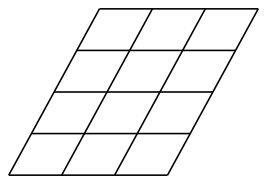
Q.Find the number of parallelograms in the following figure. [Figure: a large slanted parallelogram-shaped grid formed by 2 sets of parallel lines (3 lines crossing 4 lines) so that the whole figure is divided into a 3-column by 4-row array of unit parallelograms.]
Sikkim CbseNCERTSubjective· 2mImportance★★★★★est
95% · 120/126 Questions
You're viewing a preview — the full solution, concept, methods & PYQ mapping are locked.
Start your 14-day free trial to unlock the full solution →A grid built from 4 parallel lines in one direction (giving 3 columns) crossed by 5 parallel lines in the other direction (giving 4 rows) has its parallelograms counted by choosing any 2 lines from each family.
If a family of parallel lines is cut by another family of parallel lines, every choice of 2 lines from the first family together with 2 lines from the second family bounds exactly one parallelogram (of any size, not only the unit cells). Number of parallelograms .
- A -column strip of unit cells needs boundary lines in that direction (e.g. 3 columns are bounded by 4 vertical-family lines: the 3 dividers plus the 2 outer edges give 4 lines total). The figure is a -column by -row array, so it is generated by lines of one family and lines of the other family. …
Unlock everything free for 14 days
- Full step-by-step solutions
- Concept-first explanations
- Methods, shortcuts & mistakes
- PYQ mapping + timed mock tests
Full access for 14 days. No credit card required.