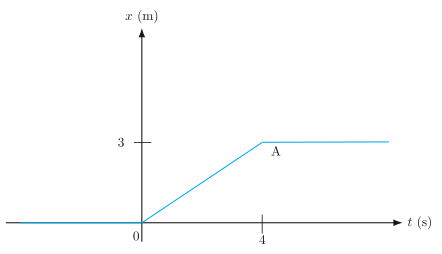
Q.A particle of mass moves along a straight line (one-dimensional motion). Its position (in metres) varies with time (in seconds) as follows: for the particle stays at ; from to its position increases uniformly (a straight sloped line) from to , reaching the point ; and for it stays constant at . Find
You're viewing a preview — the full solution, concept, methods & PYQ mapping are locked.
Start your 14-day free trial to unlock the full solution →On a position-time graph the velocity is the slope. The particle is at rest for , moves with the constant velocity for , and is again at rest for . Constant velocity means zero acceleration, so the net force is zero in every interval. The velocity jumps at and , and each jump corresponds to an impulse of magnitude .
Concept
Newton's second law gives the net force as . The velocity itself is the slope of the position-time graph, . If increases linearly with , the slope (velocity) is constant, so and . Impulse is the change in momentum, , and it is what tells us about the abrupt velocity changes at the corners of the graph.
(a) Force in each interval
Read the slope of the graph in each region:
- For : (constant), so . The particle is at rest, .
- For : rises uniformly from to , so
A constant velocity means , hence
- For : (constant), so and .
So the net force is zero in all three intervals. (The force is undefined exactly at the sharp corners and , where the slope changes suddenly — that is where the impulses act.)
(b) Impulse at and
Use .
- At : velocity changes from (just before) to (just after). …
Unlock everything free for 14 days
- Full step-by-step solutions
- Concept-first explanations
- Methods, shortcuts & mistakes
- PYQ mapping + timed mock tests
Full access for 14 days. No credit card required.