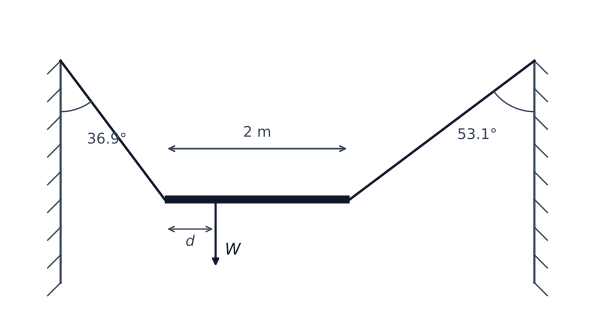
Q.A non-uniform bar of weight W is suspended at rest by two strings of negligible weight as shown in Fig. 6.33. The angles made by the strings with the vertical are 36.9° and 53.1° respectively. The bar is 2 m long. Calculate the distance d of the centre of gravity of the bar from its left end.
Imagine a book lying flat on a table. It doesn't move. A lamp hanging from the ceiling — still. A bridge holding up cars — motionless. What do all these have in common? They are in static equilibrium.
The word "static" means unchanging or stationary. "Equilibrium" comes from Latin aequilibrium — "equal balance." Put them together: a state where an object is completely at rest, with no tendency to start moving or rotating.
But here's the key insight: being at rest doesn't mean nothing is happening. Forces are still acting on that book — gravity pulls it down, the table pushes it up. The lamp feels tension from the ceiling pulling up and gravity pulling down. These forces are cancelling each other out perfectly.
Note
Static equilibrium is dynamic balance — forces are present, but their net effect is zero. The object "chooses" to stay still because all pushes and pulls are perfectly matched.
The Two Conditions for Static Equilibrium
For an object to be truly static (not moving or rotating), two separate things must be true simultaneously.
Condition 1: No Net Force (Translational Equilibrium)
The sum of all forces acting on the object must be zero. In vector form:
∑F=0
This means:
All upward forces equal all downward forces
All leftward forces equal all rightward forces
All forward forces equal all backward forces
If you break it into components (the standard exam approach):
∑Fx=0,∑Fy=0,∑Fz=0
Why this alone isn't enough: Imagine pushing a door at its handle — it rotates open. The forces might balance (you push, the hinges push back), but the door still moves. That's why we need the second condition.
Condition 2: No Net Torque (Rotational Equilibrium)
The sum of all torques (twisting effects) about any point must be zero:
∑τ=0
Torque depends on three things: the force applied, the distance from the pivot point, and the angle at which you push. For a force F applied at distance r from the pivot, at angle θ:
τ=rFsinθ
Watch out
A common mistake: thinking torque only matters if the object is actually rotating. Torque can be present even when nothing moves — it's just balanced by other torques. A seesaw with two kids of equal weight at equal distances is a perfect example.
Putting It All Together
For an object to be in static equilibrium:
∑F=0and∑τ=0
Both conditions must hold simultaneously. If either fails, the object will either accelerate (move in a straight line) or start rotating (or both).
A Simple Example: The Book on the Table
Consider a 2 kg book on a horizontal table. Gravity pulls down with force Fg=mg=2×9.8=19.6 N.
Force balance (horizontal and vertical) gives the two string tensions in terms of the weight; torque balance about the left end (where T1's moment arm is zero) then fixes the position of the centre of gravity.
Setup: Let T1 (left string) make angle θ1=36.9° with the vertical and T2 (right string) make angle θ2=53.1° with the vertical — the familiar 3-4-5 triangle, so sin36.9°=0.6,cos36.9°=0.8,sin53.1°=0.8,cos53.1°=0.6.
Step 1 — Horizontal force balance. The bar is at rest, so the horizontal components of the two tensions must cancel:
T1sinθ1=T2sinθ2⇒T1(0.6)=T2(0.8)⇒T1=34T2
Step 2 — Vertical force balance. The vertical components together support the weight W:
Resolving the two string tensions and applying both force balance and torque balance about the left end shows the bar's centre of gravity sits d=0.72 m from its left end.
Setting up
Let T1 (left string) make angle θ1=36.9° with the vertical, and T2 (right string) make angle θ2=53.1° with the vertical. These are the familiar 3-4-5 triangle angles: sin36.9°≈0.6, cos36.9°≈0.8, sin53.1°≈0.8, cos53.1°≈0.6. The bar has length L=2 m, and its weight W acts at the (unknown) centre of gravity, a distance d from the left end.
Force balance
Horizontal (∑Fx=0): the two tensions' horizontal components must cancel:
T1sin36.9°=T2sin53.1°⇒0.6T1=0.8T2⇒T1=34T2
Vertical (∑Fy=0): the two tensions' vertical components support the weight:
Concept: Torque Balance on a Suspended Bar (Static Equilibrium)
A rigid bar of weight W hangs at rest from two strings — both the net force and net torque on the bar must be zero.
Step 1: Set up the geometry
Let T1 (making 36.9° with the vertical) act at the left end, and T2 (making 53.1° with the vertical) act at the right end, L=2 m away. Using the 3-4-5 triangle: sin36.9°=0.6,cos36.9°=0.8,sin53.1°=0.8,cos53.1°=0.6.