Business Studies · Ch 8 — Controlling
Controlling Process
Controlling Process
Controlling is a systematic process, not a one-time event. It follows a logical sequence of five steps that form a continuous loop. Each step feeds into the next, and the final step often leads back to the first, creating a cycle of improvement.
Step 1: Setting Performance Standards
The foundation of control is a clear target. Standards are the criteria — the benchmarks — against which actual performance will be measured. They define what the organisation is trying to achieve.
Standards can be set in two broad ways:
- Quantitative Standards: These are expressed in numbers and are easy to measure and compare. Examples include:
- Cost to be incurred (e.g., a production budget of Rs 5 lakh)
- Revenue to be earned (e.g., quarterly sales target of Rs 20 lakh)
- Units to be produced and sold (e.g., 1,000 units per month)
- Time to be spent on a task (e.g., 30 minutes per assembly)
- Qualitative Standards: These relate to intangible aspects that are harder to measure. Examples include:
- Improving employee motivation
- Enhancing the company's goodwill
- Increasing customer satisfaction
Whenever possible, a manager should set standards in precise quantitative terms. This makes comparison with actual performance much easier and more objective. For example, instead of "reduce defects," set a standard like "reduce defects from 10 per 1,000 pieces to 5 per 1,000 pieces by the end of the quarter."
When qualitative standards are unavoidable, they must be defined in a way that makes measurement possible. For instance, "improving customer satisfaction" in a fast-food chain can be broken down into measurable sub-standards: the time a customer waits for a table, the time taken to place an order, and the time taken to collect the order.
Standards must be flexible. The internal and external business environment changes constantly. A standard that was realistic last year may be impossible today. Standards should be reviewed and modified to remain relevant and achievable.
See the "Standards used in Functional Areas to Gauge Performance" table alongside this section for the textbook's own examples of standards used in production, marketing, human resource management, and finance and accounting.
Step 2: Measurement of Actual Performance
Once standards are set, the next step is to measure what is actually happening. This measurement must be objective and reliable. Several techniques can be used:
- Personal observation
- Sample checking
- Performance reports
For easier comparison, performance should be measured in the same units in which the standards were set. If the standard is "units per hour," actual performance should also be measured in "units per hour."
It is a common belief that measurement happens only after a task is completed. However, wherever possible, measurement should be done during the performance. This allows for immediate correction. For example, in an assembly line, each part should be checked before it is assembled into the final product. In a manufacturing plant, the level of gas particles in the air should be monitored continuously for safety.
The method of measurement varies by area:
- Employee Performance: Measured through a performance report prepared by their superior.
- Company Performance: Measured by calculating financial ratios like gross profit ratio, net profit ratio, or return on investment at periodic intervals.
- Marketing Performance: Measured by the number of units sold or the increase in market share.
- Production Efficiency: Measured by the number of pieces produced and the number of defective pieces in a batch.
In small organisations, every single piece produced can be checked for quality. In large organisations, this is impractical. Instead, a sample of pieces is checked at random — this is called sample checking.
Step 3: Comparing Actual Performance with Standards
This step is straightforward: compare the actual performance data (from Step 2) against the standards (from Step 1). The purpose is to find the deviation — the gap between what was planned and what actually happened.
Comparison is much easier when standards are quantitative. For example, comparing a worker's actual weekly output of 95 units against a standard of 100 units is simple and clear.
Step 4: Analysing Deviations
Not every deviation is a crisis. Some variation is normal and expected. The manager's job is to determine the acceptable range of deviation. For example, a plan might allow for a 2% increase in labour costs. A 1.5% increase is within the acceptable range and requires no action.
To focus on what truly matters, managers use two key concepts:
-
Critical Point Control: It is neither economical nor practical to check every single activity. Control should focus on Key Result Areas (KRAs) — the critical points that are essential for the organisation's success. If something goes wrong at a critical point, the entire organisation suffers. For instance, a 5% increase in labour cost is far more damaging to a manufacturing company than a 15% increase in postal charges.
-
Management by Exception: This principle is based on the belief that trying to control everything results in controlling nothing. Only significant deviations that go beyond the permissible limit should be brought to the attention of management. For example, if the acceptable range for labour cost increase is 2%, only an increase beyond 2% (say, 5%) should be flagged for immediate managerial action.
See the "Advantages of Critical Point Control and Management by Exception" box alongside this section for the textbook's own list of benefits.
Once the significant deviations are identified, their causes must be analysed. A deviation can have multiple causes, including:
- Unrealistic standards
- A defective process
- Inadequacy of resources
- Structural drawbacks in the organisation
- Organisational constraints …
The book gives a glimpse of the standards used in different functional areas of business to gauge performance:
| Production | Marketing | Human Resource Management | Finance and Accounting |
|---|---|---|---|
| Quantity | Sales volume | Labour relations | Capital expenditures |
| Quality | Sales expense | Labour turnover | Inventories |
| Cost | Advertising expenditures | Labour absenteeism | Flow of capital |
When a manager sets critical points and focuses attention on significant deviations which cross the permissible limit, the following advantages accrue:
- It saves the time and efforts of managers as they deal with only significant deviations.
- It focuses managerial attention on important areas. Thus, there is better utilisation of managerial talent.
- The routine problems are left to the subordinates. Management by exception, thus, facilitates delegation of authority and increases morale of the employees. …
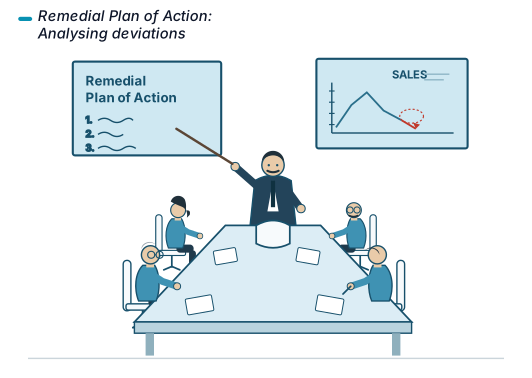
Drawn by us to help you understand the concept clearly, and verified to make sure it's accurate. For exams, practice from your NCERT textbook's own diagram.
Our own illustration of the last step of the controlling process — taking corrective action. After analysing the causes of a deviation (here, a dip in sales), the manager draws up a remedial plan of action to fix it, so performance …