Physical Education · Ch 5 — Sports and Nutrition
Healthy Weight
Healthy Weight
Healthy Weight
A healthy body weight is one of the simplest and most powerful predictors of long-term health. There are numerous advantages to maintaining a healthy weight, and the good news is that a person who is overweight or obese does not need to reach an "ideal" figure to start benefiting. For most obese or overweight people, real health benefits begin with losing just the first 5-10% of body weight. For example, a person carrying excess weight who loses even 10% of it becomes far less likely to develop conditions such as Type 2 diabetes. With a healthy body weight there is a lower likelihood of heart disease, stroke and obesity-related cancers - all of which can be life-threatening - and the chances of living a longer, healthier life go up. This is a core idea in the CBSE Class 12 Physical Education unit on Sports and Nutrition, and a frequent theme in NCERT/CBSE syllabus questions and answers.
How is body composition actually assessed? Several methods are used, each with its own strengths:
- Body Mass Index (BMI) broadly categorises a person as underweight, normal weight, overweight or obese from body mass and height. Being overweight or obese raises the risk of Type 2 diabetes, high blood pressure and cardiovascular problems; a weight that is too low raises the risk of malnutrition, osteoporosis and anaemia.
- Waist-to-Hip Ratio (WHR) - the circumference of the waist divided by the circumference of the hip - indicates the risk of obesity. A greater trunk circumference signals a high risk of hypertension and Type 2 diabetes.
- Girth (circumference) measurements of different body segments help document body size and estimate the percentage of body fat.
- Skinfolds measured with skinfold callipers determine body fat quite accurately, but only when performed by a trained technician.
- Bioelectrical Impedance Analysis (BIA) estimates body composition (especially body fat and muscle mass) by passing a weak electric current through the body and measuring the voltage to calculate the body's impedance (resistance). It uses a portable machine, is easy to administer and gives reliable results.
- Hydrostatic (Underwater) Weighing is regarded as the gold-standard method for measuring mass per unit volume of a living person's body.
Body Mass Index (Quetelet's Index)
There are various ways of assessing a healthy body weight, including weight-for-height charts, Body Mass Index (BMI) and assessment of body-fat percentage. BMI, also called Quetelet's Index, is a key index that relates weight to height. It is derived by taking a person's weight in kilograms and dividing it by his or her height in metres squared.
BMI = weight (kg) / [height (m)]^2
Today BMI is used to define normal weight, overweight and obesity in place of the traditional height/weight charts. A BMI of 30 or more for either sex indicates obesity. BMI does have a limitation, however: it does not measure how much of the body is fat mass and how much is muscle mass. A very muscular person can record a high BMI without carrying any health risk, so BMI is less accurate for people such as body-builders and pregnant women.
| BMI (kg/m^2) | Classification |
|---|---|
| < 18.5 | Underweight |
| 18.5 - 24.9 | Normal weight |
| 25.0 - 29.9 | Overweight |
| 30.0 - 34.9 | Grade I obesity |
| 35.0 - 39.9 | Grade II obesity |
| >= 40.0 | Grade III obesity |
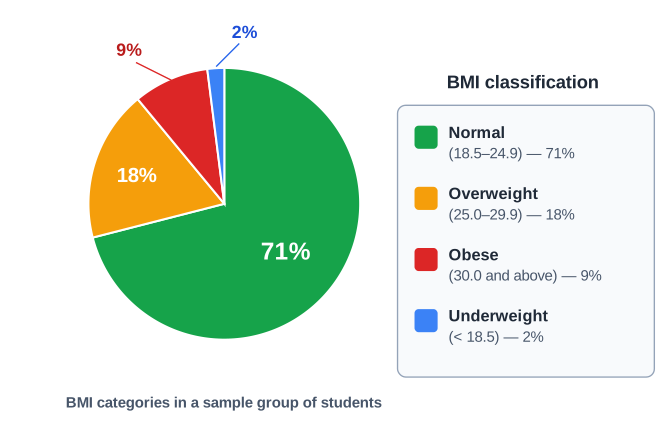
Drawn by us to help you understand the concept clearly, and verified to make sure it's accurate. For exams, practice from your NCERT textbook's own diagram.
A pie chart divides a sample group of students into four BMI categories. The largest slice, 71%, is 'Normal (18.5-24.9)'; the next, 18%, is 'Overweight (25.0-29.9)'; a 9% slice is 'Obese (30.0 and above)'; and the smallest, 2%, is 'Underweight (< 18.5)'. A boxed legend to the right names each band. The chart makes the BMI classification concrete by showing how a real group fal …
Visceral Fat and Central Obesity
Not all body fat carries the same risk. Intra-abdominal or visceral fat - the fat stored deep around the abdominal organs - has a particularly strong correlation with cardiovascular disease. Women with abdominal obesity have a cardiovascular risk similar to that of men. This can be evaluated by measuring waist circumference or by calculating the waist-to-hip ratio. The following cut-offs are used to define central obesity:
- Waist circumference: greater than 102 cm (40 inches) in men, or greater than 88 cm (35 inches) in women.
- Waist-to-hip ratio (WHR): greater than 1.0 for men, or greater than 0.85 for women. …