Biology · Ch 6 — Evolution
A Brief Account of Evolution
A Brief Account of Evolution
About 2 billion years ago, the first cellular forms of life appeared on Earth. The story of how these simple cells gave rise to the staggering diversity of plants, animals, and microbes we see today is the story of evolution. This section gives a brief, bird's-eye sketch of the major transitions along that road — not a detailed timeline — the same broad sweep that this chapter's Figures 6.9 and 6.10 sketch visually for plants and for vertebrates.
Following the appearance of oxygen-releasing cells (an early relative of modern photosynthesis), single-celled life gradually gave rise to multicellular forms. Invertebrate animal life was well established in the seas by about 500 million years ago, jawless fish appeared roughly 350 million years ago, and by about 320 million years ago seaweeds and early land plants had appeared — plants were the first colonisers of land. Among the fish of this era, some had stout, fleshy ("lobe") fins rather than the thin rayed fins of typical fish; around 350 million years ago, these lobe-finned fish began moving onto land, eventually giving rise to the first amphibians. A living relative of this lobe-finned group, the Coelacanth, was thought to have gone extinct along with the dinosaurs — until a living specimen was unexpectedly caught in 1938.
Giant tree-sized ferns from this era, once they died and were buried, went on to form many of today's coal deposits. Some reptile lineages later returned to an aquatic life, such as the dolphin-shaped Ichthyosaurs. Among the land reptiles, the dinosaurs were the most spectacular — Tyrannosaurus rex, for instance, stood about 20 feet tall and carried huge, fearsome, dagger-like teeth. The dinosaurs disappeared abruptly about 65 million years ago; whether this was mainly due to a major climate catastrophe, or because some dinosaur lines gradually evolved into birds instead of vanishing outright, remains debated.
The first mammals were small, shrew-like creatures — viviparous (bearing live young rather than laying eggs) and more intelligent than the reptiles around them. After the continents that are now South America and North America drifted together and joined, the mammal fauna of South America — which had evolved in isolation and included forms resembling a horse, a hippopotamus, a bear, and a rabbit — was largely overridden by North American species that moved south across the new land connection. Australia's pouched (marsupial) mammals, by contrast, survived largely intact, precisely because Australia's continued isolation kept placental mammals from ever reaching it and out-competing them. Some mammal lineages later returned to the water altogether, giving rise to whales, dolphins, seals, and sea cows.
The detailed evolutionary stories of particular animals — the horse, the elephant, the dog — are each fascinating in their own right, but are usually taken up separately, in more advanced study. …
Drawn by us to help you understand the concept clearly, and verified to make sure it's accurate. For exams, practice from your NCERT textbook's own diagram.
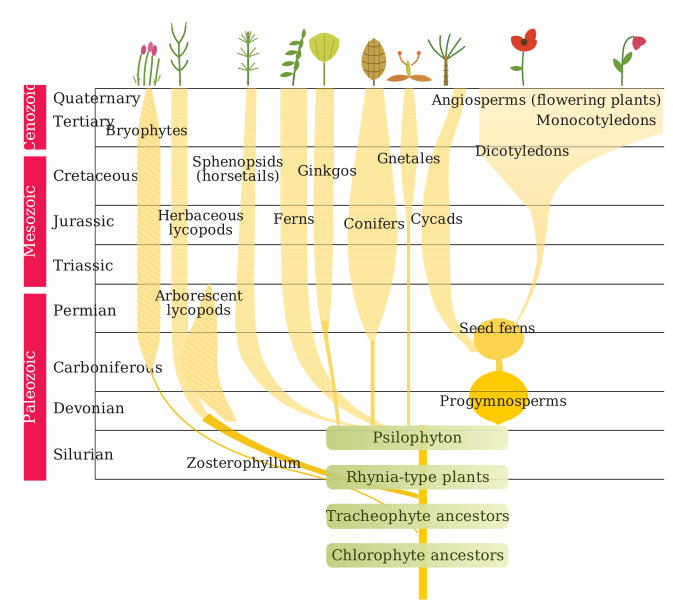
This is a branching timeline of plant evolution, running from the Silurian period (bottom) to the present day (top), grouped into the three familiar geological eras — Paleozoic, Mesozoic and Cenozoic — shown as a coloured band down the left edge.
The earliest branches shown are chlorophyte ancestors and tracheophyte ancestors. Bryophytes branch off early from the chlorophyte side and remain a comparatively simple, unbranched side-lineage all the way to the present. The tracheophyte line leads through early vascular plants — Rhynia-type plants, then Psilophyton — with Zosterophyllum branching off separately around the same time.
From this base, several lines diverge: arborescent lycopods (which died out) and herbaceous lycopods (which persist today) from the Zosterophyllum line; ferns and sphenopsids (horsetails), both still living today, from the Psilophyton line; and progymnosperms, which in turn give rise to seed ferns. The seed ferns are the pivot point for the gymnosperms — conifers, cycads, ginkgos and gnetales — and, much later, for the angiosperms, which split into monocots and dicots. …
Drawn by us to help you understand the concept clearly, and verified to make sure it's accurate. For exams, practice from your NCERT textbook's own diagram.
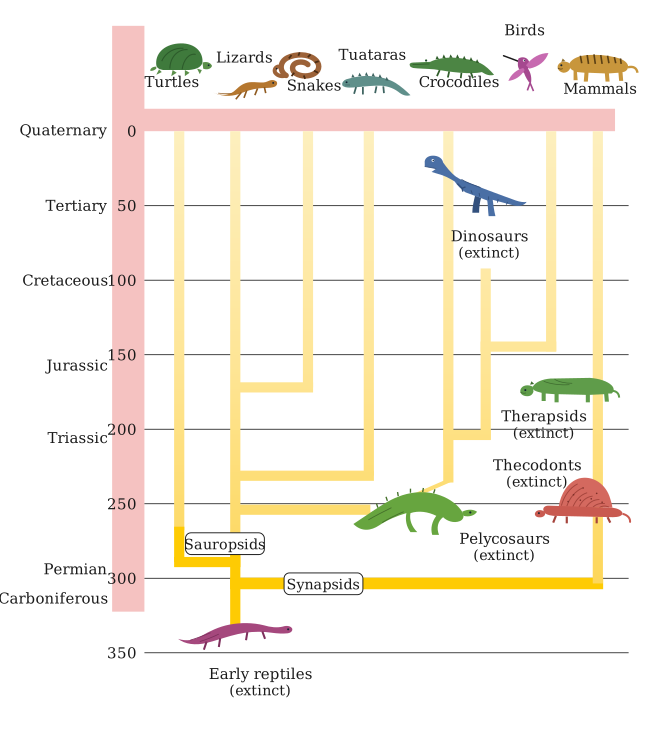
This is a branching lineage diagram of reptiles and their descendants, starting from early reptiles (extinct) around 350 million years ago — it does not begin with jawless/jawed fishes or amphibians; those stages belong elsewhere in the chapter's prose, not to this figure.
Early reptiles split into two lines: the Sauropsids and the Synapsids. The Sauropsid line splits again into the Thecodonts (extinct), which gave rise to turtles, lizards, snakes, tuataras and crocodiles, and the Dinosaurs (extinct), which gave rise to birds (and, via the same branch, crocodiles are also linked back through the archosaur stock). The Synapsid line splits into Pelycosaurs (extinct) and Therapsids (extinct), with the therapsid line leading, eventually, to mammals. …