Biology · Ch 6 — Evolution
What are the Evidences for Evolution?
What are the Evidences for Evolution?
The theory of evolution is supported by a vast body of evidence drawn from many different fields of biology. No single piece of proof stands alone; rather, the evidence converges from multiple independent sources, making the case for evolution exceptionally strong. The NCERT textbook builds this case chiefly from fossils (palaeontological evidence), embryological evidence, and comparative anatomy — homologous and analogous organs — with a brief mention of biochemical (molecular) similarity as further support. The geographic distribution of species (biogeography) is a related line of evidence, taken up separately below under adaptive radiation.
Homologous Organs
These are organs that have a similar basic structure (same underlying skeletal plan) but perform different functions in different organisms. The similarity in structure points to a common ancestry — the organisms inherited the basic design from a shared ancestor. The difference in function arose later, as each lineage adapted to its own environment (divergent evolution).
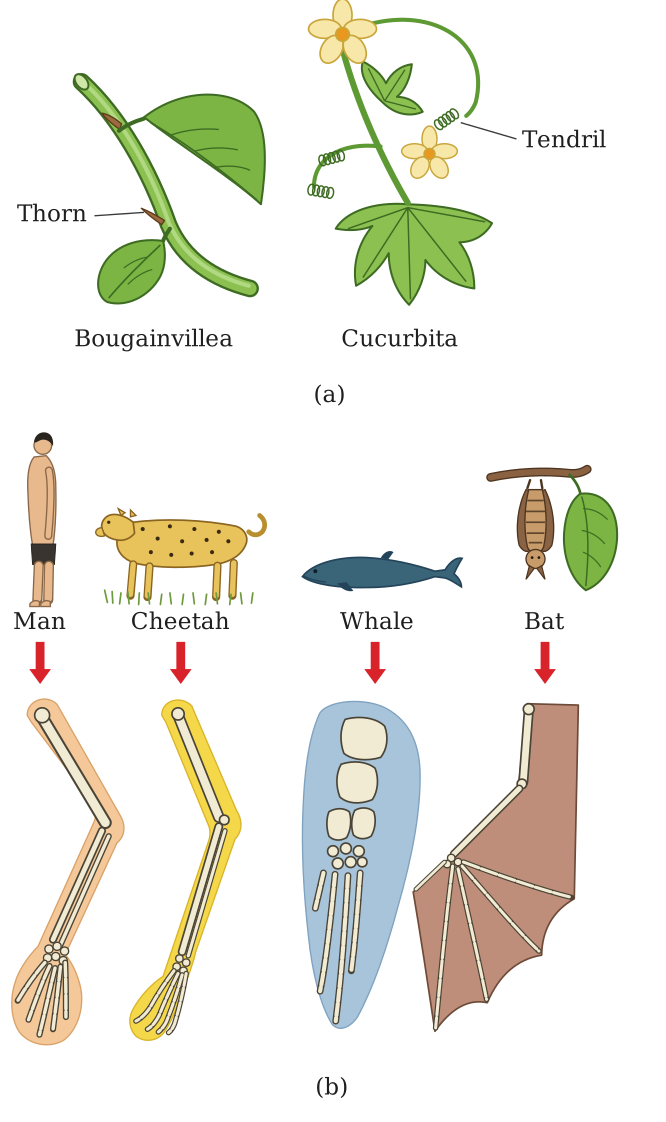
The classic example is the forelimb of mammals. The forelimbs of a human, a cheetah, a whale, and a bat all contain the same set of bones — humerus, radius, ulna, carpals, metacarpals, and phalanges — arranged in the same pattern. Yet a human uses this limb for grasping, a cat for walking, a whale for swimming, and a bat for flying. The structural similarity is inexplicable if each species was created independently; it only makes sense if they share a common ancestor.
Homologous organs are the result of divergent evolution — one basic structure diversifying into many forms.
Analogous Organs
These are organs that have a different basic structure but perform similar functions. The similarity in function arises because the organisms face similar environmental challenges, not because they share a recent common ancestor. This is called convergent evolution — unrelated species evolve similar solutions to the same problem.
A well-known example is the wings of insects and birds. Both are used for flying, but an insect wing is a membranous outgrowth of the exoskeleton, while a bird wing is a modified forelimb covered with feathers. Their internal anatomy is completely different. Another example is the eye of an octopus and the eye of a mammal — both are complex camera-type eyes, but they develop from different embryonic tissues and have a different retinal structure. The similarity is functional, not structural.
Do not confuse homologous with analogous. Homologous = same structure, different function (common ancestor). Analogous = different structure, same function (no common ancestor).
Fossils
Fossils are the preserved remains or impressions of organisms that lived in the past. They provide a direct, physical record of life's history and show a clear progression of forms over geological time. The deeper (older) the rock layer, the simpler the fossils; the shallower (younger) the layer, the more complex and modern the fossils.
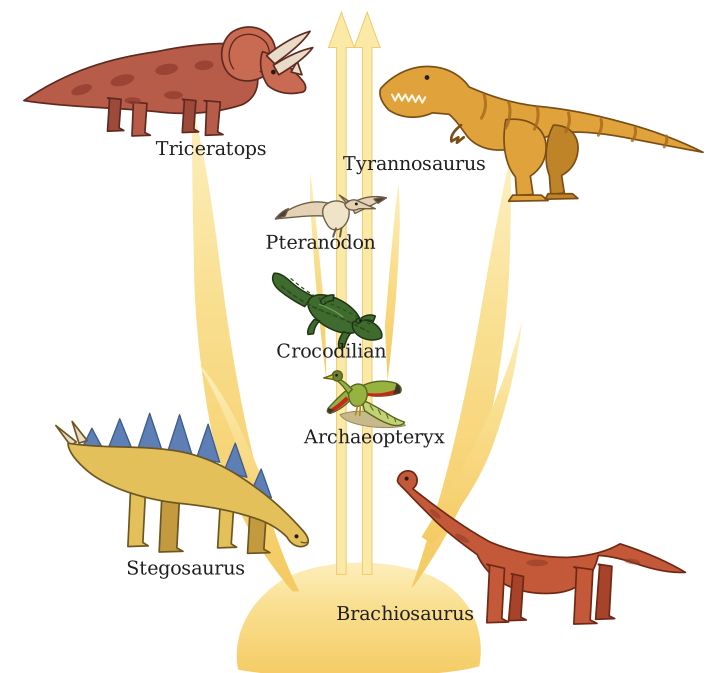
Different-aged rock layers preserve very different kinds of fossils — older, deeper sediments hold life forms with no living counterpart today, while younger, shallower sediments hold fossils that resemble organisms alive now. The most striking illustration used in this chapter is the fossil record of the dinosaurs (Figure 6.2): none of the dinosaur groups themselves survived, but their living descendants and relatives — crocodilians and birds — are still around today, showing how a whole fossil lineage can be traced through to its modern-day counterparts.
Another famous example is the discovery of Archaeopteryx, a fossil that has features of both reptiles (teeth, a long bony tail, claws on the wings) and birds (feathers, a wishbone). It is a transitional form that provides strong evidence for the evolution of birds from reptiles.
Fossils are the only direct evidence of past life. They show that life has changed over time and that simpler forms preceded more complex ones.
Embryological Evidence
Embryological support for evolution was proposed by the German biologist Ernst Haeckel, based on an observation that struck early embryologists as remarkable: at certain stages of development, the embryos of very different vertebrates look strikingly similar. One example the textbook highlights is the transient gill slit that appears just behind the head in the embryos of every vertebrate, including humans — yet it only ever matures into a functional, gas-exchanging gill in fish; in reptiles, birds, and mammals it is present only briefly before disappearing or being repurposed.
Haeckel took this further and argued that a developing embryo actually climbs through the adult body forms of its evolutionary ancestors — a fish-like stage, then an amphibian-like stage, and so on — before arriving at its own adult form. On this reading, embryonic similarity would be a kind of replay of evolutionary history.
This stronger claim did not hold up. A careful study by Karl Ernst von Baer showed that an embryo never actually passes through the adult stages of other animals — a mammal embryo's gill slit, for instance, never becomes anything resembling an adult fish's gill. What the embryos share is an early, unspecialised developmental stage, not a rerun of another species' adult body plan.
The more defensible version of the argument still stands: closely related organisms sharing an early developmental feature (like the gill slit) — a feature later put to very different uses in each lineage — points to those organisms having inherited it from a common ancestor. It just is not evidence that development "replays" an ancestor's adult anatomy.
Molecular Evidence
The most powerful evidence for evolution today comes from comparing the DNA sequences and protein sequences of different organisms. The closer two species are on the evolutionary tree, the more similar their DNA and proteins will be.
When the proteins and genes of different species are compared directly, the same pattern shows up again: species that are already judged closely related on other grounds (anatomy, fossils) also turn out to have more similar DNA and protein sequences, while distantly related species differ more. This molecular similarity is powerful confirmatory evidence, because it comes from an entirely independent source — the chemistry of heredity itself — rather than from outward appearance.
Similarly, the universal genetic code — the fact that all life uses the same triplet code to translate DNA into protein — is itself powerful evidence that all life on Earth shares a single common ancestor. If life had arisen independently multiple times, we would expect different genetic codes.
Molecular data provides a quantitative, objective measure of evolutionary relationships. It has confirmed and refined the family trees built from anatomical and fossil evidence.
Biogeographical Evidence …
Drawn by us to help you understand the concept clearly, and verified to make sure it's accurate. For exams, practice from your NCERT textbook's own diagram.
The figure shows several named organisms rising out of a stylised flame — a common way of depicting a shared evolutionary origin. On one side sit five now-extinct dinosaurs (Triceratops, Stegosaurus, Brachiosaurus, Tyrannosaurus, Pteranodon); on the other, a crocodilian; and right at the flame's tip, Archaeopteryx, the famous transitional fossil that had both feathers and reptilian teeth. …
Drawn by us to help you understand the concept clearly, and verified to make sure it's accurate. For exams, practice from your NCERT textbook's own diagram.
Figure 6.3 is split into two panels, (a) and (b), each showing a pair of homologous structures — organs that share a common evolutionary origin but have been modified for different functions.
Panel (a) — Plants. On the left is a thorn of Bougainvillea; on the right is a tendril of Cucurbita (pumpkin or gourd). Both are drawn as modified axillary shoots — that is, they arise from the axil of a leaf. The thorn is short, sharp, and woody, serving as a defence against herbivores. The tendril is long, slender, and coiled, used for climbing. Despite these different functions, both structures develop from the same basic tissue (an axillary bud) and share the same underlying anatomical plan. The figure uses arrows or labels to point out that each is a modified shoot, making the homology clear.
Panel (b) — Animals. Four forelimbs are drawn side by side: those of a whale, a bat, a cheetah, and a human. Each limb is shown in skeletal form, with the same set of bones labelled: humerus (upper arm), radius and ulna (forearm), carpals (wrist), metacarpals (palm), and phalanges (digits). The whale’s forelimb is a flipper — short, flattened, with the phalanges enclosed in a paddle — adapted for swimming. The bat’s forelimb has greatly elongated metacarpals and phalanges that support the wing membrane, adapted for flight. The cheetah’s forelimb is built for running, with long, slender bones and reduced digits. The human forelimb is a general-purpose arm with a flexible hand and opposable thumb. The figure emphasises that, despite these radically different functions (swimming, flying, running, grasping), the same set of bones is present in the same relative order — a clear sign of descent from a common ancestor. …
Drawn by us to help you understand the concept clearly, and verified to make sure it's accurate. For exams, practice from your NCERT textbook's own diagram.
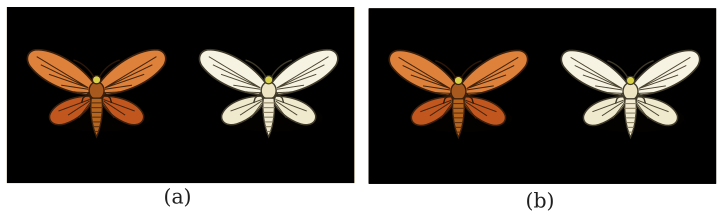
Figure 6.4 places two panels side by side, each showing a section of a tree trunk. In panel (a), labelled "unpolluted area", the trunk is pale and covered with lichen. Two moths sit on it: one with white wings and one with dark (melanised) wings. The white moth blends into the lichen-covered bark so well that it is hard to spot; the dark moth stands out sharply against the light background. In panel (b), labelled "polluted area", the same tree trunk is darkened by soot and lacks lichen. Here the dark moth is nearly invisible against the blackened bark, while the white moth is now the one that is conspicuous and easy for a predator to see.
The figure does not show arrows or any movement — it is a static comparison of two environments. The only labels are the two scene descriptions and the moths themselves (white-winged and dark-winged). The point is to illustrate how the same two colour variants have opposite survival advantages depending on the background. …