Biology · Ch 6 — Evolution
Origin and Evolution of Man
Origin and Evolution of Man
Origin and Evolution of Man
The story of human evolution is pieced together from fossil evidence stretching back many millions of years.
The Early Primates
About 15 million years ago, primates called Dryopithecus and Ramapithecus existed. Both were hairy and walked in the manner of modern gorillas and chimpanzees — but Ramapithecus was more man-like, while Dryopithecus was more ape-like.
The First Hominids
Fossils of man-like bones discovered in Ethiopia and Tanzania revealed hominid features, suggesting that man-like primates walked upright in eastern Africa around 3 to 4 million years ago. They probably stood no taller than about four feet.
By around 2 million years ago, the Australopithecines lived in the East African grasslands. Evidence shows they hunted using stone weapons, though their diet was still mostly fruit.
Homo habilis and Homo erectus
Among the fossils found were bones distinctive enough to mark out a new stage — the first member of our own genus, Homo habilis — with a brain capacity between 650 and 800 cc. Homo habilis probably did not eat meat.
Fossils discovered in Java in 1891 revealed the next stage, Homo erectus, dated to about 1.5 million years ago. Homo erectus had a considerably larger brain, around 900 cc, and probably did eat meat.
Neanderthal Man
Neanderthal man, with a brain size of about 1400 cc, lived in the Near East and Central Asia between roughly 1,00,000 and 40,000 years ago. Neanderthals used animal hides to protect their bodies and buried their dead.
Homo sapiens
Homo sapiens arose in Africa and, over time, moved out across the continents, developing into the distinct races found around the world today. Modern Homo sapiens arose during the ice age, sometime between 75,000 and 10,000 years ago.
The Dawn of Culture and Agriculture
Pre-historic cave art developed around 18,000 years ago — some of the finest examples in India can still be seen today at the Bhimbetka rock shelters in Raisen district, Madhya Pradesh. …
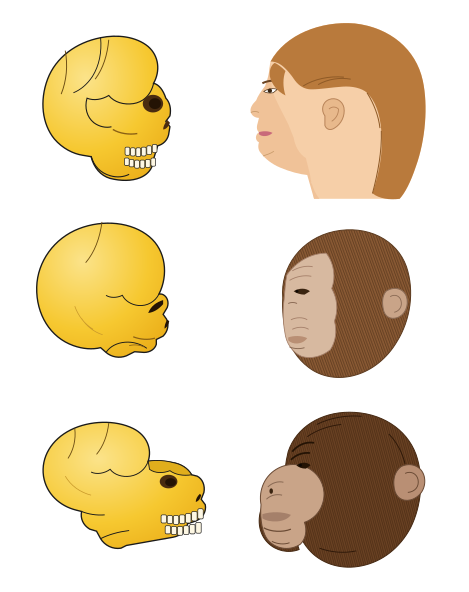
Drawn by us to help you understand the concept clearly, and verified to make sure it's accurate. For exams, practice from your NCERT textbook's own diagram.
Figure 6.11 places three skull profiles side by side: an adult modern human, a baby chimpanzee, and an adult chimpanzee. The skulls are drawn in outline, showing the shape of the cranium, the face, and the jaw. No arrows or labels mark specific bones — the comparison is purely visual, relying on the overall silhouette.
The key observation is that the baby chimpanzee skull looks much more like the adult human skull than like the adult chimpanzee skull. The infant chimp has a rounded, domed cranium, a relatively flat face, and a small jaw — features that closely match the human adult. In contrast, the adult chimpanzee skull has a sloping forehead, a protruding snout-like face, and a large, projecting jaw. The human adult skull retains the rounded braincase and reduced jaw seen in the infant chimp, while the adult chimp has undergone dramatic changes as it matured. …