Exercises · 8.4
Q.Write the IUPAC names of the following ketones and aldehydes. Wherever possible, give also common names.
(i)
(ii)
(iii)
(iv)
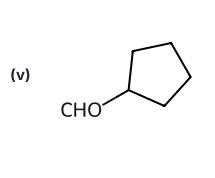
(vi)
Sikkim CbseNCERTSubjective· 3mImportance★★★★★
20% · 17/87 Questions
You're viewing a preview — the full solution, concept, methods & PYQ mapping are locked.
Start your 14-day free trial to unlock the full solution →Each name comes from naming the longest carbon chain (or ring) bearing the carbonyl group. Aldehydes end in -al with the -CHO carbon as C-1; ketones end in -one with the lowest possible locant for the C=O; a -CHO attached straight onto a ring is a "...carbaldehyde".
How to name each
- CH3CO(CH2)4CH3 — Expand: CH3-CO-CH2-CH2-CH2-CH2-CH3. The longest chain has 7 carbons with the C=O at position 2, so it is heptan-2-one. Common name = methyl pentyl ketone (methyl n-amyl ketone), from the two groups flanking the C=O.
- CH3CH2CHBrCH2CH(CH3)CHO — The -CHO fixes C-1. Numbering from the aldehyde: C1 = CHO, C2 = CH(CH3) (a methyl branch), C3 = CH2, C4 = CHBr (a bromo substituent), C5 = CH2, C6 = CH3. A 6-carbon aldehyde with substituents Br at C-4 and CH3 at C-2 → 4-bromo-2-methylhexanal.
- CH3(CH2)5CHO — A straight chain of 7 carbons ending in -CHO → heptanal (common name heptaldehyde or enanthaldehyde).
- C6H5-CH=CH-CHO — The parent is prop-2-enal (CHO = C1, C2=C3 double bond) carrying a phenyl group on C-3 → 3-phenylprop-2-enal; its common name is cinnamaldehyde. …
Unlock everything free for 14 days
- Full step-by-step solutions
- Concept-first explanations
- Methods, shortcuts & mistakes
- PYQ mapping + timed mock tests
Full access for 14 days. No credit card required.