Chemistry · Ch 8 — Aldehydes, Ketones and Carboxylic Acids
Reactions Involving Cleavage of O–H Bond
Reactions Involving Cleavage of O–H Bond
Acidity of Carboxylic Acids
The hydrogen is acidic. Like alcohols, carboxylic acids liberate hydrogen gas with reactive (electropositive) metals, and like phenols they form salts with alkalis. Unlike phenols, however, they are strong enough to react even with the weak bases sodium carbonate and sodium hydrogencarbonate, releasing gas — this effervescence with is the classic laboratory test used to detect a carboxyl group in an unknown compound.
Dissociation and Ka
In water, a carboxylic acid dissociates reversibly to give a resonance-stabilised carboxylate anion and a hydronium ion:
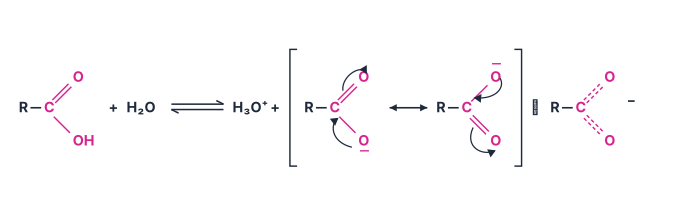
Drawn by us to help you understand the concept clearly, and verified to make sure it's accurate. For exams, practice from your NCERT textbook's own diagram.
Redrawn from the NCERT page with the structures, printed labels (R, C, O, OH, O–) and reagent placement exactly as the textbook prints them. Every element of this display was checked against the printed page during the sweep's blind-judge verification pass, so wha …
The equilibrium constant for this dissociation, expressed with respect to the acid, is the acid dissociation constant:
Because values are inconveniently small, acid strength is more conveniently expressed as .
Smaller the , the stronger the acid (the better it is as a proton donor). By convention: strong acids have ; moderately strong acids have between 1 and 5; weak acids have between 5 and 15; extremely weak acids have .
As reference points: hydrochloric acid, ; trifluoroacetic acid (the strongest common carboxylic acid), ; benzoic acid, ; acetic acid, . For comparison, ethanol has and phenol has .
Acidity order: mineral acids > carboxylic acids > phenols > alcohols.
Why carboxylic acids are more acidic than phenols
Both carboxylic acids and phenols lose a proton to give an anion stabilised by resonance, but the stabilisation is not equally effective:
- In the carboxylate ion, the two resonance structures are exactly equivalent — the negative charge sits on an electronegative oxygen atom in each structure, and by symmetry the charge is shared equally over both oxygens.
- In the phenoxide ion, the resonance structures are not equivalent — some of them place the negative charge on a (less electronegative) ring carbon rather than on oxygen, so this delocalisation is intrinsically less effective, and the charge is spread over only one oxygen and the ring carbons.
Because delocalisation over two electronegative oxygen atoms is more stabilising than delocalisation partly onto carbon, the carboxylate ion is more stabilised than the phenoxide ion — so carboxylic acids are more acidic than phenols, which are in turn more acidic than alcohols (whose conjugate base has no resonance stabilisation at all).
Effect of substituents on acid strength
A substituent changes acid strength by changing the stability of the conjugate base (the carboxylate anion):
- Electron-withdrawing groups (EWG) near the pull electron density away through the inductive and/or resonance effect, further delocalising (and so stabilising) the negative charge on the carboxylate ion. This strengthens the acid — i.e., increases and lowers .
- Electron-donating groups (EDG) push electron density towards the carboxylate, destabilising the extra negative charge. This weakens the acid.
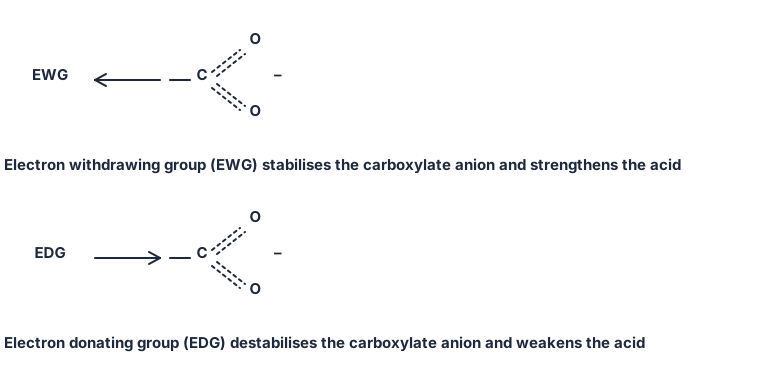
Drawn by us to help you understand the concept clearly, and verified to make sure it's accurate. For exams, practice from your NCERT textbook's own diagram.
Redrawn from the NCERT page with the structures, printed labels () and reagent placement exactly as the textbook prints them. Every element of this display was checked against the printed page during the sweep's blind-judge verification pass, so what …
The effect strengthens with the electronegativity/electron-withdrawing power of the group, in the order:
This is reflected in measured acidities: halogen or nitro substitution on acetic acid raises acidity sharply — the textbook prints the full increasing-acidity ordering (based on values) as one continuous three-line display, each line underscored by a long left-pointing arrow marking the direction of increasing acidity, the continuation lines prefixed exactly as printed:
…
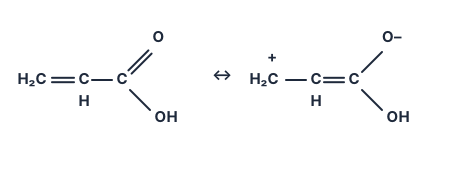
Drawn by us to help you understand the concept clearly, and verified to make sure it's accurate. For exams, practice from your NCERT textbook's own diagram.
Redrawn from the NCERT page with the structures, printed labels (H2C, C, H, O, OH, +, O–) and reagent placement exactly as the textbook prints them. Every element of this display was checked against the printed page during the sweep's blind-judge verification pass, so wh …
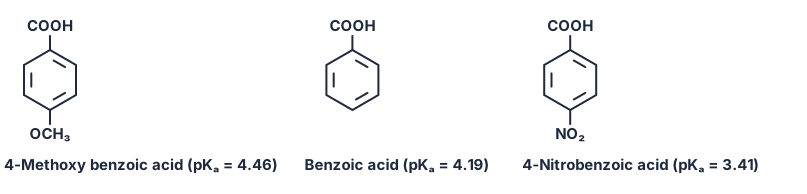
Drawn by us to help you understand the concept clearly, and verified to make sure it's accurate. For exams, practice from your NCERT textbook's own diagram.
Redrawn from the NCERT page with the structures, printed labels (COOH, OCH₃, NO₂) and reagent placement exactly as the textbook prints them. Every element of this display was checked against the printed page during the sweep's blind-judge verification pass, so wha …