Q.Which of the following is not true about enantiomers? (A) They have the same density. (B) They have the same melting or boiling point. (C) They have the same specific rotation. (D) They have the same chemical reactivity.
You're viewing a preview — the full solution, concept, methods & PYQ mapping are locked.
Start your 14-day free trial to unlock the full solution →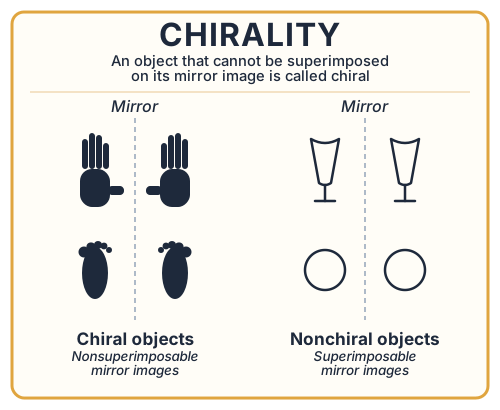
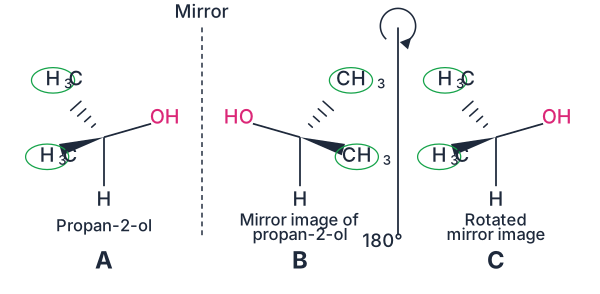
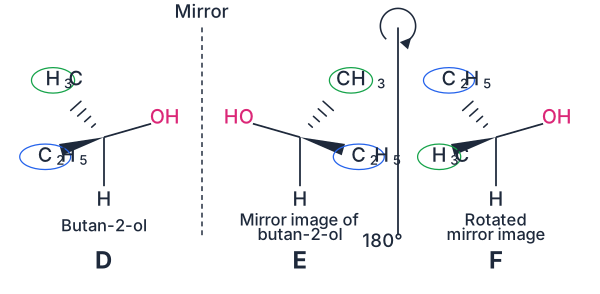
Enantiomers are mirror-image molecules that are identical in most physical properties (density, melting/boiling points) and react identically with achiral reagents, but they rotate plane-polarised light in opposite directions — so they do not have the same specific rotation. The false statement is (C).
Enantiomers are like your left and right hands — mirror images that cannot be superimposed. In chemistry, this “handedness” (chirality) leads to a fascinating split: most physical properties are identical, but interaction with polarised light is opposite. That’s the key to spotting the wrong option here.
Let’s check each statement one by one.
-
Density — Enantiomers have the same density.
Density depends on molecular mass and packing in the bulk state. Since enantiomers are identical in every way except spatial arrangement at a chiral centre, their crystals or liquids pack identically. So density is the same. Option (A) is true.
-
Melting or boiling point — Again, these are bulk physical properties.
In a pure sample, enantiomers have identical melting and boiling points. (A mixture of equal amounts, a racemate, may have a different melting point — but the question asks about enantiomers themselves, not their mixture.) So (B) is true.
-
Specific rotation — This is the trick.
Specific rotation measures how much a compound rotates plane-polarised light. Enantiomers rotate light by exactly the same magnitude but in opposite directions — one is (+) and the other is (−). So they do not have the same specific rotation; they have equal but opposite values. Option (C) is false — and that’s what we’re looking for.
-
Chemical reactivity — This needs a careful nuance. …
Unlock everything free for 14 days
- Full step-by-step solutions
- Concept-first explanations
- Methods, shortcuts & mistakes
- PYQ mapping + timed mock tests
Full access for 14 days. No credit card required.