Q.Write the structures and names of the compounds formed when compound ‘A’ with molecular formula, is treated with in the presence of .
You're viewing a preview — the full solution, concept, methods & PYQ mapping are locked.
Start your 14-day free trial to unlock the full solution →The key idea is that with undergoes electrophilic aromatic substitution (chlorination) on the benzene ring, not free-radical side-chain chlorination. The compound is toluene (), and the reaction gives a mixture of ortho- and para-chlorotoluene as the major products, with a minor amount of meta-chlorotoluene.
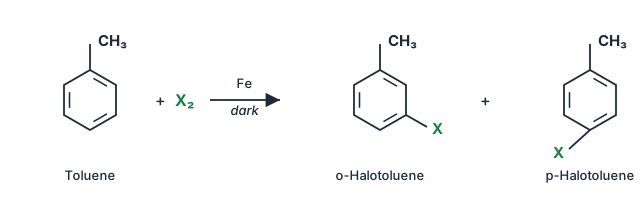
Concept and Intuition: Why This Reaction Works
The molecular formula is a classic giveaway — it fits toluene (methylbenzene). The reagent in the presence of is the standard condition for electrophilic aromatic chlorination. Here, acts as a Lewis acid catalyst, generating the active electrophile (or a polarized complex).
Why does this matter? Because the methyl group () on toluene is an activating and ortho/para-directing group. It donates electron density into the benzene ring via hyperconjugation and inductive effect, making the ortho and para positions more nucleophilic. So when the attacks, it preferentially goes to those positions.
A common pitfall: students often confuse this with free-radical chlorination (using /light or heat), which would attack the side-chain methyl group. But here, the presence of ensures electrophilic substitution on the ring, not radical substitution.
Do not use free-radical conditions here. is a Lewis acid catalyst for electrophilic substitution, not a radical initiator. The side-chain chlorination (to give benzyl chloride) requires UV light or high temperature, not .
Step-by-Step Solution
1. Identify the starting compound ‘A’.
The formula has a degree of unsaturation:
Four degrees of unsaturation strongly suggest a benzene ring (which accounts for 4 DU) plus one extra carbon. The only common aromatic compound with is toluene (). So compound A is toluene.
2. Recognize the reaction type.
is the classic electrophilic aromatic chlorination system. The polarizes the chlorine molecule:
The (or the polarized complex) acts as the electrophile.
3. Predict the directing effect of the methyl group.
The group is an ortho/para director because it stabilizes the intermediate carbocation (arenium ion) formed during attack at ortho and para positions. Attack at meta position gives a less stable intermediate.
4. Write the products.
The major products are: …
Unlock everything free for 14 days
- Full step-by-step solutions
- Concept-first explanations
- Methods, shortcuts & mistakes
- PYQ mapping + timed mock tests
Full access for 14 days. No credit card required.