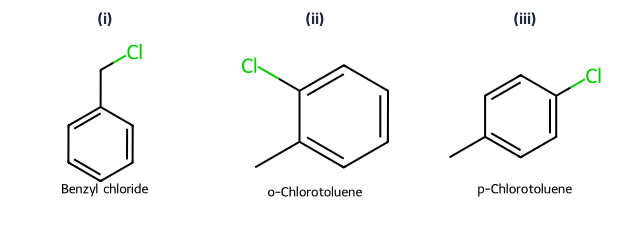
Q.The reaction of toluene with chlorine in the presence of iron and in the absence of light yields ____________.
You're viewing a preview — the full solution, concept, methods & PYQ mapping are locked.
Start your 14-day free trial to unlock the full solution →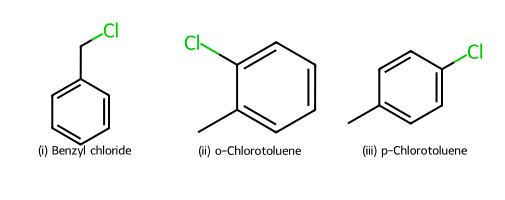
Toluene undergoes electrophilic aromatic substitution with chlorine in the presence of a Lewis acid (Fe/FeCl₃) and in the absence of light. The methyl group is an ortho/para director, so the products are o-chlorotoluene and p-chlorotoluene — a mixture. The correct option is (iv).
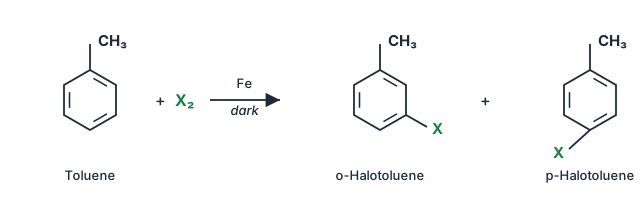
The key here is to recognise that the reaction conditions — chlorine gas, iron (which generates FeCl₃ in situ), and no light — are the classic setup for electrophilic aromatic substitution (EAS) on an aromatic ring.
If light were present, you’d get free-radical substitution at the benzylic position (giving benzyl chloride). But without light, the iron catalyst activates chlorine to form an electrophile, and the reaction proceeds on the ring.
Toluene has a methyl group attached to the benzene ring. The methyl group is an activating group and an ortho/para director in EAS reactions. This is because the methyl group donates electron density into the ring via hyperconjugation and the inductive effect, stabilising the intermediate carbocation (arenium ion) when substitution occurs at the ortho or para positions.
So, when chlorine attacks the ring, it will preferentially go to the ortho and para positions relative to the methyl group. Both ortho and para products are formed, and they are not separated under typical reaction conditions — you get a mixture.
A very common mistake is to think that the absence of light automatically means side-chain chlorination. That’s wrong — side-chain chlorination requires light or heat (free-radical conditions). Without light, the iron catalyst directs the reaction to the ring.
Remember the mnemonic: No light, ring site; with light, side-chain site. For toluene:
- Fe/Cl₂, dark → ring substitution (o/p mixture)
- Cl₂, hv or heat → benzylic substitution (C₆H₅CH₂Cl)
Let’s walk through the reasoning step by step:
-
Identify the reaction type.
Given: toluene + Cl₂, in presence of iron (Fe), in absence of light.
Iron reacts with Cl₂ to form FeCl₃, a Lewis acid. This is the classic catalyst for electrophilic aromatic chlorination. No light means no free radicals are generated, so the mechanism is ionic, not radical.
-
Formation of the electrophile.
FeCl₃ polarises the Cl–Cl bond, making one chlorine more electrophilic:
The actual attacking species is effectively (or a chlorine atom with strong positive character).
- Attack on the aromatic ring. …
Unlock everything free for 14 days
- Full step-by-step solutions
- Concept-first explanations
- Methods, shortcuts & mistakes
- PYQ mapping + timed mock tests
Full access for 14 days. No credit card required.