Physics · Ch 4 — Moving Charges and Magnetism
Magnetic Field due to a Current Element, Biot-Savart Law
Magnetic Field due to a Current Element, Biot-Savart Law
Concept: From Current to Magnetic Field
All magnetic fields arise from moving charges (currents) or intrinsic magnetic moments. The Biot-Savart law gives the magnetic field produced by a small, directed piece of current — a current element.
The Law: Vector Form
Consider a conductor carrying a steady current . Take an infinitesimal element of the conductor, represented by the vector (its direction is the direction of the current). The magnetic field produced by this element at a point located at a displacement vector from the element is:
- Proportional to the current and the length .
- Inversely proportional to the square of the distance .
- Direction: Perpendicular to the plane containing and .
In vector form, the law is:
Here:
- is the permeability of free space (or vacuum). Its exact value in SI units is:
- The cross product gives the direction (right-hand screw rule: curl fingers from to ; thumb gives direction of ).
- This expression holds for a current element in vacuum.
The Law: Magnitude Form
Using the property of the cross product, , where is the angle between and . The magnitude of the magnetic field is:
- Key point: When (point lies along the line of the current element), , so . The field is zero directly in front of or behind the element.
Comparison with Coulomb’s Law
| Feature | Biot-Savart Law (Magnetic) | Coulomb’s Law (Electric) |
|---|---|---|
| Source | Vector source: | Scalar source: charge |
| Distance dependence | ||
| Direction of field | Perpendicular to and | Along (radial) |
| Angle dependence | Yes () | No |
| Superposition | Applies (linear in source) | Applies (linear in source) |
Connection Between Constants
The constants (permeability) and (permittivity) are related to the speed of light :
Since m/s is fixed, choosing fixes (and vice versa). In SI, is defined as .
Worked Example (from textbook) …
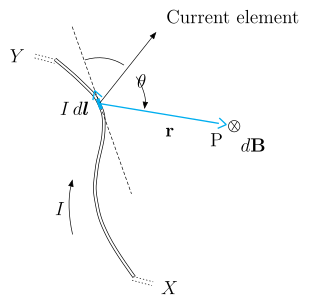
Drawn by us to help you understand the concept clearly, and verified to make sure it's accurate. For exams, practice from your NCERT textbook's own diagram.
What the Figure Shows
The diagram depicts a finite curved conductor XY carrying a steady current flowing upward (from X at the bottom to Y at the top). At a chosen point on the conductor, a bold arrow labeled "Current element" represents the infinitesimal vector — its direction is tangent to the wire, pointing along the current. A dashed line extends along this element to show its line of action.
From the same point, a blue arrow labeled (the displacement vector) points from the element to a point P located to the right. The angle between the direction of and is marked at the element. At point P, a ⊗ symbol (cross inside a circle) labeled indicates that the magnetic field due to the element is directed into the page (perpendicular to the plane of the diagram).
Physical Idea Taught
The figure illustrates the Biot-Savart law, which gives the magnetic field produced by a tiny segment of a current-carrying conductor. The key idea is that the field at a point depends on:
- The current and the length of the element.
- The inverse square of the distance from the element to the point.
- The sine of the angle between and .
- The direction of is perpendicular to the plane containing and , given by the right-hand screw rule.
The ⊗ symbol at P shows that for the geometry shown (with upward and to the right), the field points into the page.
Key Formula Developed
The Biot-Savart law in vector form is:
where:
- is the permeability of free space.
- is the current in the conductor.
- is the infinitesimal length vector of the current element (direction of current).
- is the displacement vector from the element to the field point. …