Physics · Ch 10 — Wave Optics
Seeing the Single Slit Diffraction Pattern
Seeing the Single Slit Diffraction Pattern
Why the Pattern Is Easy to See
The single‑slit diffraction pattern is not just a textbook idea — you can observe it at home with simple items. The key is that the slit width must be comparable to the wavelength of light (about m). When you hold two razor blades close together, the narrow gap acts as the single slit. The filament of a clear electric bulb (preferably straight) serves as the source — it replaces the first slit in the standard experimental setup. Your eye’s lens then focuses the diffracted light onto your retina, which acts as the screen.
How to See the Pattern
- Hold two razor blades between thumb and forefinger so their edges are parallel, forming a narrow slit.
- Keep the slit parallel to the bulb’s filament and place it right in front of your eye.
- Adjust the slit width and the parallelism of the edges until you see alternating bright and dark bands.
- Because the position of every band except the central one depends on wavelength, the bands show colours.
- Using a red filter or a blue filter makes the fringes clearer. With both filters, you can see that red fringes are wider than blue fringes — this is because red light has a longer wavelength.
The Role of the Eye and the Source
- The bulb filament acts as the first slit (the source) in the standard diffraction setup.
- The lens of your eye focuses the pattern onto the retina (the screen).
- During daytime, you can also use the reflection of the Sun from a shiny convex surface (e.g., a cycle bell) as a bright source that subtends a small angle at the eye. Never look directly at the Sun — it can damage your eye and, because the Sun subtends an angle of , it will not produce fringes anyway. …
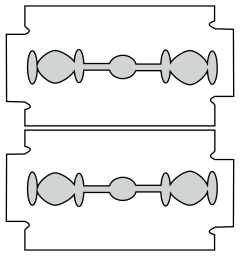
Drawn by us to help you understand the concept clearly, and verified to make sure it's accurate. For exams, practice from your NCERT textbook's own diagram.
What the figure shows
The figure is a simple line drawing of a hand holding two razor blades between thumb and forefinger. The blades are arranged with their straight, sharp edges parallel and extremely close together, forming a narrow slit. The drawing is schematic — it does not show the bulb or the eye, but the caption and surrounding text make clear that the slit is held in front of the eye, aligned parallel to the straight filament of a clear glass bulb. The labels are: two blades, narrow slit, and arrows indicating the direction to the eye and to the bulb filament.
Physical idea
The figure illustrates a home experiment to observe single-slit diffraction of light. The narrow slit between the blades acts as a single rectangular aperture. When light from the bulb filament passes through this slit, it spreads out (diffracts) and produces a pattern of alternating bright and dark bands on the retina of the eye. The filament serves as a narrow, extended light source (like the first slit in a standard diffraction setup), and the eye’s lens focuses the diffracted light onto the retina, which acts as the screen.
The key point is that the pattern is wavelength-dependent: the position of all bands except the central one depends on the wavelength of light. This is why the bands appear coloured when white light is used — different colours (wavelengths) have their maxima and minima at slightly different angles. Using a red or blue filter makes the fringes clearer, and the red fringes are wider than the blue ones because red light has a longer wavelength.
Key formula(s)
For a single slit of width , the condition for dark fringes (minima) in the diffraction pattern is:
where:
- = width of the slit (distance between the two blade edges)
- = angle from the central axis to the direction of the -th minimum
- = wavelength of light in the medium (usually air)
- = order of the minimum (an integer, excluding zero)
The central maximum is twice as wide as the other maxima, and its angular width (from the first minimum on one side to the first minimum on the other) is:
The intensity distribution for single-slit diffraction is given by: …