Q.Which of the following impurity can be removed by electrodialysis method ?
You're viewing a preview — the full solution, concept, methods & PYQ mapping are locked.
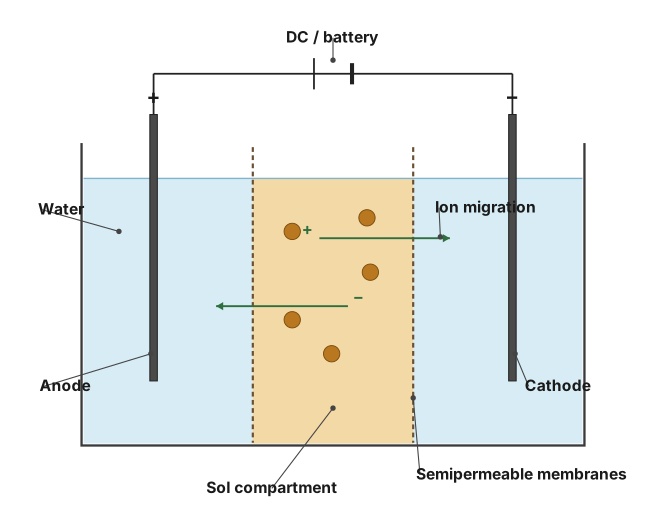
Start your 14-day free trial to unlock the full solution →Electrodialysis speeds up dialysis by applying an electric field across the semi-permeable membrane, so that charged impurities (ions/electrolytes) migrate rapidly to the oppositely-charged electrode and are removed — it purifies colloids of ionic impurities specifically.
A colloidal sol (e.g., ferric hydroxide sol) is often contaminated with an electrolyte like left over from its preparation. In ordinary dialysis, this small ionic impurity diffuses out through the membrane down its concentration gradient; electrodialysis accelerates this by using an applied potential to actively pull the and ions toward the cathode/anode respectively. Urea (a), glucose (c), and sugar (d) are neutral, non-ionic molecules — they diffuse out …
Unlock everything free for 14 days
- Full step-by-step solutions
- Concept-first explanations
- Methods, shortcuts & mistakes
- PYQ mapping + timed mock tests
Full access for 14 days. No credit card required.