Mathematics · Ch 6 — Applications of Vector Algebra
Application of Dot and Cross Products in Geometry
Application of Dot and Cross Products in Geometry
Placing a convenient vertex at the origin turns several classical Euclidean-geometry theorems into short vector computations.
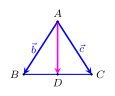
Apollonius's theorem (Example 6.6). If is the midpoint of side of , taking as origin with gives and ; computing and simplifying (the cross terms cancel) gives
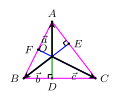
Concurrency of altitudes (Example 6.7). With the orthocentre as origin, . Since altitude means , and altitude means ; adding these two equations gives , i.e. — so the perpendicular from to also passes through . All three altitudes meet at one point.
Medial-triangle area (Example 6.8). If are the midpoints of of (origin at ), a short computation with shows — the medial triangle always has a quarter of the original's area. …
Drawn by us to help you understand the concept clearly, and verified to make sure it's accurate. For exams, practice from your textbook's own diagram.
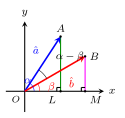
What this figure shows. Fig. 6.10 - Unit vectors a-hat = OA and b-hat = OB making angles alpha and beta with the positive x-axis; the angle between them is alpha-beta, used to prove …
Drawn by us to help you understand the concept clearly, and verified to make sure it's accurate. For exams, practice from your textbook's own diagram.
What this figure shows. Fig. 6.11 - Triangle ABC with D the midpoint of BC and median AD; position vectors AB = b and AC = c taken with A as origin (Apolloniu …
Drawn by us to help you understand the concept clearly, and verified to make sure it's accurate. For exams, practice from your textbook's own diagram.
What this figure shows. Fig. 6.12 - Triangle ABC with altitudes AD, BE and CF concurrent at the orthocentre O; position vectors a = OA, b = OB, c = OC used to prove …