Mathematics · Ch 6 — Applications of Vector Algebra
Geometrical Interpretation
Geometrical Interpretation
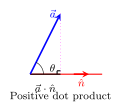
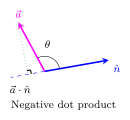
Projections. If is any vector and a unit vector, then is the (signed) projection of onto the line along : it is positive when the angle between and is acute, and negative when that angle is obtuse.
For arbitrary non-zero vectors : can be read as the length of the projection of along 's direction or of along 's direction. We recall , where is the angle from to measured counter-clockwise.
Remark 6.1(1). The angle between two non-zero vectors is .
Remark (2). are parallel iff the angle between them is or .
Remark (3). are perpendicular iff the angle between them is or .
Properties (for any non-zero ):
For any vectors and scalar : (commutative), (distributive), ; and (anticommutative, not commutative), , . …
Drawn by us to help you understand the concept clearly, and verified to make sure it's accurate. For exams, practice from your textbook's own diagram.
What this figure shows. Fig. 6.4 - Positive dot product: the angle theta between a and the unit vector n-hat is acute, so the projection a.n-hat lies along n-hat an …
Drawn by us to help you understand the concept clearly, and verified to make sure it's accurate. For exams, practice from your textbook's own diagram.
What this figure shows. Fig. 6.5 - Negative dot product: the angle theta between a and the unit vector n-hat is obtuse, so the projection a.n-hat falls opposite to n-hat a …