Mathematics · Ch 6 — Applications of Vector Algebra
Different Forms of Equation of a Straight Line
Different Forms of Equation of a Straight Line
A straight line is uniquely fixed by either of two kinds of data:
- a point on the line, together with the direction of the line, or
- two points on the line (the direction is then just the vector joining them).
To find the vector equation of a line, take an arbitrary point on the line with position vector , and use the given data (point-plus-direction, or two points) to write down a relation that must satisfy — that relation IS the vector equation of the line.
A vector equation may or may not carry a free real parameter:
- if it involves a parameter (traditionally or ), it is the equation in parametric form;
- if no parameter appears, it is the equation in non-parametric form. …
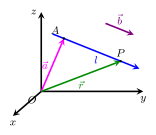
Drawn by us to help you understand the concept clearly, and verified to make sure it's accurate. For exams, practice from your textbook's own diagram.
What this figure shows. Fig. 6.18 - Vector equation of a straight line l through a point A with position vector a and parallel to vector b; a general point P has position vect …