Mathematics · Ch 6 — Applications of Vector Algebra
Straight Line Passing Through Two Given Points
6.7.3
Straight Line Passing Through Two Given Points
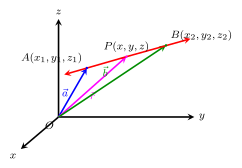
Theorem 6.12. The line through two given points with position vectors and has parametric vector equation
This follows immediately from Theorem 6.11 by taking the direction to be (the vector from the first point to the second) instead of a separately-given .
(b) Non-parametric form: .
(c) Cartesian equations. With , , , substituting into the parametric form and comparing components gives , etc., i.e.
…
Figure 6.19Fig. 6.19 — Straight line through two points $A(x_1,y_1,z_1)$ and $B(x_2,y_2,z_2)$ with position vectors $\vec a,\vec r,\vec b$ from the origin
Drawn by us to help you understand the concept clearly, and verified to make sure it's accurate. For exams, practice from your textbook's own diagram.
What this figure shows. Fig. 6.19 — Straight line through two points and with position vectors fro …