Mathematics · Ch 4 — Inverse Trigonometric Functions
The Graph of the Secant Function
The Graph of the Secant Function
On : in Quadrants I and IV (i.e. ), is positive; in Quadrants II and III (), is negative. Piece by piece: rises from to over ; rises from to over ; falls from to over ; and falls from to over . This is continuous except at , and produces Fig. 4.23: a U-shaped branch above centred near , and an inverted-U branch below centred near .
Being periodic with period , this same segment repeats over every subsequent interval of length , producing the entire graph Fig. 4.24 with a vertical asymptote at every odd multiple of . …
![Fig. 4.23 — Graph of y = sec x on [0, 2pi] excluding pi/2 and 3pi/2: positive branches rising to infinity near pi/2 and from infinity to 1 after 3pi/2, and a downward branch over (pi/2, 3pi/2) with maximum -1 at pi; vertical asymptotes at pi/2 and 3pi/2.](/figures/inverse-trigonometric-functions/secant-function-interval-0-2pi-fig-4-23.svg)
Drawn by us to help you understand the concept clearly, and verified to make sure it's accurate. For exams, practice from your textbook's own diagram.
What this figure shows. A U-shaped branch above centred near and an inverted U-shaped branch below centred near , shooting to near the two asymptotes. …
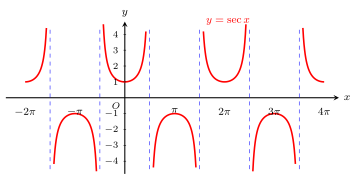
Drawn by us to help you understand the concept clearly, and verified to make sure it's accurate. For exams, practice from your textbook's own diagram.
What this figure shows. The Fig. 4.23 pair of U-shaped branches repeated at every interval of length , with vertical asymptotes at every odd multiple of . …