Mathematics · Ch 5 — Two Dimensional Analytical Geometry-II
Condition for the Line y = mx + c to be a Tangent to the Circle x²+y²=a², and Finding the Point of Contact
5.2.3
Condition for the Line y = mx + c to be a Tangent to the Circle x²+y²=a², and Finding the Point of Contact
Let the circle be (centre the origin, radius ) and the line .
- Condition to be a tangent. The perpendicular distance from to is . The line touches the circle exactly when this distance equals the radius :
So is a tangent to for every slope — there are always two parallel tangents of a given slope, one on each side of the circle.
- Point of contact. Let be the point of contact. Since it lies on the line, . The tangent at (from §5.2.2, general-form tangent with ) is , i.e. . Matching this with (same line, so coefficients are proportional) gives , so and ; using , the point of contact is . …
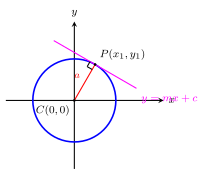
Figure 5.14A tangent line y = mx + c touching the circle x^2 + y^2 = a^2 at a single point of contact P(x1,y1); the radius a to P is perpendicular to the tangent
Drawn by us to help you understand the concept clearly, and verified to make sure it's accurate. For exams, practice from your textbook's own diagram.
What this figure shows. The line meeting the circle at the single point , with the perpendicular from the centre to the line equal to the radius — the picture behind the condition. …