Question 98 of 126
Q.Draw the diagram for the given situation: "A comet is moving in a parabolic orbit around the sun which is at the focus of a parabola. When the comet is 80 million kms from the sun, the line segment from the sun to the comet makes an angle of radians with the axis of the orbit."
Tamil Nadu DgeTamil Nadu HSC (DGE) Board 2019Subjective· 2mImportance★★★★★
78% · 98/126 Questions
You're viewing a preview — the full solution, concept, methods & PYQ mapping are locked.
Start your 14-day free trial to unlock the full solution →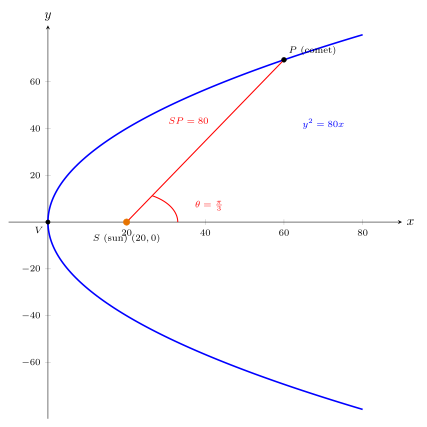
Using the focus-polar equation of a parabola with the given point gives the semi-latus rectum, hence the orbit's Cartesian equation and a closest approach of 20 million km.
- Model the orbit as a parabola with the sun at the focus. Take as pole and the axis of the parabola as the initial line, oriented so the curve opens away from the sun (comet arrives from far away and swings past the sun).
- The polar equation of a parabola referred to its focus is , where is the semi-latus rectum ( for ).
- Substitute the given data , : , so .
- Hence (million km), so .
- With the vertex taken as the Cartesian origin and the axis along the x-axis, the orbit is . …
Unlock everything free for 14 days
- Full step-by-step solutions
- Concept-first explanations
- Methods, shortcuts & mistakes
- PYQ mapping + timed mock tests
Full access for 14 days. No credit card required.