Computer Science · Ch 3 — Emerging Trends
Robotics
Robotics
A robot is essentially a machine that can carry out one or more tasks automatically, with accuracy and precision. What separates a robot from any other machine is that a robot is programmable by a computer — it follows instructions given through computer programs, so its behaviour can be changed by changing the program.
Why robots were built, and what they are made of
- Robots were initially conceived for repetitive industrial tasks — work that is boring or stressful for humans, or highly labour-intensive.
- Sensors are one of the prime components of a robot — they let the robot perceive its surroundings so it can act on them.
Types of robots
Robots come in many physical forms:
- Wheeled robots — move on wheels
- Legged robots — walk on legs
- Manipulators — robotic arms that grasp and move objects
- Humanoids — robots that resemble humans
Where robots are used
Robots serve in industries, medical science, bionics, scientific research, the military and more. Three well-known examples:
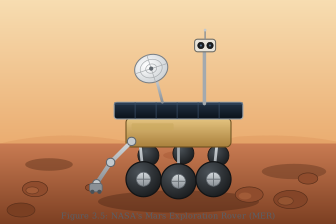
- NASA's Mars Exploration Rover (MER) — a robotic space mission sent to study the planet Mars (Figure 3.5).
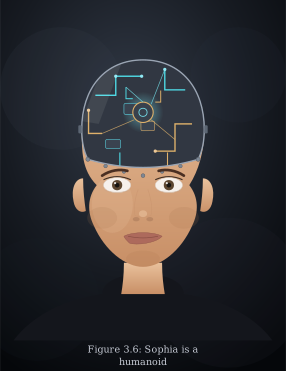
- Sophia — a humanoid that uses artificial intelligence, visual data processing and facial recognition, and can also imitate human gestures and facial expressions (Figure 3.6).
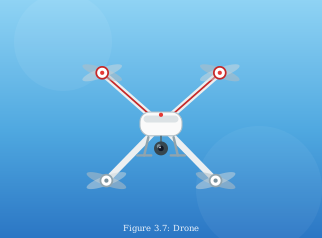
- Drones — a drone is an unmanned aircraft that can be remotely controlled, or can fly autonomously through software-controlled flight plans stored in its embedded systems, working together with onboard sensors and GPS (Figure 3.7).
Applications of drones
Drones are used across a remarkable range of fields:
- journalism, filming and aerial photography
- shipping or delivery over short distances
- disaster management, and search and rescue operations
- healthcare
- geographic mapping and structural safety inspections
- agriculture
- wildlife monitoring (including anti-poaching work)
- law enforcement and border patrolling …
Drawn by us to help you understand the concept clearly, and verified to make sure it's accurate. For exams, practice from your textbook's own diagram.
This image shows a rover from NASA's Mars Exploration Rover (MER) mission — the textbook's example of a robot doing scientific work far beyond human reach. The six-wheeled vehicle stands on reddish-brown, rocky Martian terrain, and its main working parts are all visible:
- a flat solar-panel deck across its back, which powers the rover;
- a vertical mast topped with a camera head, acting as the rover's "eyes" for surveying the landscape;
- a high-gain antenna for communicating across the vast distance to Earth;
- an articulated robotic arm extended toward the ground, with which the rover examines rocks and soil. …
Drawn by us to help you understand the concept clearly, and verified to make sure it's accurate. For exams, practice from your textbook's own diagram.
This photograph is a head-and-shoulders view of Sophia, the textbook's example of a humanoid — a robot that resembles a human. Sophia has a realistic, human-like female face and wears a dark top, photographed against a dark, blurred background. The one deliberate departure from human appearance is telling: her skull cap is bare and transparent, exposing the internal circuitry — a visual reminder that beneath the lifelike face is a machine.
The figure anchors the section's definition of humanoids. As the text explains, Sophia uses artificial intelligence, visual data processing and facial recognition, and can imitate human gestures and facial expressions. The realistic face in the photograph is what makes that imitation possible — Sophia is built not just to think with AI but to interact in a recognisably human way. …
Drawn by us to help you understand the concept clearly, and verified to make sure it's accurate. For exams, practice from your textbook's own diagram.
This photograph shows a drone in flight — a white quadcopter with four rotor arms and red accent markings, against a clear blue sky. Mounted underneath its body is a small camera/sensor unit, the payload that makes the drone useful for observation work such as aerial photography, mapping and inspections.
The figure illustrates the section's definition: a drone is an unmanned aircraft that can either be remotely controlled by an operator or fly autonomously, following software-controlled flight plans stored in its embedded systems and working in conjunction with onboard sensors and GPS. The visible camera unit is one such onboard sensor. …