Q.What is triple fusion? Where and how does it take place? Name the nuclei involved in triple fusion.
🔒You're viewing a preview — the full solution, concept, methods & PYQ mapping are locked.
🔒 Start your 14-day free trial to unlock the full solution →Concept understanding — Triple Fusion Process
Triple Fusion Process – A First Look
Imagine you are baking a cake. You have three separate ingredients: flour, eggs, and sugar. On their own, each is useful but incomplete. When you mix them together and bake, they fuse into something entirely new — a cake that has properties none of the individual ingredients had. That is the spirit of triple fusion, though in biology the ingredients are far more specific.
What Triple Fusion Actually Means
In the context of plant reproduction — specifically in flowering plants — triple fusion is a fertilisation event that happens inside the ovule (the part that becomes the seed). It involves the fusion of three nuclei: one sperm cell from the pollen grain fuses with two polar nuclei present in the central cell of the embryo sac. The result is a triploid (3n) nucleus, which then develops into the endosperm — the nutritive tissue that feeds the developing embryo.
This is not a random event. It is a carefully orchestrated step that occurs simultaneously with the fusion of another sperm cell with the egg cell (which forms the zygote). Because two fertilisation events happen together — one forming the zygote, the other forming the endosperm — the entire process is called double fertilisation. Triple fusion is the name given specifically to the second of these two events.
Triple fusion is not a separate process from double fertilisation. It is the second half of it. Double fertilisation = fusion of sperm with egg (syngamy) + fusion of sperm with two polar nuclei (triple fusion). The "triple" refers to the three nuclei that come together.
Why Does Triple Fusion Matter?
The endosperm produced by triple fusion is triploid — a condition unique to flowering plants. This triploid tissue is rich in nutrients (starch, proteins, oils) and serves as the food supply for the developing embryo. In many seeds we eat — like wheat, rice, maize, and coconut — the endosperm is the edible part.
Without triple fusion, the embryo would have no built-in food source. The seed would either fail to develop or would be too small to survive. This is why triple fusion is considered a key evolutionary innovation of angiosperms (flowering plants). It gave them a reproductive advantage over gymnosperms (like pines and cycads), whose endosperm is haploid and formed before fertilisation.
What the NCERT Textbook Says
The NCERT Class 12 Biology textbook (Chapter 2: Sexual Reproduction in Flowering Plants) describes triple fusion as follows:
- One of the two male gametes (sperm cells) moves towards the egg cell and fuses with it to form the zygote (2n).
- The other male gamete moves towards the central cell of the embryo sac, where it fuses with two polar nuclei (both haploid, 1n each). This fusion of three haploid nuclei produces a triploid primary endosperm nucleus (PEN).
- The PEN then divides repeatedly to form the endosperm, which nourishes the embryo.
The textbook emphasises that this is a unique feature of angiosperms — no other plant group does this.
Triple fusion is not the fusion of three cells. It is the fusion of three nuclei — one sperm nucleus + two polar nuclei. The result is a triploid nucleus, not a triploid cell. The cell that contains this nucleus is called the central cell, and it becomes the endosperm mother cell.
A Simple Way to Remember
Think of it as a three-way handshake inside the ovule:
- Player 1: Sperm nucleus (from pollen)
- Player 2: First polar nucleus (in the central cell)
- Player 3: Second polar nucleus (also in the central cell) …
Triple fusion is a distinctive process in flowering plants where one male gamete nucleus fuses with two polar nuclei. This crucial event occurs within the central cell of the embryo sac, which is situated inside the ovule.
After the pollen tube releases two male gametes into the synergids, one male gamete moves towards the central cell. There, it fuses with the two polar nuclei, which often have already fused to form a diploid secondary nucleus. This fusion leads to the formation of the primary endosperm nucleus.
The nuclei involved in triple fusion are: …
Triple fusion is the unique event in flowering plants where one male gamete fuses with the two polar nuclei in the central cell of the embryo sac, forming the primary endosperm nucleus.
Sexual reproduction in flowering plants, or angiosperms, is distinguished by a remarkable and unique process known as double fertilisation. This process involves two distinct fusion events occurring almost simultaneously within the embryo sac. One of these crucial events is triple fusion, a term that precisely describes the fusion of three nuclei.
Triple fusion is the specific event where one of the male gametes, delivered by the pollen tube, fuses with the two polar nuclei located within the central cell of the embryo sac. This fusion results in the formation of a triploid (3n) structure called the Primary Endosperm Nucleus (PEN). The PEN is significant because it subsequently develops into the endosperm, which serves as the primary nutritive tissue for the developing embryo within the seed.
This intricate event unfolds deep within the female reproductive structures of the flower. The primary site for triple fusion is the embryo sac, also known as the female gametophyte. The embryo sac is typically an oval-shaped, seven-celled, eight-nucleate structure embedded within the ovule, which in turn is housed inside the ovary of the flower. More precisely, triple fusion occurs within the central cell of the embryo sac, which is the largest cell and contains the two polar nuclei.
The journey leading to triple fusion begins with pollination, where a pollen grain lands on the receptive stigma of a flower.
- Pollen Germination and Tube Growth: Upon landing, the pollen grain absorbs moisture and nutrients from the stigma and germinates, producing a pollen tube. This tube grows downwards through the tissues of the stigma and style, guided by chemical signals.
- Entry into Ovule: The pollen tube eventually reaches the ovary and enters the ovule, typically through a small opening called the micropyle.
- Entry into Embryo Sac: Once inside the ovule, the pollen tube usually enters one of the synergids, which are specialized cells flanking the egg cell within the embryo sac. The synergids play a crucial role in guiding the pollen tube and then degenerate after its entry.
- Release of Male Gametes: The pollen tube then releases its two male gametes into the cytoplasm of the synergid. …
- TG EAPCET 2026Set ap-2026-05-04-FN1 markMCQQ.Both sporophyte and gametophytes are multicellular in this life cycle (A) Haplotonic (B) Diplontic (C) Haplodiplontic and Diplontic (D) Haplodiplontic and Diplohaplontic
›Reveal solutionSolution
In a haplodiplontic life cycle, both the diploid sporophyte and the haploid gametophyte stages are multicellular, making option (D) the correct answer.
Concept and Intuition
Organisms reproduce through various life cycles, which are broadly classified based on the ploidy (number of sets of chromosomes) of their dominant stage and where meiosis occurs. A key distinction in these cycles is whether the haploid (gametophyte) and diploid (sporophyte) stages are unicellular or multicellular.
- Sporophyte: This is the diploid (2n) stage of an organism's life cycle. It produces haploid spores through meiosis.
- Gametophyte: This is the haploid (n) stage of an organism's life cycle. It produces haploid gametes through mitosis.
The question asks for the life cycle type where both the sporophyte and gametophyte are multicellular. Let's examine the three main types of life cycles:
- Haplotonic Life Cycle: The dominant, multicellular stage is the haploid gametophyte. The diploid stage is represented only by a unicellular zygote. Meiosis occurs immediately after zygote formation (zygotic meiosis).
- Diplontic Life Cycle: The dominant, multicellular stage is the diploid sporophyte. The haploid stage is represented only by unicellular gametes. Meiosis occurs during gamete formation (gametic meiosis).
- Haplodiplontic Life Cycle (Alternation of Generations): Both the haploid gametophyte and the diploid sporophyte stages are multicellular and often free-living, alternating with each other. Meiosis occurs in the sporophyte to produce spores (sporic meiosis).
Step-by-step Explanation
-
Understanding the Haplotonic Life Cycle:
- In this cycle, the main plant body is a haploid gametophyte, which is multicellular.
- It produces gametes by mitosis.
- Gametes fuse to form a diploid zygote.
- The zygote undergoes meiosis immediately (zygotic meiosis) to produce haploid spores.
- These spores germinate to form new haploid gametophytes.
- The diploid sporophyte stage is represented only by the unicellular zygote.
- Conclusion: Only the gametophyte is multicellular; the sporophyte is unicellular.
- Examples: Many algae (e.g., Volvox, Spirogyra, Chlamydomonas) and most fungi.
-
Understanding the Diplontic Life Cycle:
- In this cycle, the main plant body is a diploid sporophyte, which is multicellular.
- It produces haploid gametes by meiosis (gametic meiosis).
- Gametes fuse to form a diploid zygote.
- The zygote develops by mitosis into a new diploid sporophyte.
- The haploid gametophyte stage is represented only by the unicellular gametes.
- Conclusion: Only the sporophyte is multicellular; the gametophyte is unicellular.
- Examples: All animals, some algae (e.g., Fucus), and seed plants (though their gametophytes are highly reduced, they are still considered part of a diplontic-like cycle where the sporophyte is dominant).
-
Understanding the Haplodiplontic Life Cycle (Alternation of Generations):
- This cycle involves an alternation between a multicellular diploid sporophyte and a multicellular haploid gametophyte. …
- TG EAPCET 2025Set ap-2025-04-29-AN1 markMCQQ.Identify the correctly matched pairs. A. Leptotene – Synapsis occurs B. Zygotene – Pairing of homologous chromosomes C. Pachytene – Crossing over do not occur D. Diplotene – Nuclear membrane dissolves E. Diakinesis – Terminalisation of chiasmata (A) B and E are correct (B) B and C are correct (C) A and B are correct (D) B and D are correct
›Reveal solutionSolution
Meiosis I prophase is divided into five substages, each with a distinct chromosomal event. The correctly matched pairs are B (Zygotene – Pairing of homologous chromosomes) and E (Diakinesis – Terminalisation of chiasmata), so the answer is option (A).
The question tests your knowledge of the five substages of prophase I of meiosis — Leptotene, Zygotene, Pachytene, Diplotene, and Diakinesis. Each substage is defined by a specific event in chromosome behaviour, and mixing them up is a classic exam trap. The key is to remember the sequence and what happens at each step.
Let’s go through each pair one by one.
-
A. Leptotene – Synapsis occurs
Leptotene is the first substage. Chromosomes begin to condense and become visible as thin threads. However, synapsis — the pairing of homologous chromosomes — does not start here. Synapsis begins in the next stage, Zygotene. So this pair is incorrect.
-
B. Zygotene – Pairing of homologous chromosomes
This is correct. Zygotene is defined by the onset of synapsis, where homologous chromosomes align closely along their entire length, forming bivalents. The pairing is stabilised by the synaptonemal complex. This pair is correct.
-
C. Pachytene – Crossing over do not occur
This is wrong. Pachytene is precisely the stage where crossing over occurs. Homologous chromosomes are fully paired, and recombination takes place between non-sister chromatids. So the statement "crossing over do not occur" is false. This pair is incorrect.
-
D. Diplotene – Nuclear membrane dissolves …
-
- TG EAPCET 2024Set ap-2024-05-07-AN1 markMCQQ.‘A’ diploid chromosome number is 4. ‘B’ haploid chromosome number is twice to that of A. ‘C’ diploid chromosome number is thrice to that of A. A, B and C respectively are (A) A = Maize B = House fly C = Onion (B) A = Housefly B = Potato C = Onion (C) A = Haplopappus B = House fly C = Tomato (D) A = Haplopappus B = Onion C = House fly
›Reveal solutionSolution
A has 2n=4 so A is Haplopappus; B's haploid number =2×4=8, i.e. 2n=16 → Onion; C's diploid number =3×4=12 → Housefly. Option (D).
We are given three organisms defined by their chromosome numbers relative to A.
-
Organism A — diploid number 2n=4. The classic organism with the smallest diploid chromosome number (2n=4) is Haplopappus gracilis. So A = Haplopappus.
-
Organism B — its haploid number is twice that of A, i.e. nB=2×4=8, giving 2nB=16. Onion (Allium cepa) has 2n=16 (n=8). So B = Onion. …
-
- TG EAPCET 2024Set ap-2024-05-07-AN1 markMCQQ.The thick filaments in a sarcomere of a myofibril are held together by a thin fibrous membrane called (A) Dobie’s line (B) Krause’s membrane (C) Z – Line (D) M – Line
›Reveal solutionSolution
The thick filaments in a sarcomere are anchored at the centre by the M-line, which is a thin fibrous membrane that holds them together. The correct option is (D).
The sarcomere is the basic functional unit of a myofibril in striated muscle. To understand which structure holds the thick filaments together, you need to picture the sarcomere’s layout. The thick filaments (made of myosin) sit in the middle of the sarcomere, flanked by thin filaments (actin) that extend inward from the ends. The key is that the thick filaments don’t just float freely — they are stabilised at their centre by a protein-rich mesh.
The M-line (short for Mittelscheibe, German for “middle disc”) is precisely that central anchoring structure. It runs perpendicular to the filaments, right through the middle of the A-band, and consists of proteins like myomesin that cross-link the thick filaments. Without the M-line, the thick filaments would slide past each other unevenly during contraction.
Now let’s rule out the other options quickly:
- Dobie’s line — This is another name for the Z-line (see below), not a separate structure. It marks the boundary between sarcomeres, not the centre. …
- TG EAPCET 2023Set ap-2023-05-10-AN1 markMCQQ.When pollen mother cell of Apple plant undergoes meiotic division, number of chromatids present in Anaphase I, Anaphase II and number of bivalents respectively are (A) 34, 34, 34 (B) 34, 17, 17 (C) 34, 17, 34 (D) 17, 17, 34
›Reveal solutionSolution
Apple is diploid with 2n=34, so n=17. In Prophase I/Metaphase I there are 17 bivalents. At Anaphase I, each pole receives 17 chromosomes, each still with 2 chromatids, giving 34 chromatids per pole. At Anaphase II, sister chromatids have separated, so each pole has 17 single-chromatid chromosomes. The correct option is (B) 34, 17, 17.
Apple's somatic (diploid) chromosome number is 2n=34, so the haploid number is n=17.
-
Bivalents. A bivalent is a pair of synapsed homologous chromosomes formed in Prophase I. With 34 chromosomes forming 17 homologous pairs, there are 17 bivalents.
-
Anaphase I. Homologous chromosomes separate and move to opposite poles, but each chromosome still consists of two sister chromatids joined at the centromere (the centromeres do not split in Meiosis I). Each pole receives 17 chromosomes, each with 2 chromatids, giving 17×2=34 chromatids per pole. …
-
- TG EAPCET 2023Set ap-2023-05-11-AN1 markMCQQ.Which of the following statements regarding endosperm of angiosperms are true? A. Endosperm is formed by triple fusion B. Endosperm is nutritive in function C. It is a pre-fertilized structure D. It may or may not be completely utilized by the developing embryo (A) A, B & D (B) A, B & C (C) B, C & D (D) A, C & D
›Reveal solutionSolution
The endosperm in angiosperms is a nutritive tissue formed by triple fusion after fertilization, and its utilization by the embryo varies across different seeds. Statements A, B, and D are true, making (A) the correct option.
Concept and Intuition
In angiosperms, the process of reproduction involves a unique event called double fertilization. This process is crucial for the formation of both the embryo and the endosperm. The endosperm is essentially the food supply for the developing embryo, analogous to the yolk in an egg, but formed through a distinct mechanism. Understanding its origin and function is key to evaluating the given statements.
Step-by-step Evaluation
-
Evaluate Statement A: "Endosperm is formed by triple fusion"
- During double fertilization, one of the two male gametes (sperms) fuses with the egg cell to form the zygote (which develops into the embryo).
- The other male gamete fuses with the central cell, which typically contains two polar nuclei. This fusion of one male gamete (n) with two polar nuclei (n+n) is called triple fusion.
- Triple fusion results in the formation of a triploid (3n) primary endosperm nucleus (PEN). The PEN then undergoes repeated divisions to form the endosperm tissue.
- Therefore, this statement is true.
Male gamete (n) + Polar nuclei (n+n) → Primary Endosperm Nucleus (3n)
-
Evaluate Statement B: "Endosperm is nutritive in function"
- The primary role of the endosperm is to provide nourishment to the developing embryo. It stores food reserves such as starch, proteins, and oils, which are essential for the embryo's growth and subsequent germination of the seed.
- Therefore, this statement is true.
-
Evaluate Statement C: "It is a pre-fertilized structure"
- As explained in step 1, the endosperm is formed after triple fusion, which is an integral part of the fertilization process. Fertilization is the fusion of gametes.
- Structures that exist before fertilization are considered pre-fertilized. The endosperm, being a product of fertilization, is a post-fertilized structure.
- Therefore, this statement is false. …
-
- TG EAPCET 2022Set ap-2022-07-31-AN1 markMCQQ.Choose the correct combinations from the following: A) Nucleus irregularly shaped – Cell size smaller – Generative cell B) Spindle shaped cell – Cell size bigger – Vegetative cell C) Outer wall of pollen grain – Cannot withstand high temperature – Variety of designs and patterns D) Micropyle close to funiculus – Ovule covered by an integument – Anatropous ovule of Asteraceae E) Prior to the pollen release, stigma becomes receptive – Endospermic seeds in potato – Dichogamy The correct answer is : (A) C, D, E only (B) A, B, E only (C) D, E only (D) C, D only
›Reveal solutionSolution
This question tests knowledge of pollen grain structure, ovule morphology, and reproductive strategies in plants. We evaluate each statement for biological accuracy, finding that statements D and E are correct. The final answer is (C).
Concept and Intuition
To choose the correct combinations, we need to carefully examine each statement, breaking it down into its constituent parts. Each part must be biologically accurate for the entire statement to be considered correct. The statements cover various aspects of plant reproduction, including:
- Pollen grain structure: Differentiating between the vegetative and generative cells and the properties of the pollen wall.
- Ovule morphology: Understanding the structure of an ovule, particularly the anatropous type.
- Pollination mechanisms and seed types: Concepts like dichogamy (protogyny) and the classification of seeds based on endosperm presence.
We will evaluate each statement part by part, identifying any inaccuracies.
Step-by-Step Evaluation
-
Evaluate Statement A: Nucleus irregularly shaped – Cell size smaller – Generative cell
- The pollen grain typically contains two cells: a larger vegetative cell and a smaller generative cell.
- The vegetative cell is larger, has abundant food reserves, and its nucleus is typically large and irregularly shaped.
- The generative cell is smaller, spindle-shaped, and floats in the cytoplasm of the vegetative cell. Its nucleus is distinct and often spindle-shaped or lenticular.
- Statement A attributes "nucleus irregularly shaped" to the generative cell, which is incorrect. The generative cell is indeed smaller, but its nucleus is not irregularly shaped; that feature belongs to the vegetative cell.
- Therefore, statement A is incorrect.
-
Evaluate Statement B: Spindle shaped cell – Cell size bigger – Vegetative cell
- As discussed above, the generative cell is typically spindle-shaped.
- The vegetative cell is indeed bigger than the generative cell.
- Statement B attributes "spindle shaped cell" to the vegetative cell, which is incorrect. The vegetative cell is larger but not spindle-shaped; that feature belongs to the generative cell.
- Therefore, statement B is incorrect.
-
Evaluate Statement C: Outer wall of pollen grain – Cannot withstand high temperature – Variety of designs and patterns
- The outer wall of the pollen grain is called the exine.
- The exine is composed of sporopollenin, which is one of the most resistant organic materials known. It is highly resistant to high temperatures, strong acids, and alkalis, and it does not degrade easily. This resistance is crucial for the preservation of pollen as fossils.
- The exine also exhibits a variety of designs and patterns, which are characteristic of different species.
- The phrase "Cannot withstand high temperature" is factually incorrect due to the presence of sporopollenin.
- Therefore, statement C is incorrect.
-
Evaluate Statement D: Micropyle close to funiculus – Ovule covered by an integument – Anatropous ovule of Asteraceae
- An anatropous ovule is the most common type of ovule in angiosperms. In this type, the ovule body is inverted by 180∘ during development, causing the micropyle (the small opening) to lie close to the funiculus (the stalk attaching the ovule to the placenta). This part is correct.
- Angiosperm ovules are typically protected by one or two integuments, which later develop into the seed coat. This part is correct.
- The family Asteraceae (e.g., sunflower, daisy) is a large and diverse family of flowering plants, and its members typically possess anatropous ovules. This part is correct.
- All parts of statement D are correct.
- Therefore, statement D is correct.
-
Evaluate Statement E: Prior to the pollen release, stigma becomes receptive – Endospermic seeds in potato – Dichogamy
- "Prior to the pollen release, stigma becomes receptive" describes a condition called protogyny, where the female reproductive organs (stigma) mature before the male reproductive organs (anthers release pollen). This is a mechanism to promote cross-pollination. This part is correct. …
- TG EAPCET 2021Set ap-2021-08-10-AN1 markMCQQ.Match the following List-I List-II List-III A) Circular DNA i) Sprouting out of cell I) Attach the bacteria to the host tissue B) Fimbriae ii) Outermost layer of the cell wall II) Solanaceae C) Middle lamella iii) Makoi III) Plasmid DNA D) Mesocarp and endocarp fused iv) No nuclear membrane IV) Develops from the cell plate The correct match is (A) A - i, IV; B - iii, I; C - iv, III; D - ii, II (B) A - iv, III; B - i, I; C - ii, IV; D - iii, II (C) A - iii, I; B - ii, IV; C - iv, II; D - i, III (D) A - iv, III; B - i, I; C - iii, II; D - ii, III
›Reveal solutionSolution
This question requires matching biological terms and characteristics across three lists. We will systematically match each item from List-I with its correct descriptions from List-II and List-III. The correct match is (B) A - iv, III; B - i, I; C - ii, IV; D - iii, II.
Matching questions test your ability to recall specific facts and connect related concepts. The best approach is to tackle the most certain matches first, as this often helps eliminate incorrect options and narrow down possibilities for the more ambiguous ones. We will go through each item in List-I and find its corresponding descriptions.
-
Matching A) Circular DNA:
- Concept: DNA in prokaryotes and plasmids.
- From List-II: Circular DNA is characteristic of prokaryotic cells, which lack a nuclear membrane. Thus, 'iv) No nuclear membrane' is a correct association.
- From List-III: Plasmid DNA is a well-known example of circular DNA found in bacteria, separate from the main bacterial chromosome. Thus, 'III) Plasmid DNA' is a correct association.
- Match for A: A - iv, III.
-
Matching B) Fimbriae:
- Concept: Bacterial surface structures.
- From List-II: Fimbriae are short, hair-like appendages that project from the surface of many prokaryotic cells. So, 'i) Sprouting out of cell' accurately describes their appearance.
- From List-III: The primary function of fimbriae is to help bacteria attach to host tissues or other surfaces, aiding in colonization and infection. So, 'I) Attach the bacteria to the host tissue' is a correct function.
- Match for B: B - i, I.
-
Matching C) Middle lamella:
- Concept: Plant cell wall structure and formation.
- From List-II: The middle lamella is a thin, cementing layer rich in pectin that lies between the primary cell walls of adjacent plant cells, holding them together. In this context, it can be considered the 'ii) Outermost layer of the cell wall' in terms of being the shared boundary between cells.
- From List-III: During cytokinesis in plant cells, a cell plate forms in the center of the dividing cell, which then develops into the middle lamella, followed by the primary cell walls on either side. So, 'IV) Develops from the cell plate' is a correct description of its origin. …
-
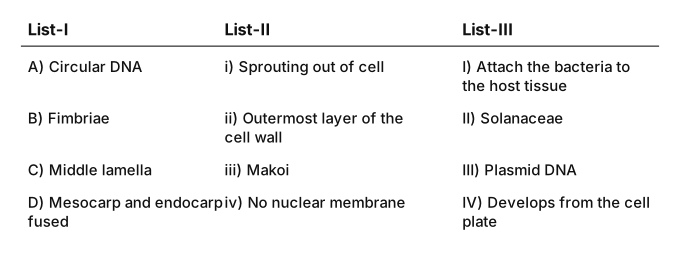
- TG EAPCET 2021Set ap-2021-08-10-FN1 markMCQQ.Match the following lists. List-I: A) Circular DNA B) Fimbriae C) Middle lamella D) Mesocarp and endocarp fused List-II:i) Sprouting out of cellii) Outermost layer of the cell walliii) Makoiiv) No nuclear membrane List-III: I) Attach the bacteria to the host tissue II) Solanaceae III) Plasmid DNA IV) Develops from the cell plate The correct match is: (A) A - i, IV; B - iii, I; C - iv, III; D - ii, II (B) A - iv, III; B - i, I; C - ii, IV; D - iii, II (C) A - iii, I; B - ii, IV; C - iv, II; D - i, III (D) A - iv, III; B - i, I; C - iii, II; D - ii, III
›Reveal solutionSolution
Circular DNA = plasmid in a membrane-less nucleus; fimbriae are outgrowths that anchor bacteria to host tissue; the middle lamella is the outermost wall layer formed from the cell plate; and Makoi (Solanaceae) is a berry with fused mesocarp and endocarp. That gives A–iv,III; B–i,I; C–ii,IV; D–iii,II — option (B).
The concept first
This is a three-column item, so each entry in List-I needs one descriptive tag (List-II) and one identity/consequence tag (List-III). Solve the unambiguous pairs first and let them eliminate the rest.
Step-by-step
- A) Circular DNA. Bacteria carry a single circular chromosome loose in the cytoplasm — there is no nuclear membrane around it, which is the defining prokaryotic trait → iv. Besides the chromosome, many bacteria hold small circular extra-chromosomal DNA molecules; these are called plasmids → III. So A – iv, III.
- B) Fimbriae. These are small bristle-like fibres sprouting out of the bacterial cell surface → i. Their function is adhesion: they attach bacteria to rocks in streams and to host tissues → I. So B – i, I. …
🎓Unlock everything free for 14 days
- ✓Full step-by-step solutions
- ✓Concept-first explanations
- ✓Methods, shortcuts & mistakes
- ✓PYQ mapping + timed mock tests
Full access for 14 days. No credit card required.