Q.Differentiate between:
🔒You're viewing a preview — the full solution, concept, methods & PYQ mapping are locked.
🔒 Start your 14-day free trial to unlock the full solution →Concept understanding — Seed Structure Terminology
Seed Structure Terminology – A First Look
Think of a seed as a tiny, self-contained survival kit. A plant makes a seed to send its offspring out into the world, equipped with everything needed to travel, wait, and eventually sprout into a new plant. The terminology around seed structure is simply the names we give to the parts of that kit.
The Three Essential Parts
Every seed, from a mustard seed to a mango seed, has three basic components. You can remember them as the baby, the lunchbox, and the coat.
- Embryo – This is the baby plant itself. It is a miniature, dormant plant with tiny leaves (cotyledons or plumule), a tiny stem (hypocotyl), and a tiny root (radicle). When conditions are right, the embryo wakes up and starts growing.
- Endosperm – This is the lunchbox. It is a tissue that stores food (starch, proteins, oils) for the embryo to use when it germinates. In some seeds, the endosperm is consumed by the embryo before the seed matures, and the food is stored directly in the cotyledons instead.
- Seed Coat – This is the coat. It is a tough, protective outer layer that shields the embryo from injury, drying out, and disease. It often has a tiny scar called the hilum where the seed was attached to the mother plant, and a small pore called the micropyle that lets water enter during germination.
The micropyle is a tiny opening in the seed coat. It is not just a scar — it is a functional pore. Water enters through the micropyle to trigger germination, and later, the radicle (the first root) emerges through it.
Why This Matters for Exams
In NCERT textbooks (Class 11 Biology, Chapter 5), seed structure is taught to help you understand how plants reproduce and how seeds are adapted for survival. The key distinction you must know is between two types of seeds based on where the food is stored:
- Albuminous seeds – The endosperm remains present and stores food. Example: castor, coconut, maize.
- Exalbuminous seeds – The endosperm is completely used up during development, and food is stored in the cotyledons. Example: pea, bean, groundnut.
In exalbuminous seeds, the cotyledons become thick and fleshy because they have absorbed the endosperm. In albuminous seeds, the cotyledons remain thin and papery because the endosperm does the job of food storage.
A Simple Way to Visualise
Imagine a packed lunch in a lunchbox inside a backpack. The embryo is the child, the endosperm is the lunch, and the seed coat is the backpack. In an albuminous seed, the lunchbox is still full when the child opens it. In an exalbuminous seed, the child has already eaten the lunch and packed the food into its own pockets (the cotyledons) before the journey begins.
Common Exam Terms at a Glance
| Term | Meaning |
|---|---|
| Radicle | The part of the embryo that becomes the root |
| Plumule | The part that becomes the shoot (stem and leaves) |
Let’s take each pair one by one, exactly as the NCERT textbook presents them.
- Hypocotyl and epicotyl In a dicot embryo, the part of the embryonal axis below the cotyledons is the hypocotyl; it terminates in the radicle. The part above the cotyledons is the epicotyl; it terminates in the plumule. So the hypocotyl is below the cotyledonary node, the epicotyl is above it.
- Coleoptile and coleorrhiza In a monocot embryo (e.g., grass), the plumule is covered by a protective sheath called the coleoptile. The radicle is similarly covered by a protective sheath called the coleorrhiza. Coleoptile protects the shoot tip; coleorrhiza protects the root tip.
- Integument and testa The integument is the protective covering layer(s) that surround the ovule before fertilisation. After fertilisation, the integument(s) develop into the testa — the hard, protective outer covering of the seed. So integument is the pre-fertilisation structure; testa is its post-fertilisation derivative.
- Perisperm and pericarp …
These four pairs of terms describe distinct structures in seeds and seedlings — each pair contrasts a protective or embryonic part with its functional counterpart, as defined in NCERT.
Let’s take each pair one by one, starting with the context of seed structure. A seed, in flowering plants, develops from the ovule after fertilisation. The embryo inside has several regions: the radicle (future root), the plumule (future shoot), and one or two cotyledons (seed leaves). The terms you’ve asked about relate to the embryo’s axis, protective sheaths, seed coverings, and nutritive tissues. NCERT is very precise about these, so we’ll stick to its definitions.
(a) Hypocotyl and Epicotyl
These are parts of the embryo’s axis — the central line that runs from the radicle to the plumule.
The hypocotyl is the portion of the embryo axis below the point where the cotyledons are attached. It terminates at the radicle. In a germinating seed, the hypocotyl elongates and pushes the cotyledons above the ground (in epigeal germination) or remains short (in hypogeal germination). Its key role is to connect the radicle to the cotyledons.
The epicotyl is the portion above the cotyledonary node — that is, above the attachment point of the cotyledons. It ends at the plumule. In germination, the epicotyl elongates to lift the plumule and the first true leaves above the soil.
A simple way to remember: hypo means below, epi means above — so hypocotyl is below the cotyledons, epicotyl is above them.
(b) Coleoptile and Coleorrhiza
These are protective sheaths found in the seeds of monocotyledons (like maize, wheat, rice). NCERT describes them specifically in the context of the monocot embryo.
The coleoptile is a hollow, conical, protective sheath that covers the plumule (the young shoot). It is not a leaf but a specialised structure that guards the delicate shoot tip as it pushes through the soil. Once the shoot emerges, the coleoptile stops growing and the first true leaf breaks through its tip.
The coleorrhiza is a protective sheath that covers the radicle (the young root) in monocot seeds. It is a tough, root-like covering that helps the radicle penetrate the soil. The radicle eventually emerges by rupturing the coleorrhiza.
Both coleoptile and coleorrhiza are non-photosynthetic protective structures — they are not the actual shoot or root, just temporary covers. NCERT emphasises that the coleoptile is for the plumule, the coleorrhiza for the radicle.
(c) Integument and Testa
These terms relate to the seed coat — the outer covering of the seed.
The integument is the protective layer that surrounds the ovule before fertilisation. In a typical angiosperm ovule, there are usually two integuments (outer and inner). They cover the nucellus except at the micropyle (a small opening). After fertilisation, the integuments undergo changes — they harden and become the seed coat.
The testa is the outer seed coat that develops from the integument(s) after fertilisation. It is the hard, protective covering of the mature seed. In some seeds, the testa may be thin (like in beans) or thick and woody (like in coconut). The testa is derived entirely from the integument(s) of the ovule. …
Showing the 12 most recent of 13 on this concept.
- TG EAPCET 2026Set ap-2026-05-04-AN1 markMCQQ.Zygomorphic flowers showing imbricate aestivation (A) Calotropis and Bean (B) Cassia and Gulmohar (C) Cassia and citrus (D) Canna and Bean
›Reveal solutionSolution
The key is to identify plants with zygomorphic (bilaterally symmetrical) flowers that also show imbricate aestivation (petals overlapping irregularly, with one petal completely outside and one completely inside). The correct pair is Cassia and Gulmohar, which is option (B).
The question tests two botanical features simultaneously: flower symmetry and the arrangement of petals (aestivation). You need to know which plants have each, then find the overlap.
Zygomorphic flowers are those that can be divided into two mirror-image halves along only one plane — think of a pea flower or an orchid. This is opposed to actinomorphic (radially symmetrical) flowers like those of a rose or mustard.
Imbricate aestivation is a specific type of petal arrangement where the petals overlap one another, but not in a regular, twisted pattern (like in convolute aestivation). In imbricate aestivation, one petal is completely outside (its edges cover both neighbours), one is completely inside (both its edges are covered), and the rest are partially in and out. It's an irregular overlapping.
Now, let's check each option.
-
Option (A): Calotropis and Bean
- Calotropis (Madar) has actinomorphic flowers, not zygomorphic. Its aestivation is valvate (petals just touch at edges, no overlap). So it fails on both counts.
- Bean (Fabaceae family) has zygomorphic flowers, but its aestivation is vexillary (a special type of descending imbricate, with a large standard petal outside, two wings, and two keel petals inside). Vexillary is a type of imbricate, but the question likely means the general imbricate pattern (not the specialised one). More importantly, Calotropis is wrong, so this option is out.
-
Option (B): Cassia and Gulmohar
- Cassia (a genus in Fabaceae, subfamily Caesalpinioideae) has zygomorphic flowers. Its aestivation is imbricate — the petals overlap irregularly, with one petal (the standard) outside, but not in the strict vexillary pattern of the bean subfamily.
- Gulmohar (Delonix regia, also in Caesalpinioideae) also has zygomorphic flowers with imbricate aestivation. Both fit perfectly.
-
Option (C): Cassia and Citrus
- Cassia is correct (zygomorphic, imbricate).
- Citrus (lemon, orange) has actinomorphic flowers. Its aestivation is valvate (petals just meet at edges). So Citrus fails. …
-
- TG EAPCET 2026Set ap-2026-05-04-AN1 markMCQQ.Which of the following two parts observed in the embryo of grass plant are not observed in the embryo of pea plant? (A) Shoot apex and Coleoptile (B) Radicle and coleorrhiza (C) Coleoptile and coleorrhiza (D) Scutellum and coleoptile
›Reveal solutionSolution
Grass plants are monocots, while pea plants are dicots. Monocot embryos possess specialized protective sheaths around their plumule and radicle, which are absent in dicot embryos. Therefore, the coleoptile (protecting the plumule) and coleorrhiza (protecting the radicle) are observed in grass embryos but not in pea embryos. The correct option is (C).
Concept and Intuition
Flowering plants (angiosperms) are broadly classified into two major groups: monocotyledonous (monocots) and dicotyledonous (dicots). This classification is primarily based on the number of cotyledons (embryonic leaves) present in their embryos. Beyond the number of cotyledons, there are other distinct structural differences in their embryos, particularly concerning protective coverings for the embryonic shoot and root.
- Monocot embryos (like that of grass) typically have a single cotyledon and often possess specialized protective sheaths around their developing shoot (plumule) and root (radicle).
- Dicot embryos (like that of pea) have two cotyledons and lack these specific protective sheaths.
The question asks us to identify two parts found in a grass embryo that are not found in a pea embryo. This requires understanding the unique features of monocot embryos compared to dicot embryos.
Step-by-step Explanation
-
Identify the plant types:
- Grass is a monocot plant.
- Pea is a dicot plant.
- The task is to find structures present in a monocot embryo (grass) but absent in a dicot embryo (pea).
-
Examine the structure of a grass embryo (monocot):
- A grass embryo has a single, large, shield-shaped cotyledon called the scutellum.
- The embryonal axis consists of a plumule (which develops into the shoot system, including the shoot apex) and a radicle (which develops into the root system).
- The plumule is enclosed in a hollow, foliar structure called the coleoptile. This sheath protects the young shoot as it emerges through the soil.
- The radicle and the root cap are enclosed in an undifferentiated sheath called the coleorrhiza. This sheath protects the young root.
-
Examine the structure of a pea embryo (dicot):
- A pea embryo has two large cotyledons that store food.
- The embryonal axis consists of a plumule (containing the shoot apex) and a radicle.
- Crucially, pea embryos do not have specialized protective sheaths like the coleoptile around the plumule or the coleorrhiza around the radicle.
-
Compare and identify unique structures:
Based on the descriptions above, the structures observed in a grass embryo but not in a pea embryo are:
- Scutellum: The specific single, shield-shaped cotyledon of monocots. While pea has cotyledons, they are two in number and not referred to as a scutellum.
- Coleoptile: The protective sheath covering the plumule.
- Coleorrhiza: The protective sheath covering the radicle.
-
Evaluate the given options:
- (A) Shoot apex and Coleoptile: The shoot apex is part of the plumule and is present in both grass and pea embryos. Therefore, this option is incorrect. …
- TG EAPCET 2025Set ap-2025-04-29-AN1 markMCQQ.Consider the following statements Assertion (A): Hilum is a scar on the seed coat Reason (R): Through hilum the developing seeds were attached to the fruit (A) Both (A) and (R) are true, (R) is the correct explanation of (A) (B) Both (A) and (R) are true, (R) is not the correct explanation of (A) (C) (A) is true, but (R) is false (D) (A) is false, but (R) is true
›Reveal solutionSolution
The hilum is indeed a scar on the seed coat, and it marks the point where the developing seed was attached to the fruit (ovary wall) via the funiculus. Both statements are true, and the reason correctly explains why the hilum exists as a scar.
Understanding Seed Structure and the Hilum
To answer this question, we need to understand what the hilum is and how seeds develop within fruits.
What is the hilum?
The hilum is a visible mark or scar on the seed coat (testa). If you've ever looked closely at a bean seed, you'll notice an oval-shaped mark on its surface—that's the hilum. It's essentially the "belly button" of the seed.
Why does this scar exist?
During seed development, the ovule (which becomes the seed) is attached to the ovary wall (which becomes the fruit) through a stalk-like structure called the funiculus. This funiculus serves as the lifeline, transporting nutrients and water from the parent plant to the developing seed. When the seed matures and detaches from the funiculus, it leaves behind a scar—the hilum.
Evaluating the Statements
Let's examine each statement carefully:
-
Assertion (A): "Hilum is a scar on the seed coat"
- This is anatomically correct. The hilum appears as a distinct mark or scar on the outer covering (seed coat) of the seed.
- Status: TRUE
-
Reason (R): "Through hilum the developing seeds were attached to the fruit"
- This is also correct. The hilum marks the exact point where the funiculus connected the developing seed (ovule) to the fruit wall (pericarp). …
-
- TG EAPCET 2025Set ap-2025-04-29-AN1 markMCQQ.Zygomorphic flowers showing imbricate aestivation are present in (A) Cucumber and Cassia (B) Cassia and disc florets of Tridax (C) Pisum and Calotropis (D) Gulmohur and Cassia
›Reveal solutionSolution
This question tests your knowledge of floral symmetry (zygomorphic) and aestivation (imbricate). We need to identify the pair of plants where both flowers are zygomorphic and exhibit imbricate aestivation. The correct pair is Gulmohur and Cassia.
Concept and Intuition
Flowers exhibit various forms of symmetry and arrangements of their floral parts, which are important characteristics for plant identification and classification.
-
Floral Symmetry:
- Zygomorphic (Bilateral Symmetry): A flower is zygomorphic if it can be divided into two equal halves in only one specific vertical plane. Think of it like a human face – you can only cut it down the middle to get two symmetrical halves. Examples include pea, bean, Gulmohur, and Cassia.
- Actinomorphic (Radial Symmetry): A flower is actinomorphic if it can be divided into two equal radial halves by any radial plane passing through the center. Imagine a star or a wheel – you can cut it in many ways to get symmetrical halves. Examples include mustard, Datura, and lily.
-
Aestivation:
Aestivation refers to the mode of arrangement of sepals or petals in a floral bud with respect to the other members of the same whorl. There are several types:
- Valvate: The margins of sepals or petals just touch each other without overlapping.
- Twisted: One margin of the appendage overlaps the next one, and so on, in a regular direction.
- Imbricate: The margins of sepals or petals overlap one another, but not in any particular regular direction. This type includes both ascending and descending imbricate forms.
- Vexillary (Papilionaceous): This is a specific type of aestivation found in pea flowers (Fabaceae family). The largest posterior petal (standard) overlaps the two lateral petals (wings), which in turn overlap the two smallest anterior petals (keel). While vexillary involves overlapping, it is often treated as a distinct category from general imbricate aestivation due to its very specific and consistent pattern.
For this question, we are looking for plants that are both zygomorphic and show imbricate aestivation. It's crucial to distinguish imbricate from vexillary based on standard botanical definitions, especially as presented in common textbooks.
Step-by-Step Analysis
Let's analyze each option by checking the floral symmetry and aestivation of the plants mentioned:
-
Analyze Option (A): Cucumber and Cassia
- Cucumber: Flowers are typically actinomorphic (radially symmetrical) and show twisted or valvate aestivation. They are not zygomorphic, nor do they have imbricate aestivation.
- Cassia: Flowers are zygomorphic (bilaterally symmetrical) and exhibit imbricate aestivation (specifically, ascending imbricate).
- Since Cucumber does not fit the criteria, option (A) is incorrect.
-
Analyze Option (B): Cassia and disc florets of Tridax
- Cassia: As established, Cassia flowers are zygomorphic and have imbricate aestivation.
- Disc florets of Tridax: These are actinomorphic (radially symmetrical) and have valvate aestivation. They are not zygomorphic, nor do they have imbricate aestivation. …
-
- TG EAPCET 2025Set ap-2025-04-29-FN1 markMCQQ.In Pea plant, Mendel studied seven pairs of contrasting characters. The ratio of pairs of characters that are related to flower, pod and seed respectively. (A) 1:2:2 (B) 1:1:2 (C) 2:2:1 (D) 2:2:2
›Reveal solutionSolution
Mendel studied seven pairs of contrasting characters in pea plants. When categorized by the plant part they affect, there are 2 characters related to the flower, 2 related to the pod, and 2 related to the seed, giving a ratio of 2:2:2.
Mendel's groundbreaking work on heredity used the garden pea plant (Pisum sativum) because it exhibited several distinct, easily observable contrasting characters. He meticulously studied seven such pairs of traits, each controlled by a single gene, which allowed him to deduce the fundamental laws of inheritance. To answer this question, we need to identify these seven characters and then classify them based on whether they relate to the flower, pod, or seed.
-
Identify Mendel's Seven Contrasting Characters:
Mendel studied the following seven pairs of contrasting characters in pea plants:
- Seed Shape: Round (dominant) vs. Wrinkled (recessive)
- Seed Color: Yellow (dominant) vs. Green (recessive)
- Flower Color: Purple (dominant) vs. White (recessive)
- Pod Shape: Inflated (dominant) vs. Constricted (recessive)
- Pod Color: Green (dominant) vs. Yellow (recessive)
- Flower Position: Axial (dominant) vs. Terminal (recessive)
- Stem Height: Tall (dominant) vs. Dwarf (recessive)
-
Categorize Characters by Plant Part:
Now, let's classify each of these seven characters into the categories specified in the question: flower, pod, or seed.
-
Characters related to Flower:
- Flower Color
- Flower Position
- Count for Flower: 2
-
Characters related to Pod:
- Pod Shape …
-
-
- TG EAPCET 2025Set ap-2025-04-30-FN1 markMCQQ.The given diagram is longitudinal section of an embryo of grass plant. Identify A, B, C and D parts (A) A – Epicotyl, B – Coleoptile, C – Radicle, D – Root cap (B) A – Scutellum, B – Shoot apex, C – Epiblast, D – Root cap (C) A – Shoot apex, B – Coleoptile, C – hypoblast, D – Radicle (D) A – Scutellum, B – Shoot apex, C – Mesoblast, D – Coleorhiza
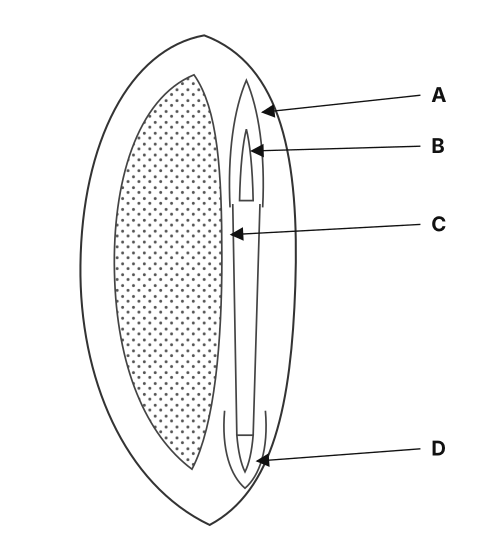
›Reveal solutionSolution
The key is to recall the anatomy of a grass embryo (monocot): the scutellum is the large shield-shaped cotyledon, the shoot apex sits above it, the epiblast is a small flap opposite the scutellum, and the root cap covers the radicle. The correct match is option (B).
The question asks you to identify four labelled parts (A, B, C, D) in a longitudinal section of a grass embryo. Grass (monocot) embryos have a distinctive structure: a single cotyledon called the scutellum, a shoot apex (plumule) often protected by a coleoptile, a radicle (embryonic root) covered by a coleorhiza, and sometimes a small outgrowth called the epiblast. The trick is to match each label to its correct name.
Let’s reason through each part:
-
Identify part A – In the diagram, A is the large, shield-shaped structure that occupies most of the embryo. This is the scutellum, the single cotyledon of grasses that absorbs nutrients from the endosperm. Options (B) and (D) list A as Scutellum; (A) and (C) do not. So A is likely Scutellum.
-
Identify part B – B is located at the top of the embryo, above the scutellum, and appears as a small dome or point. This is the shoot apex (the embryonic shoot tip). In grass embryos, the shoot apex is often surrounded by a coleoptile, but the apex itself is the growing point. Options (B) and (D) list B as Shoot apex; (A) says Epicotyl (which is the region above the cotyledon, not the apex itself), and (C) says Coleoptile (the sheath, not the apex). So B is Shoot apex.
-
Identify part C – C is a small flap or outgrowth on the side opposite the scutellum, near the base. This is the epiblast, a small scale-like structure unique to grass embryos (it is thought to be a vestigial second cotyledon). Option (B) lists C as Epiblast; (A) says Radicle (the root, not a flap), (C) says hypoblast (not a standard term in grass embryo), (D) says Mesoblast (a tissue layer, not a part). So C is Epiblast. …
-
- TG EAPCET 2025Set ap-2025-04-30-FN1 markMCQQ.Chromosomes number in endosperm cell of "X" plant and the chromosomes number of gamete of plant "Y" are equal. Plants X and Y respectively are (A) Apple and Rice (B) Maize and potato (C) Onion and Rice (D) Onion and potato
›Reveal solutionSolution
The endosperm of an angiosperm is triploid (3n), while a gamete is haploid (n). We need to find a pair of plants (X and Y) such that the chromosome number in the endosperm of X is equal to the chromosome number in the gamete of Y. This condition is met by Onion (X) and Potato (Y), where both numbers are 24.
In angiosperms, the process of double fertilisation leads to the formation of two key structures: the zygote and the primary endosperm nucleus. Understanding the ploidy (number of sets of chromosomes) of these structures is crucial for solving this problem.
- Gamete: A gamete (like a sperm or egg cell) is a reproductive cell that contains a single set of chromosomes. Therefore, its chromosome number is denoted as n (haploid).
- Endosperm: The endosperm is a nutritive tissue that develops in the seeds of most flowering plants. It is formed by the fusion of one male gamete (haploid, n) with the two polar nuclei (each haploid, n) of the central cell. This fusion results in a triploid (3n) primary endosperm nucleus, which then develops into the endosperm tissue.
The problem states that the chromosome number in the endosperm cell of plant "X" is equal to the chromosome number of the gamete of plant "Y". Mathematically, if nX is the haploid chromosome number of plant X and nY is the haploid chromosome number of plant Y, then we are looking for a pair where:
3nX=nY
Let's determine the haploid chromosome numbers (n) for the plants mentioned in the options and then check the condition.
-
Recall standard chromosome numbers:
- Apple: Diploid number (2n) is typically 34. So, n=17.
- Rice: Diploid number (2n) is 24. So, n=12.
- Maize: Diploid number (2n) is 20. So, n=10.
- Potato: Diploid number (2n) is 48. So, n=24.
- Onion: Diploid number (2n) is 16. So, n=8.
-
Evaluate each option:
- (A) Apple (X) and Rice (Y)
- For Apple (X): Endosperm chromosome number (3nX) = 3×17=51.
- For Rice (Y): Gamete chromosome number (nY) = 12. …
- (A) Apple (X) and Rice (Y)
- TG EAPCET 2024Set ap-2024-05-07-AN1 markMCQQ.Characters of sunflower ovule I. Micropyle lie close to funicle II. Inverted ovule III. Ovule curvature is 180∘ IV. Curved embryo sac (A) I, II and IV (B) II, III and IV (C) I, II and III (D) I, III and IV
›Reveal solutionSolution
The sunflower ovule is anatropous — it is inverted with a 180∘ curvature, the micropyle lies close to the funicle, and the embryo sac is straight (not curved). So only statements I, II, and III are correct.
The question asks you to identify which statements correctly describe the sunflower ovule. This is a botany classification problem — you need to recall the types of ovules based on orientation and curvature. The sunflower belongs to the family Asteraceae, and its ovule is a classic example of the anatropous type.
In an anatropous ovule, the body of the ovule is completely inverted so that the micropyle comes to lie very close to the funicle (the stalk that attaches the ovule to the placenta). The curvature of the ovule is 180∘ — the funicle and the body of the ovule are fused along one side, forming a ridge called the raphe. The embryo sac inside remains straight, not curved.
Let’s check each statement one by one.
-
Statement I: Micropyle lie close to funicle
In an anatropous ovule, because the ovule is inverted, the micropyle (the opening at the tip of the nucellus) ends up right next to the point where the funicle attaches. This is true for sunflower.
-
Statement II: Inverted ovule
Yes — “anatropous” literally means “turned back” or inverted. The body of the ovule is rotated 180∘ relative to the funicle. This is correct.
-
Statement III: Ovule curvature is 180∘
The curvature refers to the angle through which the ovule body has turned relative to the funicle. In an anatropous ovule, that angle is exactly 180∘. This is correct. …
-
- TG EAPCET 2023Set ap-2023-05-11-FN1 markMCQQ.Select the correct statements A. In liverworts, mosses and ferns gametophytes are free living B. Sporophyte in mosses are more elaborate than in liverworts C. In Gymnosperms and Angiosperms gametophytes are independent D. Pinus and Cycas are dioecious (A) A and C are correct (B) A and B are correct (C) A, B and C are correct (D) A, B, C and D are correct
›Reveal solutionSolution
The question tests the life-cycle patterns across plant groups. Gametophytes are free-living in bryophytes and pteridophytes but dependent in seed plants; moss sporophytes show more complexity than liverwort sporophytes; and both Pinus and Cycas are monoecious, not dioecious. The correct option is (B).
Plant life cycles alternate between two generations: the haploid gametophyte (which produces gametes) and the diploid sporophyte (which produces spores). The evolutionary trend from bryophytes to angiosperms shows a progressive reduction of the gametophyte and dominance of the sporophyte. Understanding which generation is "free-living" (nutritionally independent) versus dependent is central to plant classification.
Let me examine each statement:
Statement A: In liverworts, mosses and ferns gametophytes are free living
-
In liverworts and mosses (bryophytes), the gametophyte is the dominant, photosynthetic, independent plant you see. The leafy green thallus or moss plant is the gametophyte. The sporophyte grows attached to it, deriving nutrition from the gametophyte.
-
In ferns (pteridophytes), the gametophyte is a small, heart-shaped structure called a prothallus. Though tiny, it is photosynthetic and lives independently in moist soil. The familiar fern plant is the sporophyte, which becomes independent after the gametophyte stage.
-
All three groups have gametophytes that can photosynthesize and live on their own, at least for part of their life cycle.
Statement A is correct.
Statement B: Sporophyte in mosses are more elaborate than in liverworts
-
In liverworts, the sporophyte is extremely simple: typically just a capsule (sporangium) on a short stalk (seta), with no differentiation into complex tissues. It remains embedded in or attached to the gametophyte throughout its life.
-
In mosses, the sporophyte shows greater elaboration. It has a well-developed seta, a capsule with a complex spore-dispersal mechanism (peristome teeth), and often a sterile columella inside. Some mosses even have primitive stomata on the capsule.
-
This represents an evolutionary advancement in structural complexity.
Statement B is correct.
Statement C: In Gymnosperms and Angiosperms gametophytes are independent
- In both gymnosperms and angiosperms, the gametophytes are highly reduced and completely dependent on the sporophyte. …
-
- TG EAPCET 2023Set ap-2023-05-11-FN1 markMCQQ.Carpels and Stamens are in 1:2 ratio in the following family (A) Brassicaceae (B) Solanaceae (C) Fabaceae (D) Liliaceae
›Reveal solutionSolution
The carpel-to-stamen ratio is determined by counting the gynoecium and androecium parts in the floral formula. Brassicaceae has 2 carpels and 4 long + 2 short stamens (1:3), Solanaceae has 2 carpels and 5 stamens (2:5), Fabaceae has 1 carpel and 10 stamens (1:10), and Liliaceae has 3 carpels and 6 stamens (1:2). The answer is (D) Liliaceae.
The question asks us to identify which plant family exhibits a specific numerical relationship between female and male reproductive structures. To solve this, we need to recall the characteristic floral formulae of each family and count the parts of the gynoecium (carpels) and androecium (stamens).
The carpel-to-stamen ratio tells us about the fundamental architecture of the flower. Each family has evolved a distinctive floral plan that remains remarkably consistent across its members, making these ratios diagnostic features.
Let me examine each family systematically:
-
Brassicaceae (Mustard family)
The floral formula is Br⊕K2+2C4A2+4G(2).
The gynoecium G(2) indicates 2 fused carpels (syncarpous, superior ovary). The androecium A2+4 shows the characteristic tetradynamous condition: 4 long stamens and 2 short ones, totaling 6 stamens.
Ratio = 2:6=1:3. This does not match.
-
Solanaceae (Nightshade family)
The floral formula is So⊕K(5)C(5)A5G(2).
The gynoecium has 2 fused carpels, and there are 5 stamens (epipetalous, attached to the corolla).
Ratio = 2:5. This does not match.
-
Fabaceae (Legume family)
The floral formula is Fa%K(5)C1+2+(2)A(9)+1G1. …
-
- TG EAPCET 2022Set ap-2022-07-30-FN1 markMCQQ.Identify the character of aleurone layer from the following: A) Presence of glycosidic bonds. B) Consists of amino acids. C) Bonds between base and acid form polymers. D) It separates endosperm with embryo in maize. (A) A, B, C only (B) A, C, D only (C) B, C, D only (D) A, B, D only
›Reveal solutionSolution
The aleurone layer is a protein-rich, living layer of cells that separates the endosperm from the embryo in maize seeds. Its key characters are the presence of amino acids (proteins), the formation of peptide bonds (between amino acids), and its anatomical location. Glycosidic bonds are not a feature of this layer. Thus the correct set is B, C, D.
Concept & Intuition
The aleurone layer is a specialized, outermost layer of the endosperm in cereal grains like maize. It is not a storage tissue for starch; instead, it is packed with protein bodies and enzymes. This means its chemical character is dominated by amino acids (the building blocks of proteins) and peptide bonds (the bonds that link amino acids into proteins). Glycosidic bonds, which join sugars, are characteristic of starch and cellulose — not of the aleurone layer. Anatomically, the aleurone layer lies between the starchy endosperm and the embryo, acting as a barrier and source of hydrolytic enzymes during germination.
Step-by-step reasoning
-
Evaluate statement A: "Presence of glycosidic bonds."
Glycosidic bonds are covalent bonds between sugar molecules, found in polysaccharides like starch and cellulose. The aleurone layer is proteinaceous, not starchy. Therefore, glycosidic bonds are not a defining character of the aleurone layer.
→ False.
-
Evaluate statement B: "Consists of amino acids."
The aleurone layer is rich in proteins (e.g., storage proteins and enzymes). Proteins are polymers of amino acids. Hence, the layer indeed consists of amino acids.
→ True.
-
Evaluate statement C: "Bonds between base and acid form polymers."
This phrasing refers to peptide bonds — the bonds between the amino group (base) and carboxyl group (acid) of amino acids, forming protein polymers. Since the aleurone layer contains proteins, this statement is correct.
→ True. …
-
- TG EAPCET 2022Set ap-2022-07-31-AN1 markMCQQ.Match the following : List - I A) Submerged suspended hydrophytes B) Root caps are absent C) Rooted hydrophytes with floating leaves D) Plants live partly in water and partly in air List - II I) Pistia II) Sagittaria III) Utricularia IV) Nymphaea The correct match is: (A) A B C D II IV I III (B) A B C D II I IV III (C) A B C D III I IV II (D) A B C D III IV I II
›Reveal solutionSolution
This question asks us to match different categories of aquatic plants (hydrophytes) based on their growth habit and specific features with their respective examples. The correct match is A-III, B-I, C-IV, D-II.
Hydrophytes are plants adapted to live in aquatic environments. Their classification often depends on their relationship with water and the substrate. Understanding these categories and their characteristic adaptations is key to matching them with specific plant examples.
Here's a breakdown of the different types of hydrophytes mentioned and their corresponding examples:
-
Understanding Submerged Suspended Hydrophytes (A):
- These are plants that are completely submerged in water and are not rooted to the bottom substrate. They float freely within the water column.
- A classic example of such a plant is Utricularia (bladderwort). Utricularia is a carnivorous plant that floats freely below the water surface, trapping small aquatic organisms with its bladders. It lacks true roots.
- Therefore, A) Submerged suspended hydrophytes matches with III) Utricularia.
-
Understanding Plants with Absent Root Caps (B):
- Root caps are protective coverings over the root tip, essential for roots pushing through soil. In many aquatic plants, especially those that are free-floating or submerged, the roots do not need to penetrate soil, and thus, root caps are often absent or poorly developed.
- Pistia (water lettuce) is a free-floating hydrophyte with a rosette of leaves floating on the water surface and roots hanging freely in the water. These roots typically lack well-developed root caps.
- Therefore, B) Root caps are absent matches with I) Pistia.
-
Understanding Rooted Hydrophytes with Floating Leaves (C):
- These plants are anchored to the bottom of the water body by roots, but their leaves float on the surface of the water. This allows them to access sunlight and atmospheric gases while their roots are in the substrate.
- Nymphaea (water lily) is a prime example. It has a rhizome (underground stem) rooted in the mud, and its large, round leaves float on the water surface. …
-
🎓Unlock everything free for 14 days
- ✓Full step-by-step solutions
- ✓Concept-first explanations
- ✓Methods, shortcuts & mistakes
- ✓PYQ mapping + timed mock tests
Full access for 14 days. No credit card required.