Chemistry · Ch 13 — Hydrocarbons
Preparation of Benzene
Preparation of Benzene
Concept First
Benzene is the simplest aromatic hydrocarbon. In industry, it is obtained from coal tar — a byproduct of the destructive distillation of coal. But in the laboratory, chemists have developed several clean, step-by-step methods to prepare benzene from simpler starting materials. Each method illustrates a different type of organic reaction: cyclisation, decarboxylation, and reduction. Understanding these preparations gives you a practical feel for how benzene's unique structure can be built or revealed from other compounds.
Method (i): Cyclic Polymerisation of Ethyne
This method is the laboratory-scale version of a reaction you have already seen in Section 9.4.4. When three molecules of ethyne (acetylene, ) are passed through a red-hot iron tube at about , they undergo cyclic polymerisation — a process where three linear molecules join end-to-end and then close into a ring.
The overall reaction is:
What happens at the molecular level? Each ethyne molecule has a triple bond. Under high temperature, the -bonds break, and the three molecules link together through new -bonds. The six carbon atoms arrange themselves into a planar hexagonal ring, and the six hydrogen atoms attach to each carbon. The product is benzene.
This reaction is historically important as one of the first laboratory syntheses of an aromatic compound from an aliphatic starting material.
Method (ii): Decarboxylation of Aromatic Acids
Decarboxylation means the removal of a carboxyl group () as carbon dioxide (). When the sodium salt of benzoic acid (sodium benzoate) is heated strongly with sodalime, benzene is produced.
Sodalime is a mixture of sodium hydroxide () and calcium oxide (). It acts as a base and a heat-transfer agent.
The reaction is:
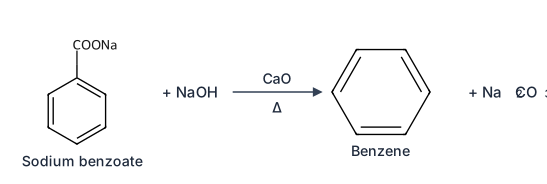
Equation 9.70 — laboratory preparation of benzene by decarboxylation: sodium benzoate heated with sodalime (/) loses its carboxylate carbon as , leaving benzene. The aromatic ring survives untouched; only …
Step-by-step reasoning:
- Sodium benzoate () contains the benzoate ion, .
- When heated with , the group is replaced by a hydrogen atom.
- The carboxyl carbon leaves as part of , which combines with sodium to form sodium carbonate ().
- The remaining fragment, , picks up a hydrogen from the base to become benzene ().
A common mistake is to think that the is released directly. In this reaction, the carbon dioxide is trapped as carbonate — it does not escape as a gas. The equation shows , not .
Method (iii): Reduction of Phenol
Phenol () is an aromatic alcohol. To convert it back to benzene, we need to remove the oxygen atom and replace it with hydrogen. This is done by passing phenol vapours over heated zinc dust.
The reaction is:
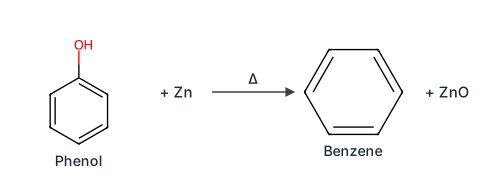
Equation 9.71 — laboratory preparation of benzene by reduction: phenol vapours passed over heated zinc dust are reduced to benzene, the zinc pulling awa …
…