Chemistry · Ch 13 — Hydrocarbons
Structure of Benzene
Structure of Benzene
The Discovery of Benzene
Benzene was first isolated by Michael Faraday in 1825. Its molecular formula, , immediately signals a problem: the molecule is highly unsaturated — compare it to the saturated alkane — yet it does not behave like a typical unsaturated hydrocarbon. It does not readily undergo addition reactions, and it shows remarkable stability. This contradiction puzzled chemists for decades.
The key experimental clues were these. First, benzene forms a triozonide, which means it must contain three double bonds. Second, benzene gives only one monosubstituted product. If you replace any one hydrogen with, say, a bromine atom, you get exactly one compound — no isomers. That tells you all six hydrogen atoms are equivalent, and therefore all six carbon atoms are equivalent too.
The Kekulé Structure
In 1865, August Kekulé proposed a structure that satisfied both clues: a cyclic arrangement of six carbon atoms with alternating single and double bonds, each carbon carrying one hydrogen atom.
This structure explains the three double bonds (hence the triozonide) and the equivalence of all six carbons and hydrogens. But it immediately creates a new problem.
The Problem of 1,2-Dibromobenzene
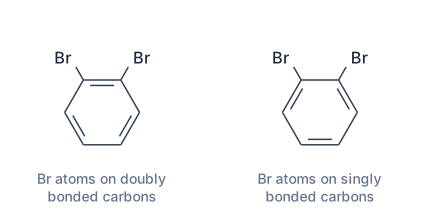
If you take the Kekulé structure and substitute two bromine atoms on adjacent carbons, you should get two different isomers. In one isomer, the bromine atoms are attached to the two carbons that are joined by a double bond. In the other, they are attached to two carbons joined by a single bond. These are structurally distinct compounds.
Drawn by us to help you understand the concept clearly, and verified to make sure it's accurate. For exams, practice from your textbook's own diagram.
The two structurally distinct 1,2-dibromobenzenes a fixed Kekulé structure predicts: in one, the bromine atoms sit on carbons joined by a double bond; in the other, on carbons joined by a single bond. Experimentally only ONE ortho isomer exists — the p …
Yet experimentally, benzene forms only one ortho-disubstituted product. There is no second isomer.
Kekulé's Solution: Oscillating Double Bonds
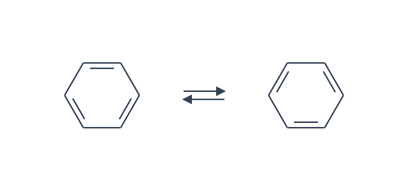
Kekulé resolved this by proposing that the double bonds in benzene are not fixed. They constantly shift positions — oscillating — between the two possible arrangements. At any instant, the molecule might look like structure A or structure B, but they interconvert so rapidly that the molecule behaves as an average of the two.
Drawn by us to help you understand the concept clearly, and verified to make sure it's accurate. For exams, practice from your textbook's own diagram.
Kekulé's own resolution of the ortho-isomer puzzle: the two ring structures with the double bonds in the two alternative positions, shown interconverting. If the double bonds oscillate rapidly between the two arrangements, the two 'different' 1,2-dibr …
The "oscillating double bond" idea was a brilliant intuition, but it is not the modern explanation. It fails to account for benzene's unusual stability and its preference for substitution reactions over addition reactions. That required the concept of resonance.
Resonance and the Modern Structure
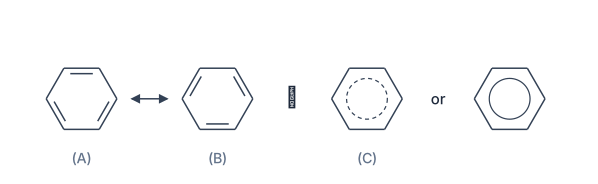
According to Valence Bond Theory, benzene is not a single structure that oscillates. Instead, it is a resonance hybrid of two equivalent contributing structures — the two Kekulé structures, A and B.
A resonance hybrid is not a mixture of structures that flips back and forth. It is a single, real molecule whose electron distribution is a weighted average of the contributing structures. The hybrid is more stable than any individual contributing structure.
The two Kekulé structures are the main contributors. The hybrid structure is conventionally represented by drawing a circle (or a dotted circle) inside the hexagon. That circle represents six electrons that are delocalised — spread out — over all six carbon atoms.
Drawn by us to help you understand the concept clearly, and verified to make sure it's accurate. For exams, practice from your textbook's own diagram.
The modern (valence bond) reading of the same drawings: structures A and B are the two Kekulé contributors, and C — the hexagon with an inscribed circle — is the resonance hybrid. The circle stands for six electrons delocalised equally over all six carbons; the real …
The circle in the hexagon is not a ring of alternating single and double bonds. It means the six electrons are shared equally among all six carbons. There are no localised double bonds.
Orbital Picture: Hybridisation
The resonance picture is powerful, but the orbital description gives a deeper understanding.
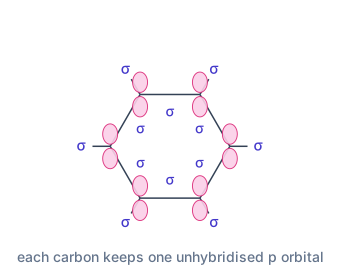
All six carbon atoms in benzene are hybridised. Each carbon uses two of its hybrid orbitals to form sigma bonds with the two adjacent carbons. These six sigma bonds lie in the plane of the ring, forming a regular hexagon. The third hybrid orbital on each carbon overlaps with the orbital of a hydrogen atom, forming six sigma bonds — also in the plane.
Drawn by us to help you understand the concept clearly, and verified to make sure it's accurate. For exams, practice from your textbook's own diagram.
The sigma framework of benzene: all six carbons are hybridised, each forming two C–C sigma bonds with its neighbours and one C–H sigma bond, all lying in one plane (a regular hexagon). The remaining unhybridised orbital on each carbon stands perpendicular to the rin …
That accounts for all the sigma bonds. What about the bonds?
Each carbon atom still has one unhybridised orbital. These orbitals are perpendicular to the plane of the ring. They are close enough to each other to overlap laterally, forming bonds.
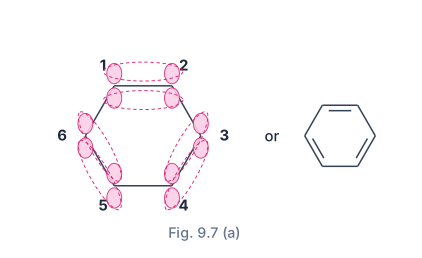
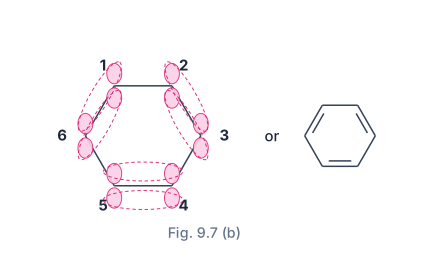
There are two equal possibilities for this overlap. The orbitals of and can overlap, and , and — that gives one Kekulé structure with localised bonds. Alternatively, the overlap could be and , and , and — that gives the other Kekulé structure.
Drawn by us to help you understand the concept clearly, and verified to make sure it's accurate. For exams, practice from your textbook's own diagram.
One of the two equally possible sets of p-orbital overlaps in benzene. Each of the six carbons keeps one unhybridised orbital perpendicular to the ring plane; in this arrangement the orbitals pair up as C1–C2, C3–C4 and C5–C6, producing three localised $ …
Drawn by us to help you understand the concept clearly, and verified to make sure it's accurate. For exams, practice from your textbook's own diagram.
The other equally possible set of p-orbital overlaps in benzene: the same six perpendicular orbitals now pair as C2–C3, C4–C5 and C6–C1. This is the second Kekulé structure. Since nothing makes either pairing preferable, nei …
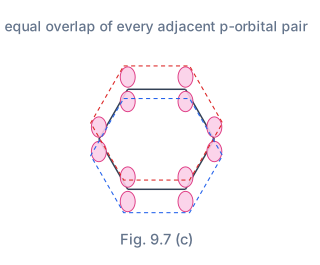
But here is the crucial point: X-ray diffraction shows that all six bond lengths in benzene are identical. There is no alternation of single and double bond lengths. This means the orbital of each carbon has an equal probability of overlapping with the orbitals of both adjacent carbons. The result is not three separate bonds, but a single, continuous electron cloud.
Drawn by us to help you understand the concept clearly, and verified to make sure it's accurate. For exams, practice from your textbook's own diagram.
Because both pairings in Figs. 9.7(a) and (b) are equally probable, each carbon's orbital in fact overlaps equally with the orbitals of BOTH its neighbours. The figure shows this continuous, equal overlap running around the whole ring — the six $\pi …
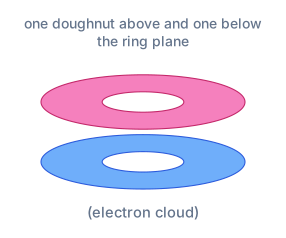
Think of it as two doughnut-shaped rings of electron density — one above the plane of the ring and one below it. The six electrons are delocalised over the entire ring, free to move about all six carbon nuclei.
Drawn by us to help you understand the concept clearly, and verified to make sure it's accurate. For exams, practice from your textbook's own diagram.
The result of complete delocalisation, drawn as an electron-cloud picture: two continuous doughnut-shaped (torus) clouds of electron density, one above and one below the plane of the ring. This is why benzene's six C–C bonds are all identical (139 pm) and why the hexagon-with …
Stability and Bond Lengths
This delocalisation has two direct consequences.
Stability. A delocalised electron cloud is attracted more strongly by the nuclei of all six carbon atoms than a localised bond is attracted by just two nuclei. This extra attraction makes benzene significantly more stable than the hypothetical molecule "cyclohexatriene" — a six-membered ring with three fixed, localised double bonds. …