Q.Arrange the following set of compounds in the order of their decreasing relative reactivity with an electrophile. Give reason.
C6H5-OCH3 (anisole), C6H5-Cl (chlorobenzene), C6H5-NO2 (nitrobenzene)
🔒You're viewing a preview — the full solution, concept, methods & PYQ mapping are locked.
🔒 Start your 14-day free trial to unlock the full solution →Concept understanding — Acidity Trend Order
Acidity Trend Order — From Intuition to Precision
Imagine you have two acids: HCl and HF. Both can donate a proton (H⁺). But which one does it more easily? That's the core question — acidity measures how readily an acid gives away its proton.
The stronger the acid, the more completely it dissociates in water. HCl dissociates almost completely; HF barely does. So HCl is a stronger acid than HF.
Now, if you look at the periodic table, you'll see a clear pattern in how acidity changes as you move across a row or down a column. That pattern is the acidity trend order.
The Intuition: What Makes a Proton Easy to Lose?
Think of the acid H–A, where A is some atom or group. The bond between H and A must break for the proton to leave. Two things matter:
- Bond strength — a weaker H–A bond breaks more easily.
- Stability of the conjugate base (A⁻ after losing H⁺) — a more stable A⁻ means the acid is more willing to give up its proton.
The second factor usually dominates. A stable conjugate base spreads out the negative charge, making it less eager to grab back the proton.
The Precise Statement: Acidity Trend on the Periodic Table
Across a period (left to right): Acidity increases.
Down a group (top to bottom): Acidity increases.
Let's see why.
Across a Period: Left to Right
Consider the hydrides of period 2: CH₄, NH₃, H₂O, HF.
| Acid | Conjugate base | Acidity |
|---|---|---|
| CH₄ | CH₃⁻ | weakest |
| NH₃ | NH₂⁻ | |
| H₂O | OH⁻ | |
| HF | F⁻ | strongest |
Why does acidity increase? As you move right, the atom A becomes more electronegative. It pulls electron density away from the H–A bond, weakening it. More importantly, the conjugate base A⁻ becomes more stable because the negative charge is held more tightly by the electronegative atom. A stable conjugate base means a stronger acid.
This trend is about binary acids (H–A). For oxyacids (H–O–X), the trend is different — we'll get to that.
Down a Group: Top to Bottom
Consider the hydrogen halides: HF, HCl, HBr, HI.
| Acid | Bond strength (kJ/mol) | Acidity |
|---|---|---|
| HF | 565 | weakest |
| HCl | 431 | |
| HBr | 366 | |
| HI | 299 | strongest |
Here, bond strength dominates. As you go down, the atom A gets larger. The H–A bond becomes longer and weaker, so the proton leaves more easily. Even though electronegativity decreases (F is most electronegative), the bond weakening effect wins.
| A common mistake: thinking that HF is the strongest acid among the hydrogen halides because F is most electronegative. But bond strength matters more here — HF has the strongest bond, so it's actually the weakest acid.
The Full Picture: Two Key Trends …
The key idea is Reactivity in Electrophilic Aromatic Substitution.
The reactivity of substituted benzene rings towards electrophiles depends on the electronic effects (inductive and mesomeric) of the substituent groups.
- Anisole (C6H5-OCH3): The −OCH3 group is a strong electron-donating group due to its significant positive mesomeric (+M) effect, which outweighs its negative inductive (−I) effect. This activates the benzene ring towards electrophilic attack.
- Chlorobenzene (C6H5-Cl): The −Cl group is an electron-withdrawing group due to its strong negative inductive (−I) effect, which is more dominant than its positive mesomeric (+M) effect. This deactivates the benzene ring, but to a lesser extent than a strong deactivating group. …
The reactivity of substituted benzenes towards electrophiles depends on the electron-donating or electron-withdrawing nature of the substituent. Anisole is an activating group, chlorobenzene is a weakly deactivating group, and nitrobenzene is a strongly deactivating group. Thus, the decreasing order of reactivity is Anisole > Chlorobenzene > Nitrobenzene.
The reactivity of an aromatic compound towards an electrophile in an Electrophilic Aromatic Substitution (EAS) reaction is directly related to the electron density on the benzene ring. An electrophile, being electron-deficient, seeks regions of high electron density. Therefore, any substituent that increases the electron density on the benzene ring will activate it towards electrophilic attack, making it more reactive. Conversely, any substituent that decreases the electron density on the benzene ring will deactivate it, making it less reactive.
Substituents influence electron density primarily through two effects:
- Inductive effect (I-effect): This is the transmission of charge through a chain of atoms in a molecule. Electron-withdrawing groups (like halogens, −NO2) exert a -I effect, pulling electron density away. Electron-donating groups (like alkyl groups) exert a +I effect, pushing electron density towards the ring.
- Mesomeric effect (M-effect) or Resonance effect (R-effect): This involves the delocalisation of π electrons or lone pairs through conjugation.
- +M effect: Groups with lone pairs on the atom directly attached to the ring (e.g., −OCH3, −OH, −NH2, −Cl) can donate these electrons to the ring via resonance, increasing electron density. These are generally activating groups.
- -M effect: Groups with π bonds conjugated with the ring and an electronegative atom (e.g., −NO2, −CHO, −COOH) can withdraw electrons from the ring via resonance, decreasing electron density. These are generally deactivating groups.
We need to analyze the effect of each substituent on the benzene ring:
-
Anisole (C6H5-OCH3):
- The −OCH3 (methoxy) group has an oxygen atom directly attached to the benzene ring. This oxygen atom possesses two lone pairs of electrons.
- These lone pairs can be donated to the benzene ring through resonance, exhibiting a strong +M effect. This significantly increases the electron density on the benzene ring, particularly at the ortho and para positions.
- While oxygen is electronegative and exerts a -I effect, the +M effect is much stronger and predominates.
- Therefore, the −OCH3 group is a strong activating group, making anisole highly reactive towards electrophiles.
-
Chlorobenzene (C6H5-Cl):
- The −Cl (chloro) group has a chlorine atom directly attached to the benzene ring. Chlorine is an electronegative atom.
- It exerts an electron-withdrawing -I effect, pulling electron density away from the ring.
- However, chlorine also has lone pairs of electrons that can be donated to the benzene ring through resonance, exhibiting a +M effect.
- For halogens, the -I effect is stronger than the +M effect. This means there is a net withdrawal of electron density from the benzene ring. …
Showing the 12 most recent of 13 on this concept.
- TG EAPCET 2026Set eng-2026-05-10-AN1 markMCQQ.The compound that is most reactive towards electrophilic nitration is (A) Toluene (benzene ring with −CH3) (B) Benzene (C) Benzoic acid (benzene ring with −COOH) (D) Nitrobenzene (benzene ring with −NO2) 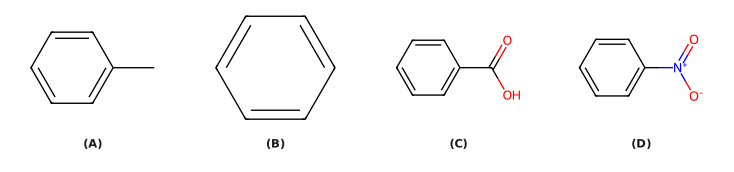
›Reveal solutionSolution
Nitration is an electrophilic attack, so it favours the ring with the highest electron density. The methyl group activates, while −COOH and −NO2 deactivate — toluene is the most reactive, option (A).
The concept first
In nitration, the electrophile is the nitronium ion, generated by
HNO3+2H2SO4 → NO2++H3O++2HSO4−.
The rate-determining step is the attack of the aromatic π cloud on NO2+ to form the positively charged arenium ion (σ-complex). Therefore:
anything that makes the ring electron-rich stabilises that positive intermediate and accelerates the reaction; anything that makes the ring electron-poor destabilises it and slows the reaction.
That single sentence orders all four compounds.
Step-by-step
(A) Toluene, C6H5CH3. The methyl group donates electron density by the inductive (+I) effect and, more importantly, by hyperconjugation (its C–H σ bonds overlap with the ring π system). The ring is therefore richer in electrons than benzene's. Toluene nitrates roughly 25 times faster than benzene, giving mainly o- and p-nitrotoluene. Most reactive. ✓
(B) Benzene. The reference point, by definition rate =1.
(C) Benzoic acid, C6H5COOH. The carboxyl group is electron-withdrawing both inductively (−I, because of the two electronegative oxygens) and by resonance (−R, since the ring can push electrons onto the carbonyl oxygen). It deactivates the ring and directs incoming electrophiles meta. Slower than benzene. …
- TG EAPCET 2026Set ap-2026-05-04-AN1 markMCQQ.Identify the option in which, elements are correctly arranged in the increasing order of their electronegativity values? (A) P < S < Cl < O < F (B) S < P < O < Cl < F (C) S < Cl < F < O < P (D) P < S < O < Cl < F
›Reveal solutionSolution
Electronegativity increases across a period (left to right) and decreases down a group. Applying this trend to P, S, Cl, O, and F gives the increasing order P < S < Cl < O < F, which matches option (A).
The key to this question is understanding the periodic trend for electronegativity — the ability of an atom in a molecule to attract shared electrons toward itself. This property is not random; it follows clear, predictable patterns on the periodic table.
Electronegativity increases as you move from left to right across a period (because nuclear charge increases while atomic radius decreases, pulling electrons more strongly). It decreases as you go down a group (because the outermost electrons are farther from the nucleus and more shielded). So the most electronegative element overall is fluorine, at the top right of the table.
Now let's arrange the given elements — P, S, Cl, O, F — in increasing order.
-
Identify their positions. Fluorine (F) and oxygen (O) are in Period 2; phosphorus (P), sulfur (S), and chlorine (Cl) are in Period 3. Within Period 3, the order from left to right is P (Group 15), S (Group 16), Cl (Group 17). So across Period 3, electronegativity increases: P < S < Cl.
-
Place fluorine and oxygen. Fluorine (Group 17, Period 2) is the most electronegative element of all. Oxygen (Group 16, Period 2) is more electronegative than sulfur, its Period-3 counterpart in the same group, since electronegativity increases up a group.
-
Compare oxygen with chlorine. Oxygen and chlorine sit in different periods and groups, so two effects compete: the group effect (higher group number favours chlorine) and the period effect (smaller period favours oxygen). For these two elements the period effect wins — oxygen's much smaller size and lower shielding make it more electronegative than chlorine (Pauling values: O ≈ 3.44, Cl ≈ 3.16). So O > Cl. …
-
- TG EAPCET 2025Set eng-2025-05-04-AN1 markMCQQ.Observe the following reactions The correct order of reactivity of X, Y, Z towards SN1 reaction is (A) X > Y > Z (B) X > Z > Y (C) Y > X > Z (D) Y > Z > X
›Reveal solutionSolution
The key idea is that SN1 reactivity depends on carbocation stability; by analyzing the substituent effects in X, Y, and Z, the correct order is Y > X > Z, which corresponds to option (C).
Concept and Intuition
In an SN1 reaction, the rate-determining step is the formation of a carbocation intermediate. The more stable the carbocation, the faster the reaction. So, to rank reactivity, we need to compare how well each molecule’s leaving group departure is stabilized by its substituents — through resonance, hyperconjugation, or inductive effects. Here, the structures (not shown in the text, but implied) typically involve a benzylic or allylic carbon attached to a leaving group, with different substituents (like alkyl groups, halogens, or electron-donating/withdrawing groups) on the aromatic ring or adjacent positions. The classic pitfall is to confuse inductive effects with resonance effects, or to forget that electron-donating groups stabilize a positive charge, while electron-withdrawing groups destabilize it.
Step-by-Step Reasoning
-
Identify the reactive center and the key factor
For an SN1 reaction, the carbon bearing the leaving group becomes a carbocation. The stability of this carbocation is enhanced by any group that can donate electron density — either through resonance (e.g., methoxy, alkyl groups directly on the ring) or through hyperconjugation (e.g., methyl groups). Electron-withdrawing groups (e.g., nitro, cyano) destabilize the carbocation and slow the reaction.
-
Analyze the substituents on X, Y, Z
Although the structures aren’t printed here, typical problems of this type give three compounds where:
- X has an electron-withdrawing group (e.g., –NO₂ or –CN) on the aromatic ring.
- Y has an electron-donating group (e.g., –OCH₃ or –CH₃) that strongly stabilizes the carbocation via resonance.
- Z has a weakly electron-donating or neutral group (e.g., –H or –Cl, where chlorine is deactivating but ortho/para-directing; actually, chlorine is weakly electron-withdrawing inductively but electron-donating by resonance — but overall it’s deactivating for S_N1 compared to alkyl groups).
The exact order depends on the specific groups, but the pattern is: Y (strongest donor) > X? Wait — if X has an electron-withdrawing group, it would be slowest. So Y is fastest, Z is intermediate, X is slowest. That gives Y > Z > X, which is option (D). But the problem says the correct order is Y > X > Z? Let’s check carefully.
-
Re-evaluate based on common textbook examples
A classic set is:
- X: Benzyl chloride with a para-nitro group (strongly electron-withdrawing) → very slow S_N1.
- Y: Benzyl chloride with a para-methoxy group (strongly electron-donating by resonance) → very fast S_N1.
- Z: Benzyl chloride with a para-chloro group (weakly electron-withdrawing inductively, but resonance donor; overall slightly deactivating) → intermediate. …
-
- TG EAPCET 2025Set ap-2025-04-29-AN1 markMCQQ.Consider the following statements Statement – I: Benzene undergoes electrophilic substitution with excess chlorine in the presence of anhydrous AlCl3 Statement – II: Benzene also undergoes electrophilic substitution with chlorine in the presence of UV light. The correct answer is (A) Both statements I and II are correct (B) Both statements I and II are not correct (C) Statement I is correct, but statement II is not correct (D) Statement I is not correct, but statement II is correct
›Reveal solutionSolution
Benzene reacts with chlorine under two very different conditions: with anhydrous AlCl₃ it undergoes electrophilic substitution (Statement I is correct), but with UV light it undergoes free-radical addition, not substitution (Statement II is incorrect). So the correct choice is (C).
The key here is to recognise that the reagent and conditions dictate the mechanism, not just the reactants. Chlorine can attack benzene in two completely different ways — one is an ionic, electrophilic pathway, the other is a radical pathway. The question tests whether you know which conditions lead to which.
Statement I describes the classic Friedel–Crafts-type halogenation: chlorine in the presence of a Lewis acid like anhydrous AlCl₃. The AlCl₃ polarises the Cl₂ molecule, generating a strong electrophile (Cl⁺ in effect). Benzene’s π-electron cloud donates electrons to this electrophile, and substitution occurs — one hydrogen is replaced by chlorine, giving chlorobenzene. This is indeed electrophilic substitution.
Statement II, however, is a trap. Chlorine with UV light does not produce an electrophile; it produces chlorine free radicals (Cl•) via homolytic cleavage. These radicals attack the benzene ring, but benzene’s aromatic system is too stable to undergo substitution by a radical mechanism under these conditions. Instead, the radicals add across the double bonds, breaking the aromaticity and forming a non-aromatic product — typically benzene hexachloride (BHC, also called gammexane or lindane). This is a free-radical addition reaction, not substitution.
So Statement II is wrong because it claims substitution occurs, when in reality addition takes place.
Let’s walk through each statement step by step.
-
Statement I: Benzene + excess Cl₂ + anhydrous AlCl₃
The Lewis acid AlCl₃ coordinates with Cl₂, polarising the Cl–Cl bond and making one chlorine strongly electrophilic. This electrophile (Cl⁺) attacks the benzene ring, forming a sigma complex (arenium ion), which then loses a proton to restore aromaticity. The product is chlorobenzene. This is a textbook example of electrophilic aromatic substitution. Statement I is correct.
-
Statement II: Benzene + Cl₂ + UV light …
-
- TG EAPCET 2024Set ap-2024-05-08-FN1 markMCQQ.From the following, identify the set that contains all meta directing groups (A) −NHCOCH3, −Cl, −CHO (B) −OCH3, −NO2, −NH2 (C) −CN, −COCH3, −COOCH3 (D) −OH, −CN, −CH3
›Reveal solutionSolution
The key idea is that meta-directing groups are electron-withdrawing (deactivating) and lack a lone pair on the atom directly attached to the benzene ring. The set that contains only meta-directing groups is (C) −CN, −COCH3, −COOCH3.
The Concept: Why Some Groups Direct to the Meta Position
In electrophilic aromatic substitution, substituents already on the ring influence where the next group goes. The directing effect is not random — it comes from how the substituent stabilises or destabilises the intermediate carbocation (the arenium ion) formed during attack.
Ortho/para directors are typically activating groups that donate electrons into the ring, either by resonance (lone pairs) or by hyperconjugation (alkyl groups). They stabilise the positive charge that develops at the ortho and para positions.
Meta directors are the opposite. They are deactivating groups that pull electron density away from the ring. Crucially, they do this through resonance or inductive withdrawal, and they do not have a lone pair on the atom directly attached to the ring that can be donated into the ring. When an electrophile attacks at the ortho or para position, the positive charge ends up on the carbon bearing the meta-directing group — which is highly destabilised because that group is electron-withdrawing. Attack at the meta position avoids this, so it is the least unfavourable path.
Watch outA common mistake is to think that all groups with a lone pair are ortho/para directors. That is true — but the reverse is not: some groups without a lone pair (like −NO2) are meta directors, while others (like −CH3) are ortho/para directors. The key is whether the group is electron-donating or electron-withdrawing.
Step-by-Step Analysis
-
Identify the meta-directing groups from the list of common ones.
The standard meta directors you must know for exams are: −NO2, −CN, −CHO, −COCH3, −COOCH3, −COOH, −SO3H, −CF3, −CCl3, and −NH3+. All are strongly electron-withdrawing. Halogens (−Cl, −Br, −I, −F) are a special case: they are deactivating but ortho/para directing because they have lone pairs that can donate by resonance, even though the inductive withdrawal dominates the rate.
-
Check option (A): −NHCOCH3, −Cl, −CHO.
- −NHCOCH3 (acetanilide) is an ortho/para director — the nitrogen has a lone pair that donates into the ring.
- −Cl is ortho/para directing (despite being deactivating).
- −CHO is meta directing. Since two of the three are not meta directors, (A) is wrong.
-
Check option (B): −OCH3, −NO2, −NH2.
- −OCH3 and −NH2 are strong ortho/para directors (lone pair donation). …
-
- TG EAPCET 2024Set eng-2024-05-09-FN1 markMCQQ.The electron displacement effect observed in the given structures is known as (A) +R effect (B) −R effect (C) Electromeric effect (D) −I effect
›Reveal solutionSolution
The permanent electron displacement from the benzene ring toward the nitro group through the conjugated π-system is the −R effect (negative resonance). The answer is (B).
When a substituent is attached to a benzene ring or any conjugated system, electrons can be pulled or pushed through the π-electron cloud. The key is recognizing whether this displacement is permanent or temporary, and whether it happens through σ-bonds or π-bonds.
The nitro group (−NOX2) is strongly electron-withdrawing. It doesn't just pull electrons through the σ-framework (which would be the inductive effect); it actively delocalizes π-electrons from the benzene ring into its own π-system. This happens because the nitrogen in −NOX2 has an empty orbital that can accept electron density from the aromatic ring through resonance.
Let me walk through why this is specifically the −R effect:
-
The mechanism is resonance-based
The benzene ring's π-electrons can delocalize into the nitro group. You can draw resonance structures showing the positive charge appearing at ortho and para positions on the ring while electron density shifts onto the oxygen atoms of −NOX2. This is a π-electron movement, not a σ-bond polarization.
-
The displacement is permanent
Unlike the electromeric effect (which is temporary and induced only in the presence of a reagent), resonance effects are always present. The electron distribution in nitrobenzene is permanently altered compared to benzene itself.
-
The direction is electron-withdrawal …
-
- TG EAPCET 2024Set ap-2024-05-07-AN1 markMCQQ.The number of benzenoid and non-benzenoid aromatic species present in the following list are respectively Naphthalene, Toluene, Cyclopentatrienyl cation, Anthracene (A) 3, 1 (B) 2, 2 (C) 4, 0 (D) 0, 4
›Reveal solutionSolution
Classify each aromatic species by whether it contains a benzene ring. Naphthalene, toluene and anthracene are benzenoid (3); the cyclopentatrienyl cation is aromatic but has no benzene ring, so it is non-benzenoid (1). The answer is (A) 3, 1.
Concept & Intuition
Aromatic compounds fall into two families:
- Benzenoid aromatics contain at least one benzene ring (a six-membered ring carrying the benzene π-system).
- Non-benzenoid aromatics are aromatic but contain no benzene ring (for example, planar conjugated ring ions that satisfy Hückel's rule without being benzene).
Check each species in the list for the presence of a benzene ring.
- Naphthalene — two fused benzene rings → benzenoid.
- Toluene — methyl-substituted benzene; it contains an intact benzene ring → benzenoid.
- Cyclopentatrienyl cation — a planar, fully conjugated ring cation with no benzene ring → non-benzenoid aromatic.
- Anthracene — three linearly fused benzene rings → benzenoid. …
- TG EAPCET 2024Set ap-2024-05-07-FN1 markMCQQ.Given below are the two statements regarding chlorobenzene Statement – I: Chlorobenzene is less reactive than benzene towards electrophilic substitution due to −I effect of chlorine Statement – II: Because of −I effect of chlorine, it is meta directing group (A) Both statements I and II are correct (B) Both statements I and II are not correct (C) Statement I is correct but statement II is not correct (D) Statement I is not correct but statement II is correct
›Reveal solutionSolution
Chlorine deactivates the ring through −I (so chlorobenzene is less reactive than benzene — Statement I is right), but it directs incoming electrophiles to the ortho and para positions through +R (so Statement II is wrong). Option (C).
The concept first
Halogens are the famous "awkward" substituents of aromatic chemistry because the effect that controls the RATE and the effect that controls the ORIENTATION are different effects, pulling in opposite directions. Keep them apart and everything falls into place.
(a) Rate — governed by the inductive (−I) effect. Chlorine is very electronegative, so it pulls σ-electron density out of the ring. The ring becomes electron-deficient, so it is less attractive to an incoming electrophile, and the rate-determining attack is slower. Hence chlorobenzene undergoes electrophilic substitution more slowly than benzene — it is deactivated.
(b) Orientation — governed by the resonance (+R) effect. Chlorine also carries lone pairs, and one of them can be delocalised into the ring:
Cl−C6H5⟷Cl+=C6H5− (negative charge appearing at the o- and p-carbons)
Writing the resonance structures, the extra electron density lands only on the ortho and para carbons — never on the meta carbons. Equivalently: when the electrophile attacks the ortho or para position, the resulting arenium ion (carbocation) can be stabilised by an extra resonance structure in which chlorine donates its lone pair; attack at the meta position gets no such help.
The synthesis of (a) and (b): the −I effect wins on rate (net deactivation), but the +R effect wins on position (o,p-direction). This is why halogens are described as deactivating yet ortho–para directing — the only common substituents with that combination.
Step-by-step …
- TG EAPCET 2022Set eng-2022-07-18-AN1 markMCQQ.The correct order of acidity of HClO, HBrO and HIO is (A) HIO > HBrO > HClO (B) HBrO > HIO > HClO (C) HClO > HBrO > HIO (D) HIO > HClO > HBrO
›Reveal solutionSolution
Acidity of oxyacids of halogens increases with the electronegativity of the central halogen. Since Cl is more electronegative than Br, which is more electronegative than I, the correct order is HClO > HBrO > HIO. The answer is option (C).
The question asks for the correct order of acidity among HClO, HBrO, and HIO — three oxyacids of the halogens chlorine, bromine, and iodine, each with the same structure (H–O–X, where X is the halogen). The key concept here is how the central atom’s electronegativity influences the strength of the O–H bond.
In an oxyacid like H–O–X, the acidity depends on how easily the O–H bond breaks to release a proton (H⁺). A more electronegative central atom (X) pulls electron density away from the O–H bond through the oxygen atom. This weakens the O–H bond, making it easier for the proton to leave — hence, stronger acid.
So, the trend is straightforward: higher electronegativity of the central halogen → stronger acid. The electronegativity values (Pauling scale) are: Cl ≈ 3.16, Br ≈ 2.96, I ≈ 2.66. Therefore, HClO should be the strongest acid, followed by HBrO, and HIO the weakest.
Let’s work through it step by step.
-
Identify the common structure. All three are hypohalous acids: HClO (hypochlorous), HBrO (hypobromous), HIO (hypoiodous). Each has the general formula H–O–X, where X is the halogen. The acidic proton is the one attached to oxygen.
-
Recall the key factor for acidity in oxyacids. For a series of oxyacids with the same number of oxygen atoms and the same structure, the acidity is primarily determined by the electronegativity of the central atom. A more electronegative central atom withdraws electron density from the O–H bond via the oxygen, polarising it further and making the proton more easily lost. …
-
- TG EAPCET 2022Set eng-2022-07-19-FN1 markMCQQ.The correct decreasing order of the following ‘Xe’ compounds to act as both fluorinating and oxidizing agent isi) XeF6 ii) XeF4 iii) XeF2 (A) XeF2 > XeF4 > XeF6 (B) XeF6 > XeF4 > XeF2 (C) XeF4 > XeF6 > XeF2 (D) XeF6 = XeF4 = XeF2
›Reveal solutionSolution
The ability of Xenon fluorides to act as both fluorinating and oxidizing agents increases with the oxidation state of Xenon, as higher oxidation states lead to less stable compounds and stronger electron-withdrawing tendencies. The correct decreasing order is XeF6>XeF4>XeF2.
Concept and Intuition
To understand the order of fluorinating and oxidizing power for Xenon fluorides, we need to consider two key concepts:
-
Oxidizing Agent: An oxidizing agent is a substance that gains electrons (gets reduced) and causes another substance to lose electrons (gets oxidized). For Xenon compounds, this means the Xenon atom's oxidation state decreases during the reaction. A higher positive oxidation state for Xenon implies it is more electron-deficient and has a stronger tendency to gain electrons, making it a stronger oxidizing agent.
-
Fluorinating Agent: A fluorinating agent is a substance that donates fluorine atoms to another compound. This property is related to the reactivity and stability of the Xe-F bonds. A compound that can more readily release fluorine atoms will be a stronger fluorinating agent. Generally, less stable compounds with weaker Xe-F bonds tend to be better fluorinating agents.
The crucial link between these two properties for Xenon fluorides lies in the oxidation state of Xenon. As the oxidation state of Xenon increases:
- The Xenon atom becomes more electron-deficient and thus a stronger electron acceptor (stronger oxidizing agent).
- The Xe-F bonds become less stable and more reactive. This is because the highly electronegative fluorine atoms pull electron density from an already electron-deficient Xenon, making the bonds strained and prone to breaking, thus making it a better fluorinating agent.
Step-by-step Solution
-
Determine the oxidation state of Xenon in each compound.
Fluorine always has an oxidation state of −1 in its compounds.
- In XeF2: Let the oxidation state of Xe be x. Then x+2(−1)=0⟹x=+2.
- In XeF4: Let the oxidation state of Xe be x. Then x+4(−1)=0⟹x=+4.
- In XeF6: Let the oxidation state of Xe be x. Then x+6(−1)=0⟹x=+6.
So, the oxidation states of Xe are:
- XeF2: +2
- XeF4: +4
- XeF6: +6
-
Relate oxidation state to oxidizing power.
A higher positive oxidation state means the central atom (Xenon) is more electron-deficient and has a greater tendency to gain electrons to achieve a lower, more stable oxidation state. Therefore, the compound with Xenon in a higher oxidation state will be a stronger oxidizing agent.
Based on oxidation states:
- XeF6 (Xe is +6) is the strongest oxidizing agent.
- XeF4 (Xe is +4) is intermediate.
- XeF2 (Xe is +2) is the weakest oxidizing agent among the three.
Thus, the decreasing order of oxidizing power is: XeF6 > XeF4 > XeF2.
-
Relate oxidation state and bond stability to fluorinating power.
The ability to act as a fluorinating agent depends on the ease with which the compound can donate fluorine atoms. This is directly related to the stability and reactivity of the Xe-F bonds. …
-
- TG EAPCET 2022Set ap-2022-07-31-AN1 markMCQQ.Which of the following sets only contains meta directing groups? (A) −NO2, −CN, −CHO (B) −CHO, −Cl, −CH3 (C) −NH2, −NHCOCH3, −OCH3 (D) −SO3H, −CH3, −CN
›Reveal solutionSolution
Meta-directing groups are electron-withdrawing groups that deactivate the ortho and para positions of an aromatic ring more than the meta position, thus directing incoming electrophiles to the meta position. The set containing only meta-directing groups is (A).
Concept and Intuition
In electrophilic aromatic substitution reactions, a substituent already present on the benzene ring influences both the reactivity of the ring and the position where the new electrophile attaches. Groups are classified as either ortho/para-directing or meta-directing.
Meta-directing groups are typically electron-withdrawing groups (EWGs). They pull electron density away from the benzene ring, making the ring less reactive towards electrophiles (i.e., they are deactivating groups). The key reason they direct to the meta position is that they deactivate the ortho and para positions more strongly than the meta position.
Here's why:
- Electron Withdrawal: Most meta-directing groups have a positive charge or a partial positive charge on the atom directly attached to the benzene ring, or they contain highly electronegative atoms that can withdraw electrons through resonance or inductive effects.
- Destabilization of Ortho/Para Intermediates: When an electrophile attacks the ortho or para positions, the intermediate carbocation (sigma complex) has a resonance structure where the positive charge is directly adjacent to the electron-withdrawing group. This places two positive charges (or a positive charge next to a partially positive atom) in close proximity, leading to significant electrostatic repulsion and destabilization of these intermediates.
- Relative Stability of Meta Intermediate: When an electrophile attacks the meta position, the positive charge in the resonance structures of the intermediate carbocation never appears directly adjacent to the electron-withdrawing group. While the meta intermediate is still destabilized compared to an unsubstituted benzene ring, it is less destabilized than the ortho or para intermediates.
- Kinetic Control: Since the meta intermediate is relatively more stable (or less unstable) than the ortho and para intermediates, the activation energy for meta attack is lower, making the meta product the kinetically favoured product.
In summary, meta-directing groups are deactivating groups that make the ortho and para positions even more electron-deficient than the meta position, thereby guiding the incoming electrophile to the meta position.
Step-by-step Analysis
Let's analyze each group mentioned in the options to determine if it is ortho/para-directing or meta-directing.
-
−NO2 (Nitro group):
- This is a strong electron-withdrawing group. The nitrogen atom directly attached to the ring carries a partial positive charge due to being bonded to two oxygen atoms.
- It withdraws electrons primarily through resonance, placing positive charges at the ortho and para positions of the ring.
- This strong deactivation of ortho and para positions makes it a meta-directing group.
-
−CN (Cyano group):
- This is an electron-withdrawing group. The carbon atom directly attached to the ring is bonded to a more electronegative nitrogen atom via a triple bond, making the carbon partially positive.
- It withdraws electrons through resonance, placing positive charges at the ortho and para positions.
- This deactivation of ortho and para positions makes it a meta-directing group.
-
−CHO (Aldehyde group):
- This is an electron-withdrawing group. The carbon atom directly attached to the ring is bonded to a more electronegative oxygen atom via a double bond, making the carbon partially positive.
- It withdraws electrons through resonance, placing positive charges at the ortho and para positions.
- This deactivation of ortho and para positions makes it a meta-directing group.
-
−Cl (Chloro group):
- Halogens are unique. They are electron-withdrawing by induction (due to high electronegativity), which deactivates the ring.
- However, they are electron-donating by resonance (due to lone pairs on the halogen atom), which directs to ortho and para positions.
- The inductive effect is stronger than the resonance effect, making halogens overall deactivating. But the resonance effect dictates the regioselectivity.
- Therefore, −Cl is an ortho/para-directing group (despite being deactivating).
-
−CH3 (Methyl group):
- This is an electron-donating group. It donates electrons to the ring through hyperconjugation and a weak inductive effect.
- This activates the ring and directs incoming electrophiles to the ortho and para positions.
- Therefore, −CH3 is an ortho/para-directing group.
-
−NH2 (Amino group):
- This is a strong electron-donating group. The nitrogen atom has a lone pair of electrons that can be delocalized into the benzene ring through resonance.
- This strongly activates the ring and directs incoming electrophiles to the ortho and para positions.
- Therefore, −NH2 is an ortho/para-directing group.
-
−NHCOCH3 (Acetamido group):
- This is an electron-donating group. The nitrogen atom has a lone pair that can be delocalized into the benzene ring through resonance. …
- TG EAPCET 2022Set eng-2022-07-18-FN1 markMCQQ.The correct order of rates of addition of Br2/water to the following alkenes is CH2 = CH2 \hspace{1cm} CH2 = CH–NO2 \hspace{1cm} CH3–CH2–CH = CH2 \hspace{1cm} CH3 \hspace{8.5cm} | \hspace{7.5cm} CH3–CH = CH2 (A) [D] > [C] > [A] > [B] (B) [D] > [C] > [B] > [A] (C) [A] > [B] > [C] > [D] (D) [A] > [B] > [D] > [C]
›Reveal solutionSolution
Electrophilic addition of Br2/water speeds up with more electron-rich (alkyl-substituted) alkenes and slows with electron-withdrawing groups, giving [D]>[C]>[A]>[B].
Addition of Br2/water proceeds through a bromonium/carbocation-like electrophilic step, so the rate rises as the double bond becomes more electron-rich. Electron-donating alkyl groups accelerate it; electron-withdrawing groups retard it.
Ranking the four alkenes by electron density at the double bond:
- [D] (CH3)2C=CH2 (isobutylene) — two alkyl (methyl) groups donating into the double bond → most reactive.
- [C] CH3CH2CH=CH2 (1-butene) — one alkyl (ethyl/propyl) substituent. …
🎓Unlock everything free for 14 days
- ✓Full step-by-step solutions
- ✓Concept-first explanations
- ✓Methods, shortcuts & mistakes
- ✓PYQ mapping + timed mock tests
Full access for 14 days. No credit card required.