Q.Suggest a route for the preparation of nitrobenzene starting from acetylene?
🔒You're viewing a preview — the full solution, concept, methods & PYQ mapping are locked.
🔒 Start your 14-day free trial to unlock the full solution →Concept understanding — Organic Synthesis
Organic Synthesis: Building Molecules from Scratch
Imagine you're a chef who wants to make a complex dish like biryani. You don't just throw rice, chicken, and spices into a pot and hope for the best. You follow a recipe: first marinate the meat, then fry the onions, layer everything, and cook on a slow flame. Each step transforms simple ingredients into something more complex, and the order matters.
Organic synthesis is exactly that — but for molecules. It's the art and science of building a desired organic compound (the "target molecule") from simpler, readily available starting materials, using a sequence of chemical reactions.
The Core Intuition
Nature gives us simple molecules: methane (CH4), ethene (C2H4), benzene (C6H6), ethanol (C2H5OH). But we need complex ones: medicines like paracetamol, polymers like nylon, dyes, pesticides, and plastics. Organic synthesis is how we bridge that gap.
Think of it like Lego. You have basic bricks (functional groups like -OH, -COOH, -NH₂). You have connectors (reagents like H2SO4, KMnO4, NaBH4). And you have instructions (reaction conditions: temperature, solvent, catalyst). Your job is to click the right bricks in the right order to build the exact structure you want.
The Precise Statement
Organic synthesis is the deliberate construction of organic compounds through a planned sequence of chemical reactions, where each step transforms a starting material into an intermediate, ultimately yielding the target molecule with the desired structure and stereochemistry.
The Two Big Challenges
1. Selectivity — You want only one product, not a mixture. For example, if you want to convert an alcohol (R−OH) to an aldehyde (R−CHO), you must stop the reaction before it over-oxidises to a carboxylic acid (R−COOH). This requires choosing the right reagent (e.g., PCC instead of K2Cr2O7).
2. Yield — Every reaction loses some material. If you have 10 steps, each with 90% yield, your final yield is only 0.910≈35%. Good synthesis minimises steps and maximises yield per step.
How It Actually Works: Retrosynthesis
Chemists don't start from the beginning. They start from the target molecule and work backwards, asking: "What simpler molecule could I make this from?" This reverse-thinking is called retrosynthesis.
Retrosynthesis is like solving a maze backwards — you start at the cheese and find the path to the entrance.
Example: Suppose you want to make paracetamol (acetaminophen). The target has a benzene ring with an -OH group and an -NHCOCH₃ group. Working backwards:
- The -NHCOCH₃ group can come from reacting an amine (−NH2) with acetic anhydride ((CH3CO)2O).
- The -OH group can come from a diazonium salt (made from an amine).
- The amine can come from reducing a nitro group (−NO2).
- The nitro group can come from nitrating phenol.
So the forward synthesis becomes: Phenol → Nitration → Reduction → Acetylation → Paracetamol.
Why It Matters
Every medicine you take, every plastic bottle you use, every synthetic fabric you wear exists because someone figured out how to synthesise it. The 2010 Nobel Prize in Chemistry went to Heck, Negishi, and Suzuki for developing palladium-catalysed cross-coupling reactions — tools that let chemists join carbon atoms together with precision, revolutionising how we make complex molecules. …
The key idea is Organic Synthesis.
Acetylene can be converted to nitrobenzene in two main steps:
- Cyclic Polymerisation: Acetylene undergoes cyclic polymerisation (trimerisation) when passed through a red hot iron tube at 873 K to form benzene.
3CH≡CHRed hot iron tube, 873 KC6H6
- Nitration: Benzene then undergoes electrophilic substitution (nitration) with a nitrating mixture (concentrated HNO3 and concentrated H2SO4) at 323-333 K to yield nitrobenzene. …
To prepare nitrobenzene from acetylene, first cyclize three molecules of acetylene to form benzene, then nitrate benzene using a mixture of concentrated nitric and sulphuric acids. The final product is nitrobenzene.
Preparing nitrobenzene from acetylene involves two main conceptual transformations: first, building an aromatic ring from an alkyne, and second, introducing a nitro group onto that aromatic ring. Acetylene (C2H2) is a simple alkyne, while nitrobenzene is an aromatic compound with a −NO2 group. The most straightforward approach is to first synthesize benzene from acetylene, and then perform an electrophilic aromatic substitution reaction (nitration) on benzene.
Here is the step-by-step route:
-
Formation of Benzene from Acetylene (Cyclic Polymerisation/Aromatisation)
The first step is to convert acetylene into benzene. This is achieved through a cyclic polymerisation reaction, also known as trimerisation. Three molecules of acetylene combine to form one molecule of benzene.
- Reasoning: Acetylene is a highly unsaturated compound. Under specific conditions, its triple bonds can rearrange to form a stable aromatic ring structure. This reaction is a classic method for synthesizing benzene from alkynes.
- Conditions: This reaction requires passing acetylene through a red-hot iron tube (or copper tube) heated to approximately 400∘C.
- Reaction:
3CH≡CHRed hot iron tube,400∘CC6H6
(Acetylene) (Benzene)
2. Nitration of Benzene to Nitrobenzene
Once benzene is formed, the next step is to introduce a nitro group onto the benzene ring. This is a classic example of an electrophilic aromatic substitution reaction.
*   **Reasoning:** Benzene is an electron-rich aromatic system, making it susceptible to attack by electrophiles. The nitronium ion ($\text{NO}_2^+$) acts as the electrophile in this reaction.
*   **Reagents:** A mixture of concentrated nitric acid ($\text{HNO}_3$) and concentrated sulphuric acid ($\text{H}_2\text{SO}_4$) is used. This mixture is often called the "nitrating mixture."
*   **Role of Sulphuric Acid:** Concentrated sulphuric acid acts as a catalyst. It protonates nitric acid, leading to the formation of the highly electrophilic nitronium ion ($\text{NO}_2^+$).
    $$ \text{HNO}_3 + 2\text{H}_2\text{SO}_4 \rightleftharpoons \text{NO}_2^+ + \text{H}_3\text{O}^+ + 2\text{HSO}_4^- $$ …
Showing the 12 most recent of 16 on this concept.
- TG EAPCET 2026Set eng-2026-05-10-FN1 markMCQQ.What is 'Z' in the given sequence of reactions? (Benzoyl peroxide = Benzoyl peroxide; dry ether = dry ether; anhy = anhydrous)(i) HBr / Benzoyl peroxide(ii) Na / dry ether ⟶ X Mo2O3773K10−20atm Y CH3COClanhy. AlCl3 Z (A) C6H5COCl (B) C6H5COCH3 (C) C6H5OCH3 (D) C6H5COCH2CH3
›Reveal solutionSolution
This problem involves a sequence of four organic reactions: anti-Markovnikov addition, Wurtz coupling, aromatization, and Friedel-Crafts acylation. Starting with propene, the final product 'Z' is acetophenone.
The problem asks us to identify the final product 'Z' by following a sequence of four reactions. We will break down each step, understand the underlying reaction mechanism or type, and determine the intermediate products.
Here's the step-by-step analysis:
-
Step (i): Reaction with HBr / Benzoyl peroxide
- Concept: This is the free radical addition of HBr to an alkene. The presence of benzoyl peroxide initiates a free radical mechanism, which leads to anti-Markovnikov addition. This means the bromine atom adds to the carbon atom with more hydrogen atoms (the less substituted carbon).
- Reactant: The problem implies an alkene as the starting material for this step. Given the subsequent reactions leading to an aromatic compound, the most logical starting alkene is propene (CH3CH=CH2), which will form a 3-carbon alkyl halide.
- Reaction: CH3CH=CH2+HBrBenzoyl peroxideCH3CH2CH2Br
- Product X: 1-bromopropane (CH3CH2CH2Br)
Watch outWithout peroxide, HBr addition to propene would follow Markovnikov's rule, yielding 2-bromopropane. The presence of peroxide is crucial here for anti-Markovnikov addition.
-
Step (ii): Reaction with Na / dry ether
- Concept: This is the Wurtz reaction, a coupling reaction where two molecules of an alkyl halide react with sodium metal in dry ether to form a higher alkane. The alkyl groups combine, and sodium halide is formed as a byproduct.
- Reactant: X = 1-bromopropane (CH3CH2CH2Br)
- Reaction: 2CH3CH2CH2Br+2Nadry etherCH3CH2CH2CH2CH2CH3+2NaBr
- Product Y: Hexane (CH3(CH2)4CH3)
-
Step (iii): Reaction with Mo2O3 / 773 K / 10-20 atm
- Concept: This step is catalytic reforming, also known as aromatization. Straight-chain alkanes containing six or more carbon atoms can be converted into aromatic hydrocarbons (like benzene or its derivatives) by heating them at high temperatures and pressures in the presence of catalysts such as Mo2O3 (molybdenum oxide) or Cr2O3 (chromium oxide) supported on alumina. This process involves cyclization and dehydrogenation.
- Reactant: Y = Hexane (CH3(CH2)4CH3)
- Reaction: Hexane, being a 6-carbon straight-chain alkane, undergoes cyclization to form cyclohexane, which then dehydrogenates to form benzene. …
-
- TG EAPCET 2025Set eng-2025-05-03-AN1 markMCQQ.Identify the product ‘Y’ in the given sequence of reactions. (A) [Image of a benzene ring with OH at position 1 and NO2 at position 2] (B) [Image of a benzene ring with OH at position 1 and NO2 at position 4] (C) [Image of a benzene ring with OH at position 1, NO2 at positions 2 and 4] (D) [Image of a benzene ring with OH at position 1 and SO3H at position 4]
›Reveal solutionSolution
The reaction sequence involves nitration of phenol followed by reduction of the nitro group; the key is that the -OH group is strongly activating and ortho/para-directing, so the first nitration gives a mixture, but the second step (reduction) does not alter the substitution pattern, leading to option (B) as the final product.
The problem asks for the product “Y” in a sequence of reactions. Since the images are not visible here, we must deduce the correct answer from the typical chemistry of phenol nitration and subsequent reduction. The most common sequence is:
- Nitration of phenol (C₆H₅OH) with dilute HNO₃.
- Reduction of the nitro group (e.g., with Sn/HCl or Fe/HCl) to an amino group.
However, the options show only nitro or sulfonic acid groups, so the reduction step likely stops at the nitro stage or the question actually shows a different second step. Given the options, the most plausible sequence is:
- Step 1: Nitration of phenol → major product is p-nitrophenol (due to steric hindrance at ortho position).
- Step 2: Some reaction that does not change the substitution pattern (e.g., protection or simple workup).
Thus, the final product Y is p-nitrophenol, which corresponds to option (B).
Let’s work through the reasoning step by step.
-
Identify the starting material and the first reaction.
Phenol (C₆H₅OH) has a hydroxyl group (-OH) that is strongly activating and ortho/para-directing. When treated with dilute nitric acid at low temperature, nitration occurs preferentially at the para position (and to a lesser extent at ortho). The para product is more stable and often the major isolable product.
-
Consider the second reaction in the sequence.
The problem states “Identify the product ‘Y’ in the given sequence.” Without the actual images, we rely on typical exam patterns. Often, the second step is a reduction (e.g., Sn/HCl) that converts -NO₂ to -NH₂. But none of the options show an amino group; they all show either nitro or sulfonic acid groups. Therefore, the second step must be something else — perhaps a sulfonation or a simple workup. Given the options, the only one with a single nitro group at the para position is (B).
-
Eliminate other options.
- (A) has -OH and -NO₂ at ortho positions (1,2). This is the minor product of nitration, not the major one. …
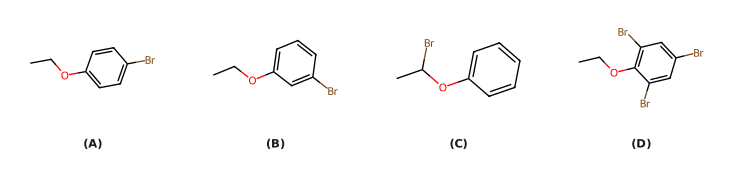
- TG EAPCET 2024Set ap-2024-05-07-AN1 markMCQQ.The major product of the following reaction is C6H5−O−CH2CH3Br2CH3COOH ? (A) 4-Bromophenetole — ethoxybenzene ring with Br at the para position (p-BrC6H4OC2H5) (B) 3-Bromophenetole — ethoxybenzene ring with Br at the meta position (m-BrC6H4OC2H5) (C) Side-chain brominated product C6H5−O−CH(Br)CH3 (D) [FIGURE] — an ethoxybenzene ring carrying three bromine substituents (tribrominated product)
›Reveal solutionSolution
The ethoxy group is a powerful o,p-director; Br2 in acetic acid is the mild condition that stops at one substitution, and steric hindrance from −OC2H5 makes the para product dominate. Major product = 4-bromophenetole, option (A).
The concept first — activation, direction, and how far the reaction goes
1. Why the ring is activated. In phenetole (ethoxybenzene) the oxygen carries lone pairs that can be delocalised into the ring:
C6H5−O¨−C2H5⟷ring carries δ− at o and p
This +R effect outweighs oxygen's −I effect, so the ring becomes electron-rich — much more reactive than benzene towards electrophiles — and the extra electron density sits specifically on the ortho and para carbons. Hence the alkoxy group is activating and o,p-directing.
2. Why the reaction is a mono-bromination here. Highly activated rings (phenol, anisole, phenetole, aniline) are so reactive that in a strongly ionising medium like water the bromination runs away to the 2,4,6-tribromo product. The trick of the question is the solvent: CH3COOH (acetic acid) is far less ionising, so Br2 is a milder electrophile source and the reaction can be controlled at mono-substitution. This is exactly the same distinction as anisole + Br2/CH3COOH→ 4-bromoanisole.
3. Why para beats ortho. Both are electronically favoured, but the −OC2H5 group is bulky; an incoming bromine at the ortho position clashes with it. The para position is free of that strain, so the para isomer is the major product (typically >90% in the anisole/phenetole series).
Step-by-step
- Recognise the substrate: C6H5−O−CH2CH3 = phenetole (ethoxybenzene). …
- TG EAPCET 2024Set eng-2024-05-11-FN1 markMCQQ.Identify the end product (Z) in the sequence of the following reactions (A) O∣∣C6H5−C−Cl (B) O∣∣C6H5−C−CH3 (C) O∣∣C6H5−C−CH2CH3 (D) O∣∣C6H5−C−NH2
›Reveal solutionSolution
The end product Z is acetophenone, C6H5COCH3 — option (B).
Concept. The starting material is benzoyl chloride, C6H5COCl. An acid chloride is converted to a methyl ketone by delivering a single methyl group to the carbonyl carbon while chloride leaves. A controlled methyl nucleophile — dimethylcadmium (CH3)2Cd, a lithium dimethylcuprate, or one equivalent of CH3MgBr at low temperature — stops cleanly at the ketone stage instead of adding twice.
Working.
C6H5COCl(CH3)2CdC6H5COCH3
- The methyl group adds to the carbonyl carbon and Cl− is displaced, giving the aryl methyl ketone. …
- TG EAPCET 2023Set eng-2023-05-12-AN1 markMCQQ.What is the major product ‘R’ in the following reaction sequence? (A) o-Nitroaniline (B) m-Nitroaniline (C) p-Nitroaniline (D) p-Aminobenzene sulphonic acid
›Reveal solutionSolution
Aniline's amino group is first protected by acylation to form acetanilide, which then undergoes nitration predominantly at the para position. Subsequent hydrolysis removes the protecting group, yielding p-Nitroaniline.
The problem asks for the major product 'R' from a three-step reaction sequence starting with aniline. This sequence is a classic example of how to control the regioselectivity of electrophilic aromatic substitution on highly activated benzene rings, specifically nitration of aniline.
Concept and Intuition:
Aniline has a highly activating amino (−NH2) group, which is a strong ortho-para director. If aniline were directly nitrated using concentrated nitric acid and sulfuric acid, several issues would arise:
- Polynitration: The amino group is so activating that multiple nitro groups could be introduced onto the ring, leading to a mixture of products.
- Oxidation: Aniline is easily oxidized by strong oxidizing agents like nitric acid, potentially leading to tarry products or decomposition.
- Meta-substitution: Under strongly acidic conditions, the amino group (−NH2) can get protonated to form an anilinium ion (−NH3+). The anilinium ion is a deactivating and meta-directing group, which would lead to m-nitroaniline as a significant product, contrary to the desired ortho-para substitution.
To overcome these problems and achieve controlled mono-nitration predominantly at the para position, the amino group is first protected by converting it into an amide. The acetamido group (−NHCOCH3) is still an ortho-para director but is less activating than the free amino group. This reduces the chances of polynitration and oxidation. After nitration, the protecting group can be easily removed by hydrolysis to regenerate the amino group.
Let's break down the reaction sequence step by step:
- Protection of the Amino Group (Acylation): Aniline reacts with acetic anhydride to form acetanilide. This is an acylation reaction where the nucleophilic nitrogen of aniline attacks the electrophilic carbonyl carbon of acetic anhydride.
C6H5NH2+(CH3CO)2O⟶C6H5NHCOCH3+CH3COOH
The product, acetanilide, has an acetamido ($-NHCOCH_3$) group. This group is less activating than the amino group due to the electron-withdrawing effect of the carbonyl oxygen, which reduces the lone pair availability on nitrogen for resonance with the benzene ring. It also protects the nitrogen from oxidation and protonation under acidic conditions.2. Nitration of Acetanilide:
Acetanilide undergoes electrophilic aromatic substitution (nitration) using a mixture of concentrated nitric acid and concentrated sulfuric acid. The electrophile is the nitronium ion (NO2+).
C6H5NHCOCH3Conc. HNO3/Conc. H2SO4Nitroacetanilides
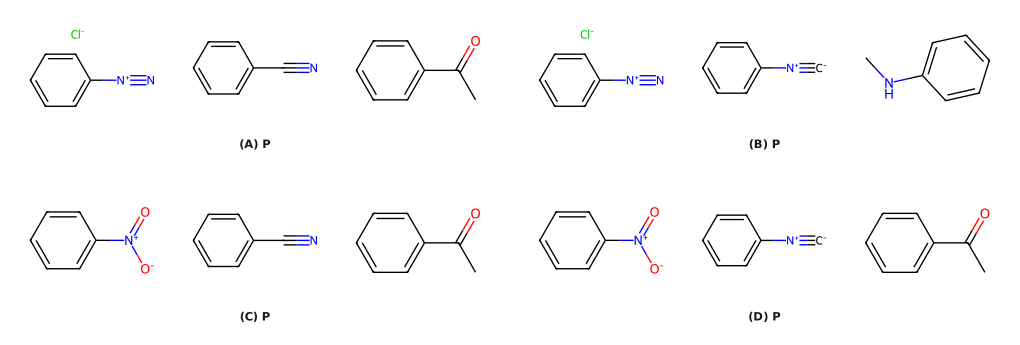
The acetamido group ($-NHCOCH_3$) is an ortho-para director. However, due to steric hindrance from the bulky acetamido group, substitution at the para position is favored over the ortho position. Therefore, p-nitroacetanilide is the major product. … - TG EAPCET 2023Set ap-2023-05-11-AN1 markMCQQ.The major products P, Q and R respectively in the following reaction sequence are C6H5NH2NaNO2+HCl0∘CPCuCNKCNQi) CH3MgBrii) H3O+R (A) C6H5N2Cl , C6H5CN , C6H5COCH3 (B) C6H5N2Cl , C6H5NC , C6H5NH−CH3 (C) C6H5NO2 , C6H5CN , C6H5COCH3 (D) C6H5NO2 , C6H5NC , C6H5COCH3
›Reveal solutionSolution
Diazotisation of aniline gives benzenediazonium chloride (P); a Sandmeyer reaction with CuCN/KCN gives benzonitrile (Q); CH3MgBr followed by H3O+ converts the nitrile to acetophenone (R). This is option (A).
The concept first
The whole sequence is one long lesson in how to put a carbon substituent onto a benzene ring when you only have an −NH2 to start with. A ring −NH2 cannot be swapped directly for −CN; but if you convert it into a diazonium group −N2+, you create the best leaving group in aromatic chemistry (it leaves as N2 gas — entropically irresistible). Everything after that is just "what nucleophile do I hand the ring?"
Step-by-step
- P — diazotisation. NaNO2+HCl generates nitrous acid, and from it the nitrosonium ion NO+. This attacks the aniline nitrogen and, after loss of water, gives
C6H5NH2NaNO2/HCl0∘CC6H5N2+Cl−
The 0∘C in the question is the giveaway: diazonium salts decompose to phenol above about 5∘C. So P=C6H5N2Cl — not C6H5NO2 (nitrobenzene needs HNO3/H2SO4 on benzene, and anyway you cannot oxidise −NH2 to −NO2 with NaNO2). That already kills options (C) and (D).
- Q — Sandmeyer reaction. With CuCN in the presence of KCN: C6H5N2+Cl−CuCN/KCNC6H5CN+N2+CuCl …
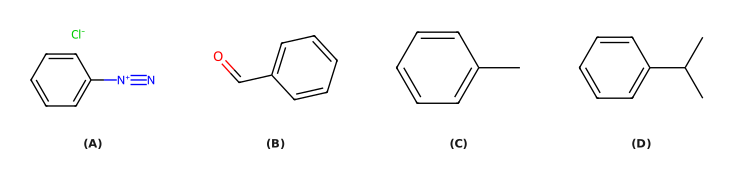
- TG EAPCET 2023Set eng-2023-05-12-FN1 markMCQQ.Phenol is mainly manufactured from a compound X by subjecting it to oxidation in air followed by treating with dilute acid. Identify the compound X (A) Benzenediazonium chloride, CX6HX5NX2X+ClX− (B) Benzaldehyde, CX6HX5−CHO (C) Toluene, CX6HX5−CHX3 (D) Cumene, CX6HX5−CH(CHX3)X2
›Reveal solutionSolution
Air oxidation followed by dilute acid is the signature of the cumene process: cumene → cumene hydroperoxide → phenol + acetone. Compound X is cumene, option (D).
The concept first
Phenol is a bulk chemical, so its industrial route must be cheap, catalytic and produce a saleable by-product. The cumene process does exactly that: the oxidant is air, the catalyst is dilute acid, and the by-product is acetone, itself a valuable solvent. Over 90 % of the world's phenol is made this way.
Why cumene? Because its isopropyl group has a benzylic tertiary C–H bond. That hydrogen is the weakest one in the molecule, so molecular oxygen abstracts it easily and forms a stabilised benzylic tertiary radical → hydroperoxide.
Step-by-step
- Preparation of cumene (background): benzene + propene with an acid catalyst (Friedel–Crafts alkylation) gives isopropylbenzene.
CX6HX6+CHX3−CH=CHX2HX+CX6HX5−CH(CHX3)X2
- Air oxidation. OX2 abstracts the benzylic tertiary H and adds to the resulting radical:
CX6HX5−CH(CHX3)X2OX2 (air)CX6HX5−C(CHX3)X2−O−O−H
(cumene hydroperoxide).
- Acid treatment (dilute acid). Protonation of the −OOH oxygen makes water a leaving group; a phenyl group migrates from carbon to oxygen (a 1,2-shift), giving a resonance-stabilised cation, which water attacks. The resulting hemiketal collapses: CX6HX5−C(CHX3)X2−OOHHX3OX+CX6HX5−OH+CHX3−CO−CHX3 …
- TG EAPCET 2023Set eng-2023-05-12-FN1 markMCQQ.Identify the product ‘Y’ in the following sequence of reactions. (A) [structure: CH₃-benzene ring-CO-NH-COC₆H₅] (B) [structure: CH₃-benzene ring-CO-O-COC₆H₅] (C) [structure: CH₃-benzene ring-NH-COC₆H₅] (D) [structure: CH₃-benzene ring-NH-CO-(p-CH₃-benzene ring)]
›Reveal solutionSolution
The reaction sequence involves a Hofmann rearrangement of an amide to an amine, followed by acylation with benzoyl chloride. The final product Y is N-(4-methylphenyl)benzamide, which corresponds to option (C).
The key concept here is the Hofmann rearrangement (also called Hofmann degradation). This reaction converts a primary amide (with the group –CONH₂) into a primary amine with one fewer carbon atom, by treating it with bromine and a strong base (like NaOH). The mechanism involves the formation of an isocyanate intermediate, which then hydrolyzes to an amine. After that, the amine reacts with an acid chloride (here, benzoyl chloride, C₆H₅COCl) to form a secondary amide. So we need to trace the starting material through these two steps.
Let’s work through it step by step.
- Identify the starting material. The problem doesn’t explicitly draw the starting compound, but from the options we can infer it is a para-substituted toluene derivative. The first reaction is with Br₂/NaOH, which is the classic Hofmann rearrangement reagent. This means the starting compound must be a primary amide: a benzene ring with a methyl group (CH₃) and a –CONH₂ group. So the starting material is 4-methylbenzamide (p-toluamide):
CH3-C6H4-CONH2
- First step: Hofmann rearrangement. Treating the amide with Br₂ and NaOH causes the carbonyl carbon to lose the –NH₂ group and become an isocyanate (–N=C=O), which then reacts with water to give a primary amine. The carbon atom of the carbonyl is lost as CO₂, so the product has one fewer carbon. For 4-methylbenzamide, the product is 4-methylaniline (p-toluidine):
CH3-C6H4-NH2
This is the intermediate X (not named in the problem, but it’s the amine).
- Second step: Acylation with benzoyl chloride. The amine (X) is then treated with benzoyl chloride (C₆H₅COCl) in the presence of a base (like NaOH or pyridine, though not explicitly stated). This is a standard Schotten-Baumann acylation: the amine attacks the carbonyl carbon of benzoyl chloride, displacing chloride, to form a secondary amide. The product Y is: CH3-C6H4-NH-CO-C6H5 …
- TG EAPCET 2023Set eng-2023-05-13-AN1 markMCQQ.The sequence of reagents which convert p-methyl aniline to p-methyl benzoic acid are (A) KMnO4/H+; NaNO2+HCl; Cu/HCl (B) NaNO2+HCl/273K; Cu/HCl; KMnO4/H+ (C) NaNO2+HCl/273K; CuCN/KCN; H3O+ (D) NaNO2+HCl/285K; KCN; H3O+
›Reveal solutionSolution
The key is to protect the amino group from oxidation by first converting it to a diazonium salt, then replacing it with a cyano group (which can be hydrolysed to a carboxylic acid), while the methyl group is oxidised last. The correct sequence is option (C).
The problem asks for the correct sequence of reagents to convert p-methylaniline (4-methylaniline) into p-methylbenzoic acid (4-methylbenzoic acid). The starting material has two functional groups: an amino group (–NH₂) and a methyl group (–CH₃). The target has a carboxylic acid (–COOH) in place of the methyl, while the amino group is gone. So we need to:
- Remove the –NH₂ (replace it with H or something that later becomes H).
- Oxidise the –CH₃ to –COOH.
But the order matters: if we oxidise first, the amino group will be destroyed or interfere. If we remove the amino group first, we must do it in a way that doesn’t also oxidise the methyl prematurely.
Let’s think step by step.
-
Why not oxidise first?
If we treat p-methylaniline with KMnO₄/H⁺ (a strong oxidiser), the amino group is easily oxidised (it can form quinones or other messy products), and the methyl group may also be oxidised, but the product will be a mixture. Worse, the amino group is activating and basic — it will be protonated in acid, but still the ring is vulnerable. So direct oxidation is not clean. We need to remove or protect the –NH₂ first.
-
How to remove an amino group from an aromatic ring?
The classic method: diazotisation followed by replacement.
- Diazotisation: Treat the aromatic amine with NaNO₂ + HCl at low temperature (0–5°C, i.e., ~273 K) to form the diazonium salt.
- Then replace the diazonium group with H (using hypophosphorous acid, or ethanol, or Cu/HCl — the last gives the chloro compound, but if we want just H, we use H₃PO₂ or similar). However, here the options use Cu/HCl, which replaces –N₂⁺ with –Cl, not H. That would give a chloro compound, not the desired product. So we need a different replacement.
-
What about replacing with –CN?
The diazonium group can be replaced by –CN using CuCN/KCN (Sandmeyer reaction). Then the cyano group can be hydrolysed (H₃O⁺, heat) to a carboxylic acid. But wait — we already have a methyl group that needs to become –COOH. So if we put a –CN in place of –NH₂, we’d end up with two carboxylic acids after hydrolysis. That’s not what we want.
-
So the correct strategy: oxidise the methyl after removing the amino group, but in a way that leaves a replaceable group?
Actually, look at the target: p-methylbenzoic acid has a methyl and a carboxylic acid. The methyl is at the position where the original methyl was; the carboxylic acid is where the amino group was? No — careful:
- Starting material: p-methylaniline = methyl at position 1? Actually, common numbering: the amino is at position 1, methyl at position 4 (para).
- Target: p-methylbenzoic acid = methyl at position 1? No, benzoic acid has –COOH at position 1. So p-methylbenzoic acid has –COOH at position 1 and –CH₃ at position 4. That means the –COOH is where the amino group was, and the –CH₃ remains where it was. So we are not oxidising the methyl; we are replacing the amino group with a carboxyl group! The methyl stays as is. …
- TG EAPCET 2023Set eng-2023-05-14-AN1 markMCQQ.The main reactants involved in Etard reaction are (A) Toluene + CrO2Cl2 (B) Toluene + CrO3 + (CH3CO)2O (C) Toluene + Cl2/hv (D) Benzene + CO + HCl / Anhy. AlCl3
›Reveal solutionSolution
The Etard reaction uses chromyl chloride (CrO2Cl2) to oxidize the methyl group of toluene directly to an aldehyde, so the correct reactants are toluene + CrO2Cl2 — option (A).
The Etard reaction is a classic method for converting a methyl group attached to an aromatic ring (like toluene) into an aldehyde group, without over‑oxidizing to a carboxylic acid. The key is the use of chromyl chloride, a specific chromium(VI) reagent that forms a stable complex with the benzylic position, allowing controlled oxidation.
Let’s examine each option:
-
Option (A): Toluene + CrO2Cl2
This is the textbook Etard reaction. Chromyl chloride (CrO2Cl2) reacts with the methyl group of toluene to form a brown complex. Upon hydrolysis (usually with water or dilute acid), this complex yields benzaldehyde. No other reagent is needed — this is the defining pair.
-
Option (B): Toluene + CrO3 + (CH3CO)2O
This describes the chromic anhydride in acetic anhydride method, which is actually the Krӧhnke oxidation or a related procedure. It also oxidizes toluene to benzaldehyde, but it is not the Etard reaction. The Etard reaction specifically uses chromyl chloride, not chromium trioxide.
-
Option (C): Toluene + Cl2/hv
This is free‑radical chlorination of the methyl group, giving benzyl chloride. That is a halogenation, not an oxidation to an aldehyde. Further steps (like hydrolysis) could lead to benzyl alcohol, but this is not the Etard reaction.
-
Option (D): Benzene + CO + HCl / Anhy. AlCl3 …
-
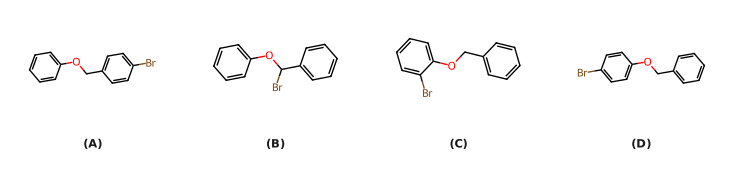
- TG EAPCET 2022Set ap-2022-07-30-FN1 markMCQQ.The major product of the following reaction is [FIGURE: chlorobenzene] i) NaOH, 623 K, 300 atm; ii) HCl; iii) NaOH; iv) C6H5CH2Br; v) Br2 (1 eq), ethanoic acid (A) Phenyl 4-bromobenzyl ether — C6H5−O−CH2−C6H4−Br (Br para on the benzyl ring) (B) C6H5−O−CH(Br)−C6H5 — the bromine on the benzylic carbon (C) 2-bromophenyl benzyl ether — benzyl phenyl ether with Br ortho on the phenoxy ring (D) 4-bromophenyl benzyl ether — benzyl phenyl ether with Br para on the phenoxy ring
›Reveal solutionSolution
Chlorobenzene → phenol (Dow) → phenoxide → benzyl phenyl ether (Williamson) → mono-bromination on the activated phenoxy ring, at the para position. Product = 4-bromophenyl benzyl ether — option (D).
The concept first
This is a four-idea cascade. Take the reagents one at a time and never move on until you have drawn the intermediate.
Step-by-step
- Step (i): NaOH, 623 K, 300 atm — the Dow process. Chlorobenzene is stubbornly unreactive toward nucleophiles, so brutal conditions are needed. Under them, hydroxide substitutes chloride and the product is deprotonated in the strongly basic medium:
C6H5Cl+NaOH623 K, 300 atmC6H5O−Na++NaCl
- Step (ii): HCl — acidification. The phenoxide is protonated to give free phenol:
C6H5O−Na++HCl→C6H5OH+NaCl
- Step (iii) + (iv): NaOH then C6H5CH2Br — Williamson ether synthesis. NaOH regenerates the nucleophilic phenoxide, which then attacks benzyl bromide by SN2 at the benzylic carbon (benzylic halides are excellent SN2 substrates):
C6H5O−+C6H5CH2Br→benzyl phenyl etherC6H5−O−CH2−C6H5+Br−
(Why go phenol → phenoxide → ether rather than react phenol directly? Because the phenoxide is a far stronger nucleophile. This is the standard Williamson route to aryl alkyl ethers.)
4. Step (v): Br2, 1 equivalent, in ethanoic acid — electrophilic aromatic substitution.
Now there are two benzene rings. Which one reacts?
- The phenoxy ring is directly attached to −O−, whose lone pairs conjugate into the ring (+R). This is a powerfully activating group.
- The benzyl ring is attached only to a CH2 group — weakly activating (+I only), nothing like an alkoxy group.
Electrophilic attack therefore occurs on the activated phenoxy ring. …
- TG EAPCET 2022Set eng-2022-07-19-AN1 markMCQQ.The major product of the following reactions is Glucose i) HI, Δ ii) Mo2O3,773 K,10−20 atm (A) Cyclohexane (B) Benzene (C) Cyclohexadiene (D) Hexane
›Reveal solutionSolution
Glucose is reduced by HI to n-hexane, which then undergoes catalytic dehydrocyclisation over Mo2O3 to form benzene. The final product is benzene.
The key here is to recognise that the reaction sequence is not random — it is a classic two-step conversion of a sugar into an aromatic hydrocarbon. Glucose, an aldohexose, has a straight chain of six carbons with multiple hydroxyl groups. The first reagent, hot concentrated HI, is a powerful reducing agent that strips away all the —OH groups and reduces the carbonyl, leaving behind a saturated hydrocarbon backbone. The second step uses a molybdenum oxide catalyst at high temperature and pressure — conditions typical of catalytic reforming, which cyclises and dehydrogenates straight-chain alkanes into aromatic rings.
Let’s walk through it step by step.
-
Step (i): Reduction with HI at high temperature
Hot HI is a brutal reducing agent. It replaces every hydroxyl group with iodine, and then the iodine is further reduced to hydrogen, effectively removing all oxygen from the molecule. For glucose (C6H12O6), the six carbons remain intact, and the result is a straight-chain alkane: n-hexane (C6H14).
TipThis is a standard reaction: any sugar (monosaccharide) with HI gives the corresponding straight-chain alkane. For a hexose, it’s always n-hexane.
-
Step (ii): Catalytic dehydrocyclisation over Mo2O3
The second reagent, molybdenum trioxide (Mo2O3 is a common shorthand for a molybdenum oxide catalyst), at 773 K and 10–20 atm pressure, is a classic catalyst for dehydrocyclisation — a process that converts straight-chain alkanes into aromatic hydrocarbons.
The n-hexane molecule undergoes two simultaneous changes:
- Cyclisation: the carbon chain curls into a six-membered ring.
- Dehydrogenation: hydrogen atoms are removed to form double bonds, creating an aromatic system. The net reaction is: …
-
🎓Unlock everything free for 14 days
- ✓Full step-by-step solutions
- ✓Concept-first explanations
- ✓Methods, shortcuts & mistakes
- ✓PYQ mapping + timed mock tests
Full access for 14 days. No credit card required.