Q.Write resonance structures of CH₂=CH–CHO. Indicate relative stability of the contributing structures.
🔒You're viewing a preview — the full solution, concept, methods & PYQ mapping are locked.
🔒 Start your 14-day free trial to unlock the full solution →Concept understanding — Resonance Structures Drawing
Resonance Structures: What They Are and How to Draw Them
Let's start with a simple question. When you draw a molecule like ozone (O3), you might put a double bond between the central oxygen and one of the end oxygens, and a single bond to the other. But experiments show both O–O bonds are identical — same length, same strength. So which drawing is correct?
Neither single drawing is correct. The real molecule is a hybrid of both possibilities. That's the core idea of resonance.
The Intuition: A Musical Analogy
Think of a chord played on a piano. A C major chord is made of three notes: C, E, G. No single note is the chord — the chord is the blend of all three. Similarly, a resonance hybrid is the blend of all valid Lewis structures (called resonance contributors or canonical forms) for a molecule. The real molecule is not flipping between these forms; it exists as a single, stable average.
Resonance structures are not in equilibrium. The molecule does not switch from one form to another. It is a single structure that is the weighted average of all contributors.
The Precise Definition
Resonance structures are two or more Lewis structures that differ only in the placement of electrons (pi bonds and lone pairs), never in the positions of atoms. The real molecule is described by a resonance hybrid — a superposition of all contributors.
Rules for Valid Resonance Structures
- Atoms never move. Only electrons (pi bonds, lone pairs, and sometimes sigma bonds in special cases) change positions.
- The total number of electrons stays the same. You are just redistributing them.
- Each structure must obey the octet rule (for second-period elements) and have valid formal charges.
- All structures must have the same net charge and the same number of unpaired electrons (if any).
How to Draw Resonance Structures: A Step-by-Step Method
Let's use the carbonate ion (CO32−) as our example.
Step 1: Draw the best Lewis structure
Start with the skeleton: carbon in the center, three oxygens around it. Count valence electrons: C has 4, each O has 6, plus 2 for the charge = 4+18+2=24 electrons. Place bonds and lone pairs to satisfy octets. You'll get one structure with a C=O double bond and two C–O single bonds, each single-bonded oxygen carrying a negative charge.
Step 2: Identify movable electrons
Look for pi bonds (double or triple bonds) and lone pairs that are adjacent to pi bonds or to atoms with an empty p orbital. In carbonate, the C=O pi bond and the lone pairs on the negatively charged oxygens are the movable parts.
Step 3: Push electrons using curved arrows
An arrow starts at the electron source (a pi bond or lone pair) and points to where the electrons go (to form a new pi bond or to become a lone pair). In carbonate:
- Take the pi bond from C=O and push it to become a lone pair on that oxygen.
- Simultaneously, take a lone pair from a negatively charged oxygen and push it to form a new C=O pi bond.
Step 4: Draw the new structure
After pushing, you get a second structure where the double bond is on a different oxygen. Repeat to get the third structure (all three oxygens take turns being double-bonded).
Always check that the total number of electrons and the net charge remain unchanged after each arrow push. A common mistake is to accidentally add or remove electrons.
Common Patterns to Recognize
| Pattern | Example | What moves |
|---|---|---|
| Allylic system | CH2=CH−CH2+ | Pi bond shifts, positive charge moves |
| Conjugated diene | CH2=CH−CH=CH2 | Pi bonds shift (less common in neutral molecules) |
| Carbonyl group | R2C=O | Lone pair from O forms pi bond, pi bond becomes lone pair |
| Benzene ring | C6H6 | Alternating double bonds shift around the ring |
The Most Common Mistake Beginners Make
Breaking sigma bonds. Remember: sigma bonds (single bonds between atoms) never break in resonance. Only pi bonds and lone pairs move. If you find yourself moving an atom or breaking a single bond, you are drawing a different molecule (a constitutional isomer), not a resonance structure. …
The key idea: resonance structures of CH₂=CH–CHO are generated by shifting π electrons across the conjugated C=C–C=O system, and their stability is ranked by covalent-bond count, octets and where the charges sit.
The textbook's three contributing structures are:
CH2=CH−CH=O(I)⟷C+H2−CH=CH−O−(II)⟷C−H2−CH=CH−O+(III)
- I is neutral: the most covalent bonds, every carbon and oxygen keeps an octet, and there is no charge separation → most stable. …
Shifting the π electrons of the conjugated C=C–C=O system of CH₂=CH–CHO gives three contributing structures: the neutral molecule (I), a charge-separated form with the negative charge on oxygen (II), and a reversed form with a positive oxygen and negative carbon (III). Stability: I > II > III, with III contributing essentially nothing.
Acrolein, CH₂=CH–CHO, has a C=C double bond conjugated with the C=O of the aldehyde group, so its real electron distribution cannot be captured by a single Lewis structure. Curved arrows shift the π electrons across the conjugated system to generate the contributing (canonical) structures; a double-headed arrow (↔) connects them.
The three contributing structures
Structure I — the neutral molecule.
CH2=CH−CH=O
No formal charges; every carbon and the oxygen has a complete octet; the maximum number of covalent bonds.
Structure II — π electrons shifted toward oxygen.
Pushing the C=C π pair toward the carbonyl and the C=O π pair onto oxygen relays electron density down the chain and gives
C+H2−CH=CH−O−
The terminal carbon carries the positive charge (an incomplete octet) and the oxygen the negative charge.
Structure III — the reversed polarisation.
C−H2−CH=CH−O+
Here the charges are exchanged: oxygen becomes positive and carbon negative.
Ranking the structures
The standard stability rules for resonance structures: more covalent bonds > complete octets > minimal charge separation > negative charge on the more electronegative atom.
- I is most stable — most covalent bonds, all octets complete, no separation of opposite charges. …
- TG EAPCET 2023Set eng-2023-05-13-FN1 markMCQQ.In the following reaction ‘C’ is an aromatic compound having substituents D&E. What are D&E?
[!FORMULA] (structure)Cr2O3773K,10−20atm(A)(i) KMnO4/OH−(ii) H3O+(B)Conc HNO3+H2SO4(C)
(A) −OH, −SO3H (B) −CHO, −NO2 (C) −COOH, −NO2 (D) −SO3H, −NO2›Reveal solutionSolution
The reaction sequence starts with toluene, which is oxidised to benzoic acid, then nitrated to give 3‑nitrobenzoic acid; the substituents D and E are –COOH and –NO₂, so the correct option is (C).
Concept & Intuition
This is a classic organic synthesis puzzle. The first step uses chromia (Cr₂O₃) at high temperature and pressure—a typical condition for the dehydrogenation of an alkylbenzene to an aromatic aldehyde or acid. But here the product (A) is then treated with alkaline KMnO₄ followed by acid, which is a strong oxidation that converts any alkyl side‑chain (or aldehyde) into a carboxylic acid. So (B) must be a benzoic acid derivative. Finally, nitration with conc. HNO₃/H₂SO₄ introduces a nitro group. The key is to identify the starting material from the given options: the final compound (C) is aromatic with two substituents D and E. Working backwards, the only combination that fits the oxidation and nitration pattern is –COOH and –NO₂.
Step‑by‑Step Reasoning
-
Identify the starting material
The first arrow shows a structure (not drawn here, but typical in such problems) being passed over Cr₂O₃ at 773 K and 10–20 atm. This is the dehydrogenation of an alkylbenzene (e.g., toluene) to benzaldehyde or benzoic acid. In fact, Cr₂O₃ at high temperature often gives the aldehyde, but the exact product (A) is not yet fully oxidised.
-
Oxidation to (B)
Step (i) KMnO₄/OH⁻ followed by (ii) H₃O⁺ is a vigorous oxidation that converts any alkyl group (–CH₃) or aldehyde (–CHO) directly to a carboxylic acid (–COOH). So (B) must be benzoic acid (or a substituted benzoic acid if the starting material already had a substituent). Since the starting material is a simple aromatic hydrocarbon (likely toluene), (B) is unsubstituted benzoic acid.
-
Nitration to (C) …
-
- TG EAPCET 2023Set eng-2023-05-13-AN1 markMCQQ.Assertion (A) : pKa of phenol is 4.19 and that of benzoic acid is 10 Reason (R) : Phenoxide ion is stabilised by non-equivalent resonance structures whereas benzoate ion by two equivalent resonance structures (A) A and R are true. R is the correct explanation of A (B) A and R are true, but R is not the correct explanation for A (C) A is true but R is false (D) A is false but R is true
›Reveal solutionSolution
The assertion is false because the pKa values are swapped (phenol ~10, benzoic acid ~4.2), but the reason about resonance stabilisation is true. So the correct choice is (D).
The key here is to understand what pKa tells us about acidity. A lower pKa means a stronger acid — the molecule more readily donates its proton. The reason given compares the stability of the conjugate bases (phenoxide vs. benzoate) via resonance. Let’s check both statements carefully.
-
Check the Assertion (A):
The problem states: pKa of phenol is 4.19 and that of benzoic acid is 10.
In reality, the pKa of phenol is about 10, and the pKa of benzoic acid is about 4.2.
So the assertion has the numbers reversed — phenol is the weaker acid, benzoic acid is the stronger one.
Therefore, Assertion (A) is false.
-
Check the Reason (R):
The reason says: Phenoxide ion is stabilised by non-equivalent resonance structures whereas benzoate ion by two equivalent resonance structures.
This is chemically correct:
- In the phenoxide ion, the negative charge can be delocalised into the ring, but the resonance structures are not all equivalent (some place the charge on carbon, which is less stable than on oxygen).
- In the benzoate ion, the two major resonance structures place the negative charge equally on the two oxygen atoms — they are equivalent, giving extra stability.
- Greater stabilisation of the conjugate base means a stronger acid. Benzoate is more stabilised than phenoxide, so benzoic acid (pKa ~4.2) is stronger than phenol (pKa ~10). …
-
- TG EAPCET 2023Set eng-2023-05-14-FN1 markMCQQ.The following molecule with the structure acts as
[!FORMULA] O2NC6H4NHCOCHCl2CH−CH−CH2OHOH
(A) Antibiotic (B) Antiseptic (C) Analgesic (D) Tranquilizer›Reveal solutionSolution
The molecule is chloramphenicol, a broad-spectrum antibiotic, so the correct answer is (A).
The key to this question is recognizing the structural features of the molecule. The given compound contains a nitrobenzene ring, a dichloroacetamide group (NHCOCHCl₂), and a chain with two hydroxyl groups and a primary alcohol. This exact arrangement is the hallmark of chloramphenicol, a well-known antibiotic.
-
Identify the functional groups: The molecule has:
- A para-nitrophenyl group (O₂N–C₆H₄–).
- An amide linkage (–NHCO–) attached to a dichloromethyl group (–CHCl₂).
- A three-carbon chain with two hydroxyl groups (–OH) and a terminal –CH₂OH.
-
Recall the known drug structure: Chloramphenicol is a natural antibiotic (originally from Streptomyces venezuelae) with the systematic name: 2,2-dichloro-N-[(1R,2R)-1,3-dihydroxy-1-(4-nitrophenyl)propan-2-yl]acetamide. Its structure matches exactly: a p-nitrophenyl ring, a dichloroacetamide, and a dihydroxypropyl side chain.
-
Eliminate other options:
- (B) Antiseptic: Antiseptics (e.g., phenol, iodine) are simpler, non-specific germicides; chloramphenicol is a specific systemic antibiotic.
- (C) Analgesic: Pain relievers like aspirin or paracetamol lack the nitro and dichloroacetamide groups.
- (D) Tranquilizer: Sedatives (e.g., diazepam) have different ring systems (benzodiazepines), not this structure. …
-
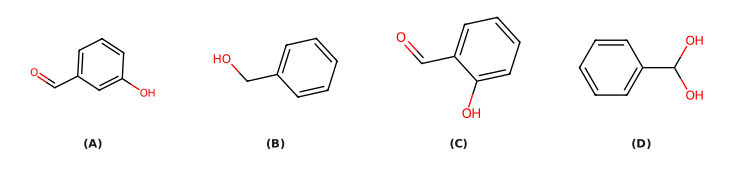
- TG EAPCET 2022Set ap-2022-07-31-AN1 markMCQQ.Identify the product, 'A' in the reaction given below C6H5CHO+Conc. NaOH⟶A+C6H5COONa (A) 3-hydroxybenzaldehyde: a benzene ring bearing −OH and −CHO in the meta positions (m-HO-C6H4-CHO) (B) Benzyl alcohol: a benzene ring bearing −CH2OH (C6H5CH2OH) (C) 2-hydroxybenzaldehyde: a benzene ring bearing −OH and −CHO in the ortho positions (o-HO-C6H4-CHO) (D) Benzaldehyde hydrate: a benzene ring attached to a carbon carrying two −OH groups and one H (C6H5-CH(OH)2)
›Reveal solutionSolution
Benzaldehyde has no α-hydrogen, so with concentrated NaOH it undergoes the Cannizzaro disproportionation: one molecule is oxidised to sodium benzoate and the other reduced to benzyl alcohol. Product 'A' is C6H5CH2OH — option (B).
The concept first
When you meet an aldehyde and a strong base, the first question is always: does it have an α-hydrogen?
- With an α-H (e.g. ethanal), the base pulls it off to make an enolate → aldol condensation.
- Without an α-H, no enolate is possible. With concentrated alkali the aldehyde has only one escape route: it oxidises one of its own molecules and reduces another. That self-oxidation–reduction is the Cannizzaro reaction.
In benzaldehyde the carbon attached to −CHO is an aromatic ring carbon carrying no hydrogen on an sp3 centre, so there is no α-hydrogen — Cannizzaro is guaranteed.
Step-by-step mechanism
Step 1 — Hydroxide attacks the carbonyl.
C6H5CHO+O−H⟶C6H5CH(O−)OH
A tetrahedral alkoxide intermediate forms.
Step 2 — Hydride transfer. This intermediate (or its doubly deprotonated dianion, which is the better hydride donor) collapses: the C−H bond breaks and the hydrogen leaves with its bonding pair as H−, attacking the carbonyl carbon of a second benzaldehyde molecule.
Step 3 — Two different fates.
- The molecule that gave away the hydride becomes benzoic acid, immediately deprotonated by the alkali to C6H5COO−Na+ — the oxidation product (printed in the question). …
- TG EAPCET 2021Set eng-2021-08-06-FN1 markMCQQ.The total number of overlapping p-orbitals present in cycloheptatrienyl cation is (A) 4 (B) 5 (C) 6 (D) 7
›Reveal solutionSolution
The cycloheptatrienyl cation is an aromatic species where all 7 carbon atoms in the ring are sp2 hybridized, each contributing a p-orbital to a continuous, delocalized π-system. Therefore, there are 7 overlapping p-orbitals.
Concept and Intuition
In organic chemistry, the concept of "overlapping p-orbitals" is central to understanding the stability and reactivity of molecules, particularly those with double bonds and cyclic structures. When we talk about overlapping p-orbitals in a cyclic system, we are referring to the formation of a continuous π-electron cloud above and below the plane of the ring. This continuous overlap is a prerequisite for aromaticity, a special stability found in certain cyclic, planar, fully conjugated systems.
For a cyclic system to have continuous overlap of p-orbitals, two main conditions must be met:
- Each atom in the ring must be sp2 or sp hybridized. This ensures that each atom has at least one unhybridized p-orbital available. In most aromatic systems, the atoms are sp2 hybridized.
- These p-orbitals must be aligned parallel to each other. This allows for effective side-by-side overlap, forming a delocalized π-system.
The number of overlapping p-orbitals is simply the count of atoms in the ring that contribute an unhybridized p-orbital to this continuous π-system. In the case of a carbocation, if the carbon bearing the positive charge is part of a conjugated system, it will be sp2 hybridized and contribute an empty p-orbital to the overall delocalization.
Step-by-Step Solution
- Identify the structure of cycloheptatrienyl cation: The name "cycloheptatrienyl cation" indicates a 7-membered carbon ring ("cyclohept-") containing three double bonds ("-triene") and a positive charge ("-yl cation"). The structure can be drawn as a 7-membered ring with three double bonds and one carbon atom bearing a positive charge.
C1=C2/\C7+C3\/C6=C5C4
(This is a simplified representation; imagine a heptagon with alternating double bonds and a positive charge on one carbon.)2. Determine the hybridization of each carbon atom in the ring:
* Carbons involved in double bonds (e.g., C1, C2, C3, C4, C5, C6) are sp2 hybridized. Each sp2 carbon has one unhybridized p-orbital.
* The carbon bearing the positive charge (C7) is a carbocation. Carbocations are typically sp2 hybridized, with the positive charge residing in an empty p-orbital. This empty p-orbital is crucial for conjugation and delocalization.
Since all 7 carbon atoms in the ring are either part of a double bond or bear a positive charge, they are all $sp^2$ hybridized.3. Count the number of p-orbitals involved in the cyclic overlap: …
🎓Unlock everything free for 14 days
- ✓Full step-by-step solutions
- ✓Concept-first explanations
- ✓Methods, shortcuts & mistakes
- ✓PYQ mapping + timed mock tests
Full access for 14 days. No credit card required.