Physics · Ch 8 — Gravitation
Earth Satellites
Earth Satellites
Earth Satellites
An object that moves around a planet in a closed orbit is called a satellite. The Moon is Earth's natural satellite. But humans have also placed many artificial satellites in orbit around Earth — these are used for communication, weather monitoring, navigation, and scientific research.
The motion of an Earth satellite is governed entirely by the gravitational force of Earth. For a satellite of mass moving in a circular orbit of radius (measured from Earth's centre), the gravitational force provides the necessary centripetal acceleration.
Orbital Velocity
For a circular orbit, the gravitational force equals the centripetal force:
Here is Earth's mass, is the universal gravitational constant, and is the orbital speed. Cancelling and one factor of gives:
This is the orbital velocity — the speed a satellite must have to stay in a circular orbit of radius . Notice that depends only on , not on the satellite's mass. A satellite in a higher orbit (larger ) moves slower than one in a lower orbit.
Do not confuse orbital radius with altitude above Earth's surface. If is Earth's radius, then . Always use in the formula.
Time Period of a Satellite
The time period is the time taken to complete one full revolution. For a circular orbit of circumference : …
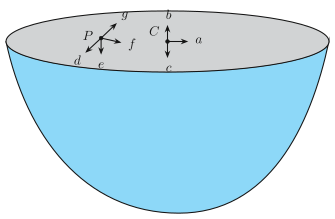
Drawn by us to help you understand the concept clearly, and verified to make sure it's accurate. For exams, practice from your textbook's own diagram.
The figure shows a hemispherical shell of uniform mass density, drawn in cross-section as a bowl shape. Its centre (the centre of the full sphere the hemisphere is half of) is marked C, sitting on the flat rim of the bowl. Three arrows radiate from C in different directions, labelled a (pointing right), b (pointing up), and c (pointing down) -- these are the candidate directions for the gravitational intensity a test mass would feel if placed exactly at C.
A second point, P, is marked at an arbitrary location inside the shell (not at the centre). Four more arrows radiate from P, labelled d, e, f, g, in different directions -- these are the candidate directions for the gravitational intensity at this off-centre point. …