Physics · Ch 8 — Gravitation
Universal Law of Gravitation
Universal Law of Gravitation
The Universal Law of Gravitation
Every object in the universe attracts every other object with a force. This is not a vague tendency — it is a precise, mathematical statement about the strength of that attraction. The force depends on just two things: how much mass each object has, and how far apart they are.
The force is always attractive, always acts along the line joining the centres of the two objects, and its magnitude is given by a remarkably simple formula.
Here:
- is the magnitude of the gravitational force between the two objects.
- and are the masses of the two objects.
- is the distance between their centres.
- is the universal gravitational constant. Its value is the same everywhere in the universe: .
The constant is tiny. That is why we do not feel the gravitational pull of a chair or a book — the masses involved are too small for the force to be noticeable. Only when at least one of the masses is enormous, like a planet or a star, does the force become significant.
The distance in the formula is always measured from the centre of one object to the centre of the other. For objects on the Earth's surface, is the Earth's radius (plus any height above the surface), not the distance from the object to the ground.
Vector Form of the Law
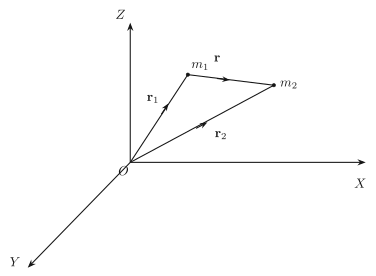
Force is a vector. The law above gives only its magnitude. To write the full vector form, we need a direction. Let be the force on mass due to mass , and let be the position vector of relative to (i.e., pointing from to ). The force on is directed towards , so it is opposite to .
Here is a unit vector pointing from to . The negative sign tells you the force is attractive — it pulls in the direction opposite to , i.e., towards .
By Newton's third law, the force on due to is equal in magnitude and opposite in direction:
Properties of the Gravitational Force
The law has several important characteristics that follow directly from its form.
Property 1: The gravitational force is central. It always acts along the line joining the centres of the two masses. There is no sideways component. This is why planetary orbits lie in a plane — the force has no component that would pull the planet out of that plane.
Property 2: The gravitational force obeys the inverse-square law. If you double the distance between two masses, the force becomes one-fourth as strong. If you triple the distance, the force becomes one-ninth. This rapid fall-off with distance is characteristic of forces that spread out uniformly in three dimensions.
Property 3: The gravitational force is conservative. The work done by gravity in moving an object from one point to another does not depend on the path taken — it depends only on the initial and final positions. This allows us to define a gravitational potential energy.
Property 4: The gravitational force is universal. It acts between any two objects that have mass, regardless of their composition, temperature, or any other property. There is no such thing as "anti-gravity" in Newtonian physics.
The Principle of Superposition
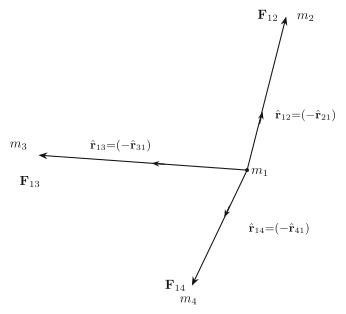
What happens when there are more than two masses? The gravitational force on any one mass is the vector sum of the forces due to every other mass individually. This is the principle of superposition.
If you have masses , the net force on is:
Each term is calculated using the universal law of gravitation for the pair , with the distance between their centres. The forces add as vectors, so you must account for direction.
Superposition works because the gravitational force is linear in mass — the force between two masses is unaffected by the presence of a third mass. This is not true for all forces in nature, but it holds for gravity.
Experimental Verification
The universal law of gravitation was not just a theoretical guess. It was tested and confirmed in several ways: …
Drawn by us to help you understand the concept clearly, and verified to make sure it's accurate. For exams, practice from your textbook's own diagram.
The figure shows a three-dimensional coordinate system with axes labelled X, Y, and Z. The origin is marked O. Two point masses, and , are placed at different locations in this space. From the origin, a position vector points to , and a position vector points to . A third vector, labelled , is drawn from to . The caption tells you that , and that the gravitational force on due to acts along this vector .
The physical idea is simple but profound: gravity is a force that acts along the straight line connecting two masses. The figure makes this directional dependence explicit. The vector is not just any line — it is the displacement from to . Its magnitude is the distance between the two masses, and its direction points from toward .
The textbook uses this figure to introduce the universal law of gravitation. The force on due to is written as
where is the universal gravitational constant, is the distance between the masses, and is a unit vector pointing from to . The minus sign tells you that the force on is directed opposite to — that is, toward . In other words, the force is attractive.
A common mistake is to think points from to . The figure defines , so it points from to . The force on is along , toward .
The same figure also sets up the force on due to , which is equal in magnitude and opposite in direction: …
Drawn by us to help you understand the concept clearly, and verified to make sure it's accurate. For exams, practice from your textbook's own diagram.
The figure shows a single point mass at the centre, with three arrows pointing outward toward three other point masses: in the upper right, on the left, and below. Each arrow is labelled with the corresponding gravitational force vector: (from on ), (from ), and (from ). The arrows are drawn in indigo, radiating from outward toward each other mass — this is the key visual: the forces act on , but they point toward the masses that exert them. That is, points from toward , not away from .
The physical idea is straightforward but foundational: gravity is a mutual attraction between every pair of masses. For a single mass surrounded by several others, the net gravitational force it experiences is the vector sum of the individual forces from each other mass. The figure makes clear that you cannot simply add magnitudes — direction matters. Each force acts along the line joining and , and its magnitude is given by the universal law of gravitation:
where is the universal gravitational constant, and is the distance between and . The same form holds for and , with and respectively.
The net force on is then:
Each term is a vector: , where is a unit vector pointing from to . The negative sign (often omitted in magnitude form) reminds you that the force on is attractive — it points toward , opposite to the direction of if you define as pointing from to .
A common mistake is to think the arrows in the figure represent forces exerted by on the others. They do not. Each arrow is labelled , meaning "force on due to ". The arrow points toward because the force is attractive — is pulled toward . …