Physics · Ch 8 — Gravitation
The Gravitational Constant
The Gravitational Constant
The Gravitational Constant
The story of gravitation has two distinct halves. Newton gave us the law — the inverse-square relation that governs the force between any two masses. But a law is just a proportionality until you know the constant that turns the proportion into an equation. That constant is , the universal gravitational constant. Its value tells you how strong gravity really is, and measuring it turned out to be one of the most delicate experiments in physics.
Newton himself could only estimate by guessing at the average density of the Earth. He got a number that was in the right ballpark, but not accurate. The problem is that gravity is incredibly weak compared to other forces — you don't feel the gravitational pull of the person sitting next to you, even though it's there. To measure , you need to detect the tiny force between two ordinary-sized masses in a laboratory, and that requires extraordinary sensitivity.
The weakness of gravity is why we don't notice it between everyday objects. The gravitational force between two 1 kg masses 1 m apart is about N — that's less than the weight of a single bacterium. No wonder it took over a century after Newton to measure it properly.
The Cavendish Experiment
The first successful measurement of was performed in 1798 by Henry Cavendish, using an apparatus called a torsion balance. The setup is elegant in its simplicity.
A light, rigid rod is suspended at its centre by a thin wire or fibre. At each end of the rod is a small lead sphere (mass ). The whole assembly is enclosed in a case to shield it from air currents. Two large lead spheres (mass ) are then brought near the small ones, one on each side, positioned so that the gravitational attraction between each large sphere and its neighbouring small sphere produces a torque that twists the suspension wire.
The wire twists until the restoring torque from the twisted fibre exactly balances the gravitational torque. By measuring the angle of twist, and knowing the torsional constant of the wire (how much torque is needed to twist it by a given angle), you can calculate the gravitational force between the masses.
A common mistake is to think Cavendish measured (the acceleration due to gravity). He did not. He measured , the universal constant. The value of was already known from pendulum experiments. Cavendish's result allowed the mass of the Earth to be calculated for the first time, which is why his experiment is sometimes described as "weighing the Earth."
The geometry is straightforward. Let the distance between the centres of a large sphere and the adjacent small sphere be . The gravitational force between them is:
This force acts at the end of the rod of length (the distance from the suspension point to the centre of the small sphere). The torque produced by one pair is . Since there are two pairs acting in the same rotational sense, the total gravitational torque is:
The suspension wire provides a restoring torque proportional to the angle of twist :
where is the torsional constant of the wire. At equilibrium, the torques balance:
Solving for :
Every quantity on the right-hand side can be measured in the laboratory. The torsional constant is determined by measuring the period of oscillation of the torsion pendulum (the rod with the small spheres) when it is set into free torsional oscillation.
The period of a torsion pendulum is , where is the moment of inertia of the rod-and-sphere system about the suspension axis. So . This gives without needing to apply a known torque directly.
The Accepted Value
Cavendish's own result was remarkably close to the modern value. Countless refinements over two centuries have pinned down to high precision. The currently accepted value is:
with an uncertainty of about 22 parts per million. It is one of the least precisely known fundamental constants — gravity is just that hard to measure.
Dimensional Analysis of
From Newton's law of gravitation:
we can solve for the dimensions of :
So has dimensions of . In SI units, this is , which matches the units since . …
Drawn by us to help you understand the concept clearly, and verified to make sure it's accurate. For exams, practice from your textbook's own diagram.
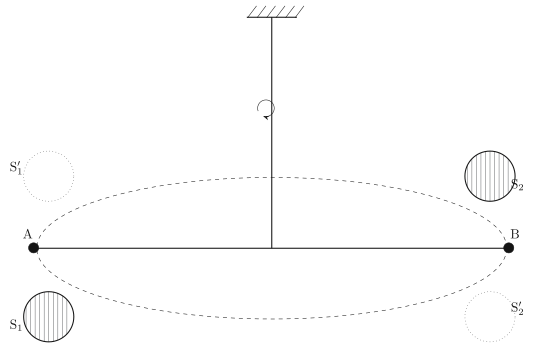
The figure is a top-down schematic of the Cavendish experiment, the first laboratory measurement of the gravitational constant . A light, rigid horizontal bar AB is suspended from a fine torsion fibre fixed to a ceiling support. Two small lead masses (at A and B) are attached to the ends of the bar. Two large lead spheres, labelled S1 and S2, are placed near the small masses — one on each side of the bar. The dashed elliptical path around the bar indicates the rotation of the bar when the large spheres are moved.
The key physical idea is that the gravitational attraction between each large sphere and its nearby small mass produces a torque that twists the torsion fibre. The fibre resists twisting with a restoring torque proportional to the angle of twist. By measuring the equilibrium twist angle, the gravitational force can be deduced.
The experiment is performed in two steps. First, the large spheres are placed in positions S1 and S2 (as shown in the figure). The gravitational attraction between S1 and mass A, and between S2 and mass B, creates a torque that rotates the bar slightly. The torsion fibre twists until the restoring torque balances the gravitational torque. The angle of twist is measured using a light beam reflected from a mirror on the fibre.
Then the large spheres are moved to the opposite sides of the small masses — to positions S1' and S2' (shown as dotted circles). The gravitational torque now acts in the opposite direction, twisting the bar the other way. The total angular deflection between the two equilibrium positions is twice the deflection due to one configuration, which doubles the measurement accuracy.
The textbook uses this figure to derive the value of from the measured deflection. The gravitational force between a large sphere of mass and a nearby small mass is:
where is the centre-to-centre distance between the sphere and the small mass. This force acts at the end of the bar of length , producing a torque:
The factor of 2 comes from both ends of the bar experiencing a force. The torsion fibre provides a restoring torque , where is the torsion constant of the fibre and is the twist angle in radians. At equilibrium:
Every symbol in this formula is directly measured or known: is determined from the period of oscillation of the bar alone, is the measured deflection angle, is the measured separation between sphere centres, and are the known masses, and is the bar length.
A common mistake is to think the force acts at the centre of the bar. It acts at the ends, so the lever arm is , not . The torque from one end is , and both ends contribute, giving total torque . …