Q.A nucleus is at rest in the laboratory frame of reference. Show that if it disintegrates into two smaller nuclei the products must move in opposite directions.
🔒You're viewing a preview — the full solution, concept, methods & PYQ mapping are locked.
🔒 Start your 14-day free trial to unlock the full solution →Concept understanding — Conservation of Momentum
Conservation of Momentum: From Push to Principle
Imagine you're standing on perfectly smooth ice, wearing skates. You're completely still. Now, you push a heavy medicine ball away from you. What happens? You roll backward. The harder you push the ball, the faster you roll back.
That's the core intuition: you can't push something away without being pushed back yourself. The push you give the ball is matched by an equal push on you, in the opposite direction. This isn't a special property of ice or skates — it's a fundamental rule of how forces work in the universe.
The Hidden Quantity That Never Changes
Physicists call the "amount of motion" an object has its momentum. For everyday speeds, momentum is simple:
p=mv
Where m is mass (how much stuff) and v is velocity (speed with direction). Momentum is a vector — it cares about which way you're going.
A truck creeping forward has huge momentum (big mass, small speed). A bullet zipping through air has moderate momentum (tiny mass, huge speed). A parked car has zero momentum (speed is zero).
Now here's the key: in any isolated system (no outside forces), total momentum stays the same. Always. Before, during, and after any interaction.
The Precise Statement
Law of Conservation of Momentum:
In a closed, isolated system (no external forces), the total vector momentum of the system remains constant over time.
Mathematically, for two objects that interact (collide, push apart, explode):
p1,initial+p2,initial=p1,final+p2,final
Or in terms of masses and velocities:
m1u1+m2u2=m1v1+m2v2
Where u means initial velocity and v means final velocity.
Why This Works: Newton's Third Law in Disguise
When you push the medicine ball, your hand exerts a force F on the ball. By Newton's Third Law, the ball exerts an equal and opposite force −F back on your hand. These forces act for the same time Δt.
Force times time equals impulse, which equals change in momentum:
FΔt=Δp
For you and the ball:
- Ball's momentum change: +FΔt (ball goes forward)
- Your momentum change: −FΔt (you go backward)
Add them: +FΔt+(−FΔt)=0
Total change is zero. Momentum is conserved because forces always come in equal-and-opposite pairs.
This is why a rocket works in the vacuum of space. It throws exhaust backward (one momentum change), and the rocket itself moves forward (equal opposite momentum change). No air needed — just Newton's Third Law and conservation of momentum.
What This Law Does NOT Mean
- It does NOT mean individual objects keep constant momentum. Only the total of all objects in the system stays constant. Individual momenta can change wildly.
- It does NOT apply if external forces act. If friction, gravity from outside, or a wall stops something, momentum is not conserved for that system. (You can expand the system to include the Earth or the wall, and then momentum is conserved again.)
- It does NOT require collisions to be elastic. Even in a messy, sticky, energy-losing collision, momentum is still perfectly conserved. Energy can be lost to heat or deformation, but momentum never disappears.
A Quick Example …
Concept: Conservation of Momentum
The nucleus is initially at rest, so its total linear momentum is zero. Since no external forces act during the disintegration, momentum must be conserved.
- Let the two product nuclei have masses m1 and m2, and velocities v1 and v2 after disintegration.
- Initial momentum: pi=0.
- Final momentum: pf=m1v1+m2v2.
- By conservation of momentum: m1v1+m2v2=0⇒m1v1=−m2v2. …
The key idea is that the total momentum of an isolated system is conserved. Since the parent nucleus is at rest, its initial momentum is zero. After disintegration, the two daughter nuclei must have equal and opposite momenta, which forces them to move in opposite directions.
Why Conservation of Momentum is the Right Tool
When a nucleus disintegrates spontaneously (radioactive decay or fission), no external force acts on the system during the brief disintegration process. The parent nucleus and the two daughter nuclei together form an isolated system. In such a system, the total linear momentum remains constant — this is the law of conservation of momentum.
Think of it this way: if you're standing still on frictionless ice and you throw a heavy ball forward, you'll slide backward. The total momentum before and after the throw is zero. The same physics governs nuclear disintegration.
Conservation of momentum: pinitial=pfinal
Let's apply this to the problem.
-
Before disintegration — The parent nucleus is at rest in the laboratory frame. Its velocity is zero, so its momentum is zero.
pinitial=0
-
After disintegration — The nucleus splits into two smaller nuclei. Let their masses be m1 and m2, and their velocities be v1 and v2 respectively. The total final momentum is:
pfinal=m1v1+m2v2
-
Apply conservation — Since no external force acts, initial momentum equals final momentum:
0=m1v1+m2v2
Rearranging:
m1v1=−m2v2
-
Interpret the result — The vector equation m1v1=−m2v2 tells us two things:
- The momentum vectors are opposite in direction (the negative sign).
- Their magnitudes are equal: m1v1=m2v2. …
Concept: Conservation of Linear Momentum in an Isolated System
Step 1: State the initial momentum
The nucleus is at rest, so its total momentum before disintegration is zero:
pi=0
Step 2: Write the final momentum
No external force acts during the (brief) disintegration, so the parent nucleus and its
two fragments form an isolated system. Let the fragments have masses m1,m2 and
velocities v1,v2:
pf=m1v1+m2v2
Step 3: Apply conservation of momentum
pi=pf⟹m1v1+m2v2=0⟹m1v1=−m2v2 …
- TG EAPCET 2026Set eng-2026-05-09-FN1 markMCQQ.Two trains A and B are moving in the same direction with velocities VA and VB respectively and a third train C is moving in opposite direction to A and B. If velocity of C with respect to B is twice the velocity of A with respect to B, then the velocity of A with respect to C is (A) 3(VA−VB) (B) 2(VA−VB) (C) 3(VA−VB) (D) 2(VA−VB)
›Reveal solutionSolution
Working in the direction of A and B, VC=2VA−3VB, so A relative to C is 3(VA−VB).
Take the common direction of trains A and B as positive. Then A has velocity +VA, B has +VB, and C (opposite direction) has −VC, where VC>0 is its speed.
Speed of C with respect to B (they move oppositely, so speeds add):
VCB=VC+VB.
Speed of A with respect to B:
VAB=VA−VB.
Given VCB=2VAB: …
- TG EAPCET 2026Set ap-2026-05-04-AN1 markMCQQ.A boat of mass 200 kg and length 10 m is floating on water. If a boy of mass 50 kg standing at one end of the boat at a distance of 20 m from the shore moves to the centre of the boat away from the shore, then the distance of the centre of mass of the boat from the shore is (A) 20 m (B) 25 m (C) 26 m (D) 24 m
›Reveal solutionSolution
The center of mass of the boat-boy system remains stationary because no external horizontal forces act on it. By calculating the initial center of mass and equating it to the final center of mass, we find that the boat's center of mass is 24 m from the shore.
The core concept here is the conservation of the center of mass. For a system of particles, if there are no external forces acting on the system in a particular direction, then the center of mass of the system will remain stationary or continue to move with a constant velocity in that direction.
In this problem, the system consists of the boat and the boy. The forces acting on this system are:
- Gravity (acting vertically downwards on both the boat and the boy).
- Normal force from the water (acting vertically upwards on the boat).
- The force exerted by the boy on the boat, and by the boat on the boy (these are internal forces within the system).
Crucially, we assume there are no external horizontal forces, such as water resistance or wind, acting on the boat-boy system. Therefore, the center of mass of the combined boat-boy system will not shift horizontally. Any movement of the boy relative to the boat will cause the boat to move in the opposite direction, ensuring the system's center of mass stays in its original position.
Let's solve the problem step-by-step.
-
Define the Coordinate System and Initial Positions:
Let the shore be at the origin, x=0.
The boat has a mass MB=200 kg and length L=10 m. Its center of mass is at its geometric center.
The boy has a mass MP=50 kg.
The boy is initially standing at one end of the boat, at a distance of 20 m from the shore. This means the end of the boat closer to the shore is at x=20 m.
- Initial position of the boy (xP,i): xP,i=20 m.
- The boat extends from x=20 m to x=20+10=30 m.
- Initial position of the boat's center of mass (xB,i): xB,i=20+2L=20+210=20+5=25 m.
-
Calculate the Initial Center of Mass of the System:
The formula for the center of mass of a two-particle system is:
XCM=M1+M2M1x1+M2x2
Using this, the initial center of mass of the boat-boy system (XCM,i) is:
XCM,i=MB+MPMBxB,i+MPxP,i
XCM,i=200 kg+50 kg(200 kg)(25 m)+(50 kg)(20 m)
XCM,i=250 kg5000 kg⋅m+1000 kg⋅m
XCM,i=250 kg6000 kg⋅m=24 m
-
Determine the Final Positions:
The boy moves to the center of the boat. Let the new position of the boat's center of mass be xB,f.
Since the boy is now at the center of the boat, his final position (xP,f) will be the same as the boat's center of mass:
- Final position of the boy (xP,f): xP,f=xB,f.
-
Calculate the Final Center of Mass of the System:
The final center of mass of the boat-boy system (XCM,f) is:
XCM,f=MB+MPMBxB,f+MPxP,f …
- TG EAPCET 2024Set ap-2024-05-07-AN1 markMCQQ.Two particles each of mass ‘m’ are separated by a distance ‘d’. If the mass of one of the particles is doubled without changing the distance between the two particles, then the shift in the position of the center of mass is (A) 6d (B) 2d (C) 4d (D) 5d
›Reveal solutionSolution
The center of mass of a system shifts towards the particle whose mass is increased. By calculating the initial and final positions of the center of mass, we find the shift to be 6d.
The center of mass of a system of particles is a unique point that represents the average position of the total mass of the system. It's a crucial concept in mechanics because the motion of the center of mass often simplifies the analysis of a complex system.
The position of the center of mass depends on two factors: the masses of the individual particles and their respective positions. If either of these changes, the center of mass will generally shift. In this problem, we are changing the mass of one particle, which will cause the center of mass to move closer to the particle whose mass has increased, as it now contributes more to the "average" position.
For a system of two particles, say with masses m1 and m2 located at positions x1 and x2 along an axis, the position of their center of mass (XCM) is given by the weighted average:
XCM=m1+m2m1x1+m2x2
Let's apply this formula to find the initial and final positions of the center of mass and then determine the shift.
- Define the initial setup and calculate the initial center of mass:
Let's place one of the particles at the origin of our coordinate system for simplicity.
- Particle 1: mass m1=m, position x1=0.
- Particle 2: mass m2=m, position x2=d. The total mass of the system is Minitial=m1+m2=m+m=2m. The initial position of the center of mass, XCM,initial, is:
XCM,initial=m1+m2m1x1+m2x2=m+mm(0)+m(d)=2mmd=2d
So, initially, the center of mass is exactly halfway between the two particles, which is expected for two equal masses.2. Define the final setup and calculate the new center of mass:
The problem states that the mass of one of the particles is doubled. Let's assume the mass of Particle 1 is doubled. The distance between them remains d.
* Particle 1: new mass m1′=2m, position x1′=0.
* Particle 2: mass m2′=m, position x2′=d. …
- Define the initial setup and calculate the initial center of mass:
Let's place one of the particles at the origin of our coordinate system for simplicity.
- TG EAPCET 2024Set eng-2024-05-10-FN1 markMCQQ.An alphabet ‘T’ made of two similar thin uniform metal plates of each length ‘L’ and width ‘a’ is placed on a horizontal surface as shown in the figure. If the alphabet is vertically inverted, the shift in the position of its centre of mass from the horizontal surface is (A) 2L−a (B) 2a−L (C) 2L−2a (D) 22L−a
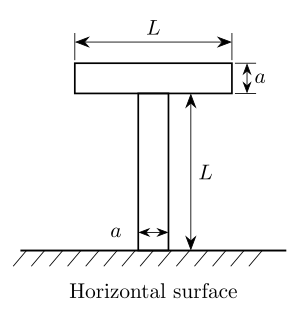
›Reveal solutionSolution
Treat the T as two equal plates. Upright: ycm=(3L+a)/4; inverted: ycm=(3a+L)/4. The shift is (L−a)/2 — option (A).
The concept first. For a body made of parts,
ycm=m1+m2m1y1+m2y2
Each uniform plate can be replaced by a point mass at its own geometric centre. Because both plates here have the same dimensions (L long, a wide) and the same material and thickness, they have equal masses m, so the composite centre of mass is simply the average of the two plate-centres. All we then need is the height of each plate's centre above the ground in the two orientations.
Step 1 — Set up the upright T.
Measure y upward from the horizontal surface.
- Stem (vertical plate, length L, width a): it stands on the ground, so it spans y=0 to y=L. Its centre: y=L/2.
- Cross-bar (horizontal plate, length L, thickness a): it rests on top of the stem, so it spans y=L to y=L+a. Its centre: y=L+a/2.
y1=2mm(2L)+m(L+2a)=223L+2a=43L+a
Step 2 — Invert the T (now it looks like ⊥).
- Cross-bar now lies flat on the ground: it spans y=0 to y=a. Its centre: y=a/2.
- Stem stands on the bar: it spans y=a to y=a+L. Its centre: y=a+L/2. …
- TG EAPCET 2023Set eng-2023-05-12-FN1 markMCQQ.A system consists of two particles of masses m1 and m2. If the particle of mass m1 is moved towards the centre of mass through a distance d, then the distance the second particle should be moved, so as to keep the centre of mass at the same position is (A) m1−m2d (B) m1+m2m2d (C) m2−m1d (D) m2m1d
›Reveal solutionSolution
When one mass moves toward the center of mass, the other must move away by a distance inversely proportional to the mass ratio to keep the center of mass fixed. The correct answer is (C) m2−m1d.
Concept: The Center of Mass Must Remain Fixed
The center of mass of a system is the weighted average position of all masses. When we require that the center of mass stays at the same location, any displacement of one mass must be balanced by an appropriate displacement of the other mass. The key insight is that heavier masses need to move less to produce the same effect on the center of mass position.
Let's set up a coordinate system with the center of mass at the origin initially.
Step-by-Step Solution
1. Initial positions relative to center of mass
Let the initial positions of m1 and m2 relative to the center of mass be x1 and x2 respectively. Since the center of mass is at the origin:
m1x1+m2x2=0
This tells us that x1 and x2 have opposite signs (the masses are on opposite sides of the center of mass).
2. After the displacements
Particle m1 is moved toward the center of mass by distance d. Since it's moving toward the center of mass, its distance from the center decreases, so its new position is x1−d (assuming x1>0; if x1<0, it would be x1+d, but the algebra works out the same).
Let particle m2 move by distance Δx2 (positive means away from center of mass in its direction). Its new position is x2+Δx2.
3. Condition for center of mass to remain fixed
For the center of mass to stay at the origin:
m1(x1−d)+m2(x2+Δx2)=0
4. Solve for the required displacement
Expanding:
m1x1−m1d+m2x2+m2Δx2=0
Since m1x1+m2x2=0 from step 1:
−m1d+m2Δx2=0
m2Δx2=m1d
Δx2=m2m1d
5. Interpret the sign …
- TG EAPCET 2022Set ap-2022-07-31-AN1 markMCQQ.Two identical bodies of same mass move with speed V0 and 2V0, respectively in directions perpendicular to each other. After some time, the bodies collide and merge with each other. The speed after collision is (A) 2V0 (B) 2V05 (C) 25V0 (D) V0
›Reveal solutionSolution
This is a perfectly inelastic collision in two dimensions. Using conservation of momentum, the final speed of the combined mass is 2V05.
The key idea here is that momentum is a vector quantity. When two bodies collide and stick together, the total momentum before the collision equals the total momentum after the collision — but you must add the momenta as vectors, not just as numbers. The masses are equal, so the problem reduces to finding the vector sum of the two initial velocities and then dividing by the total mass.
Since the initial velocities are perpendicular, the vector sum is the hypotenuse of a right triangle. That’s the entire conceptual backbone: momentum conservation in two dimensions, with perpendicular components.
Let’s work through it step by step.
-
Set up the coordinate system. Let body A move along the x-axis with speed V0, so its velocity vector is vA=V0i^. Let body B move along the y-axis with speed 2V0, so its velocity vector is vB=2V0j^. Both have the same mass m.
-
Write the total momentum before collision.
Momentum is mass times velocity. So:
pinitial=mvA+mvB=mV0i^+m(2V0)j^=mV0i^+2mV0j^.
- After collision, the bodies merge. The combined mass is 2m, and it moves with some final velocity vf. By conservation of momentum:
(2m)vf=mV0i^+2mV0j^.
Cancel m (it’s nonzero):
2vf=V0i^+2V0j^.
- Solve for the final velocity vector:
vf=2V0i^+V0j^.
- Find the speed (magnitude of vf). The components are perpendicular, so:
-
- TG EAPCET 2021Set ap-2021-08-09-AN1 markMCQQ.A car travels the first third of a distance with a speed 60 kmph, the second third at 10 kmph and the last third at speed v. If the mean speed over the entire distance is 5 m/s then the value of v in kmph is: (A) 10 (B) 20 (C) 30 (D) 40
›Reveal solutionSolution
The key idea is that mean speed is total distance divided by total time, not an average of speeds.
Converting units and solving the time equation gives v=20 kmph, so the correct option is (B).
We are told a car covers three equal thirds of a total distance D at speeds 60 kmph, 10 kmph, and v kmph respectively. The mean (average) speed over the whole trip is given as 5 m/s. We need v in kmph.
Concept and intuition
The most common mistake here is to think mean speed is the arithmetic mean of the three speeds. It is not. Mean speed is defined as
mean speed=total timetotal distance.
Since each third has a different speed, the time taken for each third is different. We must find the total time in terms of v, set the mean speed equal to the given value (after converting units), and solve for v.
- Set up the distance and times Let the total distance be 3d km, so each third is d km. Time for first third: t1=60d hours. Time for second third: t2=10d hours. Time for last third: t3=vd hours. Total time:
T=d(601+101+v1).
- Write the mean speed in kmph Mean speed in kmph is
mean speed=T3d=d(601+101+v1)3d=601+101+v13.
This is given as 5 m/s. We must convert to kmph:
5 m/s=5×518=18 kmph.
(Recall: 1 m/s=3.6 kmph, or multiply by 18/5.)
- Set up the equation
601+101+v13=18.
Invert both sides:
3601+101+v1=181.
Multiply by 3:
- TG EAPCET 2021Set ap-2021-08-10-AN1 markMCQQ.A rod has length L. The linear mass density is 2x kg/m, where x is the distance from the left end. Centre of mass of the rod from the left end lies at a distance of (A) 23L (B) 32L (C) L (D) L/2
›Reveal solutionSolution
The center of mass is found by integrating the mass-weighted position over the total mass. For a rod of length L with density λ(x)=2x, the center of mass from the left end is 32L, so option (B) is correct.
Concept & Intuition
The center of mass is the “balance point” — the average position weighted by how much mass is at each location. When density varies, you can’t just take the midpoint; you must integrate. Here, density increases linearly from the left end (density 0 at x=0) to the right end (density 2L at x=L). That means more mass is concentrated toward the right, so the center of mass should be to the right of the midpoint L/2. Among the options, only 32L is greater than L/2 and less than L, so it’s the plausible choice — but we’ll verify by calculation.
Step-by-step solution
- Set up the integrals For a one-dimensional rod along the x-axis from x=0 to x=L, the center of mass coordinate is
xcm=∫0Ldm∫0Lxdm
where dm=λ(x)dx and λ(x)=2x.
- Compute the total mass
M=∫0L2xdx=[x2]0L=L2
- Compute the first moment (numerator) ∫0Lxdm=∫0Lx⋅2xdx=2∫0Lx2dx=2[3x3]0L=32L3 …
- TG EAPCET 2021Set ap-2021-08-10-FN1 markMCQQ.A rod has length L. The linear mass density is 2x kg/m, where x is the distance from the left end. Centre of mass of the rod from the left end lies at a distance of (A) 23L (B) 32L (C) L (D) L/2
›Reveal solutionSolution
The centre of mass is found by integrating the mass-weighted position over the total mass. For a rod with linear density λ(x)=2x, the centre of mass from the left end is 32L, so the correct option is (B).
Concept & Intuition
The centre of mass is the “balance point” — the average position weighted by mass. When density varies, you can’t just take the geometric centre; you must account for where the mass is concentrated. Here, density increases linearly from the left end (x=0) to the right end (x=L), so more mass lies toward the right. That pulls the centre of mass to the right of the midpoint — but how far? We’ll compute it exactly.
Step-by-step solution
- Set up the integrals For a one-dimensional rod, the centre of mass coordinate xˉ (from the left end) is
xˉ=∫0Ldm∫0Lxdm
where dm=λ(x)dx and λ(x)=2x.
- Compute the total mass
M=∫0Lλ(x)dx=∫0L2xdx=[x2]0L=L2
- Compute the first moment of mass ∫0Lxdm=∫0Lx⋅2xdx=2∫0Lx2dx=2[3x3]0L=32L3 …
- TG EAPCET 2021Set eng-2021-08-04-FN1 markMCQQ.A small disc of mass 500 gm and radius 5 cm rolls down an inclined plane without slipping. Speed of its center of mass when it reaches the bottom of the incline plane depends on (A) mass & radius (B) mass & height of the incline (C) height of the incline (D) height of the incline and acceleration due to gravity
›Reveal solutionSolution
For pure rolling, the centre-of-mass speed depends only on the height of the incline and g — mass and radius cancel out. The answer is (D).
The key is to see that rolling motion combines translation and rotation, and the "without slipping" condition locks the two together. When the disc rolls down, gravitational potential energy gets split into two forms: translational kinetic energy of the centre of mass and rotational kinetic energy about the centre. The moment of inertia of a disc is 21MR2, and the rolling condition gives ω=v/R. That ratio is what makes mass and radius disappear from the final speed.
- Energy conservation — The disc starts from rest at height h. Its initial energy is purely gravitational potential: Mgh. At the bottom, the energy is all kinetic:
K=21Mv2+21Iω2.
- Moment of inertia — For a solid disc about its centre,
I=21MR2.
- Rolling condition — No slipping means the point of contact is instantaneously at rest, so
ω=Rv.
- Substitute into energy equation —
Mgh=21Mv2+21(21MR2)(Rv)2.
Simplify the rotational term:
21⋅21MR2⋅R2v2=41Mv2.
- Combine terms —
Mgh=21Mv2+41Mv2=43Mv2.
Cancel M (mass does not matter):
gh=43v2⇒v=34gh. …
- TG EAPCET 2021Set eng-2021-08-06-FN1 markMCQQ.A 750 kg boat is 10 m long and is floating without motion on still water. A man of mass 80 kg is at one end and if he runs to another end of the boat and stops, the displacement of boat is (A) 1.8 m in the direction of displacement of man (B) 0.96 m in the direction of opposite to the displacement of man (C) 0.96 m in the direction of displacement of the man (D) 1.8 m in the direction opposite to displacement of man
›Reveal solutionSolution
In the absence of external horizontal forces, the centre of mass of the man–boat system remains stationary. The man’s motion relative to the boat shifts the boat so that the system’s centre of mass does not move. The boat displaces by 0.96 m opposite to the man’s displacement, which is option (B).
The key idea is the conservation of centre of mass in a system with no external horizontal force. The man and boat are initially at rest on still water — no friction, no engine, no wind. So the horizontal position of the system’s centre of mass cannot change, no matter how the man moves inside the boat.
When the man runs from one end to the other, he pushes backward on the boat to move forward. The boat, in turn, moves in the opposite direction. Once he stops, both are again at rest relative to the water, but shifted relative to their original positions. The centre of mass, however, is exactly where it started.
Let’s set this up.
-
Define the system and coordinates.
Let the boat’s mass be M=750 kg and its length L=10 m. The man’s mass is m=80 kg.
Place the origin at the initial position of the left end of the boat. The boat’s own centre of mass is at its geometric centre, initially at x=5 m. The man starts at the left end, so his initial position is x=0.
-
Find the initial centre of mass of the system.
The centre of mass of the boat alone is at 5 m. The man is at 0. So:
Xcm, initial=M+mM⋅5+m⋅0=830750⋅5+80⋅0=8303750
Simplify:
Xcm, initial=8303750=83375≈4.518 m
-
Describe the final configuration.
After the man runs to the other end and stops, he is at the right end of the boat. But the boat itself has moved. Let the displacement of the boat relative to the water be d (positive if to the right).
The boat’s centre is now at 5+d. The man is at the right end, which is at 10+d (since the boat’s length is 10 m and its left end is now at d).
-
Apply centre-of-mass conservation.
The final centre of mass must equal the initial one:
M+mM(5+d)+m(10+d)=8303750
Multiply through by 830:
750(5+d)+80(10+d)=3750
Expand:
-
🎓Unlock everything free for 14 days
- ✓Full step-by-step solutions
- ✓Concept-first explanations
- ✓Methods, shortcuts & mistakes
- ✓PYQ mapping + timed mock tests
Full access for 14 days. No credit card required.