Q.If, in Exercise 4.21, the speed of the stone is increased beyond the maximum permissible value, and the string breaks suddenly, which of the following correctly describes the trajectory of the stone after the string breaks:
🔒You're viewing a preview — the full solution, concept, methods & PYQ mapping are locked.
🔒 Start your 14-day free trial to unlock the full solution →Concept understanding — Centripetal Force
Centripetal Force: The Invisible Hand That Keeps Things Going in Circles
Imagine you're in a car taking a sharp turn to the left. You feel yourself being pushed to the right, against the door. That feeling — that's your body trying to keep moving straight while the car turns. Now here's the key insight: you don't actually feel a force pushing you outward. What you feel is your own inertia — your body's natural desire to keep moving in a straight line.
The real force is the one the car door exerts on you, pushing you inward toward the centre of the turn. That inward push is centripetal force.
The Intuition: Why Does Anything Need a Force to Go in a Circle?
Newton's first law says: an object in motion stays in motion in a straight line unless acted on by an external force. A straight line is the "default" path. To make something go in a circle — which is a constantly changing direction — you need a force that continuously pulls it away from that straight line.
Think of a stone tied to a string, whirled around your head. The string is taut. That tension is the centripetal force. If you let go, the stone doesn't fly outward — it flies off tangentially, in a straight line from the point of release. The string was constantly pulling it inward, preventing it from escaping.
The word "centripetal" comes from Latin: centrum (centre) + petere (to seek). It means "centre-seeking." This is the opposite of "centrifugal" (centre-fleeing), which is a fictitious force you feel only in a rotating reference frame — not a real force in physics.
The Precise Statement
Centripetal force is any force that causes an object to follow a curved path, directed toward the centre of curvature of that path. It is not a new, independent force like gravity or friction. It is the name we give to the net force that points radially inward when an object moves in a circle.
For uniform circular motion (constant speed v along a circle of radius r), the magnitude of centripetal force is:
Fc=rmv2
Where:
- m = mass of the object
- v = speed (magnitude of velocity)
- r = radius of the circular path
The corresponding centripetal acceleration (which is always perpendicular to velocity) is:
ac=rv2
This acceleration points toward the centre. It is not constant in direction — it rotates as the object moves — but its magnitude is constant for uniform circular motion.
What Provides the Centripetal Force?
Centripetal force is always supplied by some real physical interaction. Here are common examples:
| Situation | What provides centripetal force |
|---|---|
| Car turning on a flat road | Friction between tyres and road |
| Satellite orbiting Earth | Gravitational attraction |
| Stone on a string | Tension in the string |
| Electron orbiting a nucleus | Electrostatic attraction |
| A roller coaster looping the loop | Normal force from the track (plus gravity at the top) |
Concept: Newton's First Law and Centripetal Force
When the stone moves in a circle, the tension in the string provides the centripetal force that continuously changes the direction of the velocity vector. The velocity at any instant is tangent to the circular path.
The moment the string breaks, the centripetal force vanishes. By Newton's first law, a body continues in its state of uniform motion in a straight line when no net force acts on it. Since the velocity was tangential at the breaking instant, the stone continues moving in that tangential direction. …
When the string breaks, the centripetal force vanishes instantly; by Newton's first law the stone continues with whatever velocity it had at that instant — which is tangential to the circle. The stone flies off tangentially.
Why does the stone fly off tangentially?
While the string is intact, it pulls the stone radially inward, providing the centripetal force that keeps the stone moving in a circle. The stone's velocity at every instant is tangent to the circular path — velocity is always in the direction of motion, and circular motion is motion along the circumference.
The moment the string breaks, the centripetal force disappears. No force acts on the stone (ignoring gravity for horizontal circular motion, or considering the instant before gravity becomes significant). Newton's first law tells us that an object with no net force continues in a straight line with constant velocity. The velocity the stone "inherits" at the breaking instant is precisely the tangential velocity it had while moving in the circle.
There is no radial component of velocity. The stone was never moving radially outward or inward — it was always moving tangent to the circle. The centripetal force changed the direction of that tangential velocity continuously, bending the path into a circle. Remove the force, and the bending stops; the stone proceeds straight ahead along the tangent.
Step-by-step reasoning
-
Identify the velocity at the instant of breaking.
At any point on the circular path, the stone's velocity v is tangent to the circle. Its magnitude is v (the speed), and its direction is perpendicular to the radius at that point.
-
Recognize what the centripetal force does.
The tension T in the string provides centripetal acceleration ac=rv2 directed radially inward. This acceleration changes the direction of v continuously, keeping the stone on the circular path. Crucially, centripetal force does not change the speed (it is perpendicular to velocity), only the direction.
-
Apply Newton's first law when the string breaks.
The instant the string snaps, T=0, so the net force becomes zero (in the idealized horizontal case). With no force to change its velocity, the stone continues with the velocity it had at that instant: magnitude v, direction tangent to the circle.
-
Evaluate the options. …
Concept: Newton's First Law Applied at the Instant a Centripetal Force Vanishes
Step 1: Identify the stone's velocity direction during circular motion
At every instant, the stone's velocity is tangent to the circle — the string's tension
only ever changes the direction of this velocity (providing centripetal
acceleration), never adds a radial component.
Step 2: Apply Newton's first law the instant the string breaks
Once T=0, no net horizontal force acts on the stone. By the first law it continues
with the velocity it had at that instant — tangential, unchanged in magnitude or
direction, no radial component whatsoever.
Step 3: Eliminate the wrong options …
Showing the 12 most recent of 21 on this concept.
- TG EAPCET 2026Set eng-2026-05-11-FN1 markMCQQ.A metal wire can withstand a maximum tension of 80 N. If the wire is cut into four parts of equal length, then each part can withstand a maximum tension of (A) 80 N (B) 20 N (C) 320 N (D) 40 N
›Reveal solutionSolution
The maximum tension a wire can withstand depends only on its cross-sectional area and material, not its length. Cutting the wire into equal-length parts does not change the cross-section, so each part still holds 80 N.
The key idea here is that the breaking strength of a wire — the maximum tension it can endure before snapping — is determined by two things: the material it's made of and its cross-sectional area. Length has nothing to do with it. This is a common point of confusion, because students often think that a shorter wire is "stronger" or that dividing the wire into pieces somehow splits the load-bearing capacity. Let's clear that up.
When we say a wire can withstand a maximum tension of 80 N, we mean that if you pull on it with a force greater than 80 N, the stress (force per unit area) exceeds the material's ultimate tensile strength, and the wire breaks. The formula for tensile stress is:
Stress=Cross-sectional areaForce
The wire breaks when this stress reaches a critical value, called the ultimate tensile strength, which is a property of the material alone. So the maximum force is:
Fmax=(Ultimate tensile strength)×(Cross-sectional area)
Now, cutting the wire into four equal-length parts does not change the material, and it does not change the cross-sectional area of each piece — you're just slicing the length, not shaving off the sides. Each piece has the same thickness as the original. Therefore, the product above remains unchanged.
Let's walk through it step by step.
-
Identify what determines breaking tension.
The maximum tension a wire can bear is Tmax=σmax⋅A, where σmax is the material's ultimate tensile strength (a constant for a given material) and A is the cross-sectional area. This formula comes directly from the definition of stress.
-
What happens when you cut the wire into four equal parts?
You are dividing the length into four shorter pieces. The cross-sectional area A of each piece is exactly the same as the original wire — you haven't stretched or compressed the wire sideways. The material is also unchanged, so σmax is the same.
-
Apply the formula to each part.
Since both σmax and A are unchanged, the maximum tension each part can withstand is still: …
-
- TG EAPCET 2025Set eng-2025-05-02-AN1 markMCQQ.If the moment of inertia of a thin circular ring about an axis passing through its edge and perpendicular to its plane is I, then the moment of inertia of the ring about its diameter is (A) 4I (B) 4I (C) 2I (D) 2I
›Reveal solutionSolution
The moment of inertia about a diameter is 4I — option (A).
Given: M.I. about an axis through the edge, perpendicular to the plane =I.
Step 1 — Perpendicular axis through the edge (parallel-axis theorem).
About the centre, perpendicular to the plane, a ring has IC=MR2. Shifting the axis to the edge (a distance R away):
I=IC+MR2=MR2+MR2=2MR2⟹MR2=2I.
Step 2 — Diameter (perpendicular axis theorem). …
- TG EAPCET 2025Set ap-2025-04-30-FN1 markMCQQ.The time period of a particle executing simple harmonic motion is 2π second. If the maximum acceleration of the particle is 10ms−2, then the maximum velocity of the particle is (A) 10ms−1 (B) 20ms−1 (C) 5ms−1 (D) 15ms−1
›Reveal solutionSolution
The maximum velocity in Simple Harmonic Motion can be found by dividing the maximum acceleration by the angular frequency. Given the time period T=2πs and maximum acceleration amax=10ms−2, the maximum velocity is 10ms−1.
When a particle undergoes Simple Harmonic Motion (SHM), its position, velocity, and acceleration change sinusoidally with time. The key to solving problems involving SHM is understanding the relationships between these quantities and the fundamental parameters of the motion: amplitude (A), angular frequency (ω), and time period (T).
The general equation for displacement in SHM is often written as x(t)=Asin(ωt+ϕ), where A is the amplitude (maximum displacement from equilibrium), ω is the angular frequency, t is time, and ϕ is the initial phase.
From this displacement equation, we can derive the expressions for velocity and acceleration by differentiation:
- Velocity: v(t)=dtdx=Aωcos(ωt+ϕ)
- Acceleration: a(t)=dtdv=−Aω2sin(ωt+ϕ)
The maximum values of velocity and acceleration occur when the trigonometric functions (cos and sin) reach their maximum magnitude, which is 1.
- Maximum velocity (vmax): This occurs when cos(ωt+ϕ)=±1.
vmax=Aω
- Maximum acceleration (amax): This occurs when sin(ωt+ϕ)=±1.
amax=Aω2
The time period (T) is the time taken for one complete oscillation and is related to the angular frequency (ω) by the formula:
T=ω2π
We can use these relationships to find the maximum velocity. Notice that amax=(Aω)ω. Since vmax=Aω, we can substitute this into the expression for amax:
amax=vmaxω
This gives us a direct relationship between maximum acceleration, maximum velocity, and angular frequency:
Importantvmax=ωamax
Now, let's apply these concepts to the given problem.
-
Identify the given information.
We are given:
- Time period, T=2πs
- Maximum acceleration, amax=10ms−2
-
Calculate the angular frequency (ω). …
- TG EAPCET 2024Set eng-2024-05-11-FN1 markMCQQ.A massless spring of length ‘l’ and spring constant ‘k’ oscillates with a time period ‘T’ when loaded with a mass ‘m’. The spring is now cut into three equal parts and are connected in parallel. The frequency of oscillation of the combination when it is loaded with a mass ‘4m’ is (A) T2 (B) 3T2 (C) T3 (D) 2T3
›Reveal solutionSolution
Cutting a spring into equal parts increases each part’s spring constant by the number of pieces; connecting them in parallel adds their constants. The new frequency is 3/(2T), so the correct option is (D).
Concept & Intuition
A spring’s stiffness (spring constant) is inversely proportional to its natural length. Cutting a spring into n equal pieces makes each piece n times stiffer. When springs are connected in parallel, their effective spring constant is the sum of the individual constants. The frequency of oscillation depends on k/m, so we must track how both k and m change from the original setup.
Step-by-step reasoning
-
Original system
A spring of constant k and length l with mass m oscillates with period T.
The angular frequency is ω=k/m, and T=2π/ω=2πm/k.
-
Cutting the spring into three equal parts
Each part has length l/3. For a given spring material, k∝1/length.
So each short piece has spring constant k′=3k.
-
Connecting the three pieces in parallel
For parallel springs, the effective constant is the sum:
keff=k′+k′+k′=3×(3k)=9k.
-
New mass
The problem states the load is now 4m.
-
New angular frequency
ωnew=4mkeff=4m9k=23mk.
But k/m=ωold=2π/T.
Hence
-
- TG EAPCET 2024Set eng-2024-05-11-FN1 markMCQQ.A magnetic field is applied in y-direction on an α-particle travelling along x-direction. The motion of the α-particle will be (A) along x-axis (B) a circle in xz plane (C) a circle in yz plane (D) a circle in xy plane
›Reveal solutionSolution
An α-particle moving along the x‑axis in a magnetic field along the y‑axis experiences a force perpendicular to both, causing circular motion in the xz‑plane. The correct option is (B).
The key concept here is the Lorentz force on a moving charged particle in a magnetic field:
F=q(v×B)
The force is always perpendicular to both velocity and magnetic field. For a uniform field, this perpendicular force provides the centripetal force for circular motion, but only in the plane perpendicular to the field. The component of velocity parallel to the field remains unchanged, so the particle’s path is a helix if there is a parallel component; here, there is none, so it’s a pure circle.
Let’s work through it step by step:
-
Identify the directions
The α-particle (charge q=+2e) moves initially along the x‑axis: v=vi^.
The magnetic field is applied along the y‑axis: B=Bj^.
-
Compute the Lorentz force
Using the cross product:
F=q(v×B)=q(vi^×Bj^)=qvB(i^×j^)=qvBk^
So the force is along the z‑axis (positive if q>0, v>0, B>0).
This force is perpendicular to both the velocity (x‑direction) and the field (y‑direction).
- Interpret the motion Since the force is always perpendicular to velocity, it does no work — speed remains constant. The force acts as a centripetal force, bending the path into a circle. The plane of the circle must contain both the velocity vector and the force vector. Here, velocity is along x, force is along z, so the circle lies in the xz‑plane. …
-
- TG EAPCET 2023Set ap-2023-05-11-AN1 markMCQQ.A horizontal force F pushes a 4 kg block A which pushes a 2 kg block B as shown in the figure. The blocks have an acceleration of 3 ms−2 to the right. There is no friction between the blocks and the surfaces on which they slide. The net force exerted by the block B on the block A is (A) 6 N to the right (B) 12 N to the right (C) 6 N to the left (D) 12 N to the left
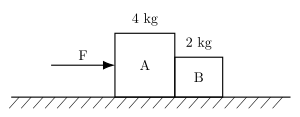
›Reveal solutionSolution
Applying F=ma to block B alone gives the push A exerts on B as 2×3=6 N to the right; Newton's third law then gives the force B exerts on A as 6 N to the left — option (C).
The concept first: choose your system, then Newton's third law
Two ideas do all the work here.
- Free-body isolation. When blocks are in contact and moving together, you can treat them as one body (to find the external force) or isolate one of them (to find the internal contact force). To find a contact force, always isolate the block on which fewer forces act — here that is B, on which the only horizontal force is the push from A. The applied F never touches B directly; it acts on A.
- Newton's third law. Contact forces come in pairs: whatever A does to B, B does back to A with equal magnitude and opposite direction. The question asks for the reaction member of that pair.
Students go wrong here by computing F (12 N) and offering it as the answer. Read the question carefully: it asks for the force exerted by B on A, not the force applied to the system.
Step-by-step
- Data. mA=4 kg, mB=2 kg, a=3 ms−2 to the right, frictionless throughout.
- Isolate block B. The only horizontal force acting on B is the normal contact force N from block A's right face, pushing B to the right. (Its weight and the floor's normal force are vertical and cancel.) Newton's second law along the horizontal:
N=mBa=2 kg×3 ms−2=6 N (to the right)
So A pushes B with 6 N to the right.
3. Apply Newton's third law. The reaction to that push is the force B exerts on A:
FB→A=6 N to the LEFT …
- TG EAPCET 2023Set ap-2023-05-11-FN1 markMCQQ.A boy of mass 'm' stands at one end of a long trolley of mass M moving with uniform speed V on a smooth horizontal floor. If the boy runs forward with a speed 2V, what is the speed of the centre of mass of the trolley-boy system? (A) 2(M−m)(2M−m)V (B) (M−m)(M+m)V (C) 2V (D) V
›Reveal solutionSolution
The centre of mass of an isolated system continues with its original velocity regardless of internal motions — so the answer is simply V, option (D).
The key idea here is that the trolley and the boy together form an isolated system on a smooth horizontal floor. "Smooth" means no external horizontal force acts on the system. When no external force acts, the velocity of the centre of mass of the system remains constant — this is a direct consequence of Newton’s first law applied to the centre of mass.
Many students get tempted to recalculate the centre-of-mass speed after the boy runs, thinking it changes. But internal forces (the boy pushing against the trolley) cannot change the motion of the centre of mass. Only an external force can do that. So the centre of mass keeps moving exactly as it was before the boy started running.
Let’s walk through it carefully.
- Before the boy runs The trolley of mass M and the boy of mass m are both moving together with uniform speed V. The velocity of the centre of mass is simply:
Vcm=M+mMV+mV=V
because both have the same velocity V.
-
The boy runs forward with speed 2V relative to what?
The problem says "runs forward with a speed 2V". In standard exam language, this means relative to the trolley (or relative to the ground? — we must check). If it were relative to the ground, the centre-of-mass speed would still be V (since no external force), but the trolley’s speed would adjust. However, the phrasing "runs forward" on a moving trolley usually means relative to the trolley itself. But here’s the beautiful part: it doesn’t matter what the boy’s speed is relative to — the centre-of-mass velocity remains unchanged.
-
Why does the centre-of-mass velocity stay the same? …
- TG EAPCET 2023Set eng-2023-05-13-AN1 markMCQQ.A car is travelling with linear velocity 'V' on a circular road of radius 'r'. If its velocity is increasing at a rate of 'a' ms−2, then the resultant acceleration will be (A) (r2V2−a2) (B) (r2V4+a2) (C) (r2V4−a2) (D) (r2V2+a2)
›Reveal solutionSolution
The resultant acceleration is the vector sum of the tangential acceleration a and the centripetal acceleration V2/r, so the magnitude is (V4/r2)+a2. The correct option is (B).
When an object moves on a circular path, its acceleration has two perpendicular components:
- Tangential acceleration at (here given as a) — changes the speed along the path.
- Centripetal (radial) acceleration ac=V2/r — changes the direction of velocity, always pointing toward the center.
Because these two accelerations are perpendicular (tangent vs. radial), the resultant acceleration is the hypotenuse of a right triangle formed by them. So we use the Pythagorean theorem to find its magnitude.
-
Identify the two perpendicular components
- Tangential: at=a (given directly).
- Centripetal: ac=rV2 (standard formula for circular motion).
-
Apply the Pythagorean theorem
Since the accelerations are perpendicular, the magnitude of the resultant acceleration is
aresultant=at2+ac2=a2+(rV2)2.
- Simplify the expression aresultant=a2+r2V4. …
- TG EAPCET 2023Set eng-2023-05-13-AN1 markMCQQ.A particle of mass ‘m’ is moving along a line y=x+a with a constant velocity ‘v’. The angular momentum of the particle about the origin is (A) mva (B) mva2 (C) 2mva (D) x2mva
›Reveal solutionSolution
Angular momentum depends only on the perpendicular distance from the origin to the line of motion. For the line y=x+a, that distance is a/2, so L=mv⋅(a/2), making the correct option (C).
The key idea is that angular momentum about a point is L=mvr⊥, where r⊥ is the perpendicular distance from the point to the line of the velocity vector. Since the particle moves along a straight line with constant velocity, its angular momentum is constant — and we only need the shortest distance from the origin to that line.
-
Identify the line of motion
The particle moves along y=x+a. This is a straight line with slope 1 and y-intercept a.
-
Find the perpendicular distance from the origin to this line
The distance from a point (x0,y0) to a line Ax+By+C=0 is
d=A2+B2∣Ax0+By0+C∣.
Rewrite y=x+a as x−y+a=0, so A=1, B=−1, C=a.
For the origin (0,0):
d=12+(−1)2∣1⋅0+(−1)⋅0+a∣=2∣a∣.
Since a is presumably positive (a constant offset), d=a/2.
- Apply the angular momentum formula Angular momentum about the origin is
L=mvr⊥=mv⋅2a=2mva.
- Match with the options …
-
- TG EAPCET 2023Set eng-2023-05-13-AN1 markMCQQ.A force of 6.4 N stretches a vertical spring by 0.1 m. If it were to oscillate with a period of 4π then the mass that is to be suspended from the spring is (A) 4π kg (B) 1 kg (C) π1 kg (D) 10 kg
›Reveal solutionSolution
Use Hooke’s law to find the spring constant, then the period formula for a mass–spring system to solve for the mass. The result is 1 kg.
Concept & Intuition
A vertical spring with a mass hanging from it oscillates with the same period as a horizontal spring: T=2πm/k. The key is that the spring constant k comes from the static stretch caused by a known force. Once we have k, the period equation directly gives the mass.
- Find the spring constant k Hooke’s law: F=kx. Given F=6.4N and x=0.1m:
k=xF=0.16.4=64N/m.
- Write the period formula for a mass–spring system
T=2πkm.
The problem states T=4π seconds.
- Substitute and solve for m
4π=2π64m.
Divide both sides by 2π:
81=64m.
Square both sides:
- TG EAPCET 2023Set eng-2023-05-14-AN1 markMCQQ.The displacement of a particle is given by the relation x=4(cosπt+sinπt). The amplitude of the particle is (A) −4 (B) 4 (C) 42 (D) 8
›Reveal solutionSolution
x=4cosπt+4sinπt is the superposition of two SHMs of equal amplitude 4 and a 90∘ phase difference; combining them gives x=42sin(πt+4π), so the amplitude is 42 — option (C).
The concept first
Adding a sine and a cosine of the same frequency always gives another sinusoid of that frequency:
acosωt+bsinωt=Rsin(ωt+ϕ),R=a2+b2,tanϕ=ba.
Physically: two SHMs along the same line, with the same ω but a phase difference of 90∘, superpose to a single SHM whose amplitude is the vector (Pythagorean) sum of the two amplitudes — not the arithmetic sum. That is why the answer is 42 and not 8.
Also remember: amplitude is a positive quantity (the maximum displacement), so a negative option like −4 can never be right.
Step-by-step
- Expand:
x=4cosπt+4sinπt.
So a=4 (coefficient of cos), b=4 (coefficient of sin), and ω=π rad s−1.
- Combine using R=a2+b2:
R=42+42=16+16=32=42≈5.66.
- Find the phase (optional but instructive): …
- TG EAPCET 2022Set ap-2022-07-31-FN1 markMCQQ.A circular sheet of radius 2m and moment of inertia 4kg m2 has initial angular speed 10rad/s. A constant tangential force is applied and the sheet is stopped in 5sec. The magnitude of the force is (A) 4N (B) 8N (C) 2N (D) 16N
›Reveal solutionSolution
Angular deceleration α=50−10=−2 rad/s2; torque τ=Iα=8 N⋅m; force F=rτ=28=4 N. Answer: (A).
Concept & Intuition
A constant tangential force at radius r gives a constant torque τ=Fr, producing a uniform angular deceleration through τ=Iα. Use rotational kinematics for α, then solve back for F.
Step-by-step …
🎓Unlock everything free for 14 days
- ✓Full step-by-step solutions
- ✓Concept-first explanations
- ✓Methods, shortcuts & mistakes
- ✓PYQ mapping + timed mock tests
Full access for 14 days. No credit card required.