Q.A particle slides down a frictionless parabolic track shaped like y=x2. It starts from rest at point A on the upper-left arm of the parabola, slides down through point B at the vertex (the lowest point of the parabola), and continues up the right arm to point C, which is at a height less than that of A. At C the particle leaves the track and moves freely through the air as a projectile, launched at some speed at an angle above the horizontal, and reaches the highest point of its flight at P. Given this, which of the following are correct? (Note: more than one option may be correct.)
🔒You're viewing a preview — the full solution, concept, methods & PYQ mapping are locked.
🔒 Start your 14-day free trial to unlock the full solution →Concept understanding — Conservation Of Mechanical Energy
Conservation of Mechanical Energy
The Intuition First
Imagine you're holding a heavy stone at shoulder height. Your arm is tired. That stone has potential energy — energy stored because of its position. Now let it go. As it falls, it speeds up. The potential energy is turning into kinetic energy — the energy of motion. Just before it hits the ground, all the original potential energy has become kinetic energy.
Now imagine the reverse: you throw a ball straight up. It leaves your hand fast (lots of kinetic energy), rises, slows down, stops for an instant at the top (zero kinetic energy), then falls back. At the top, all the kinetic energy you gave it has turned back into potential energy.
This back-and-forth transformation — potential ↔ kinetic — is the heart of the idea. Energy doesn't disappear; it just changes form. That's conservation.
The Precise Statement
Conservation of Mechanical Energy: In an isolated system where only conservative forces (like gravity or an ideal spring) do work, the total mechanical energy of the system remains constant.
Total mechanical energy is the sum of kinetic energy (K) and potential energy (U):
Emech=K+U
The law says:
Kinitial+Uinitial=Kfinal+Ufinal
Or, in symbols:
Emech, initial=Emech, final
What This Means in Practice
Let's go back to the falling stone. Suppose you hold it 5 metres above the ground. Its mass is 2 kg. Take g=10 m/s2.
-
At the top (initial):
Ki=0 (not moving)
Ui=mgh=2×10×5=100 J
Emech=0+100=100 J
-
Just before hitting ground (final):
Uf=0 (height = 0)
Kf=21mv2
Conservation says Kf=100 J, so 21×2×v2=100, giving v=10 m/s.
You never needed to know the time of fall or acceleration. Energy conservation gave you the speed directly.
The Two Critical Conditions
Mechanical energy is not always conserved. It is conserved only when:
- No non-conservative forces (like friction, air resistance, or applied pushes/pulls) do work.
- The system is isolated — no external forces transfer energy in or out.
If friction is present, some mechanical energy turns into heat (thermal energy). The total energy of the universe is still conserved, but mechanical energy alone is not.
A Simple Example to Cement It …
The track and flight are both frictionless/gravity-only, so total mechanical energy is conserved everywhere: total energy at P equals total energy at A. But at P the particle still has horizontal speed, so its KE is not zero and its height is below A; and KE at P is less than KE at B. Only (C) holds. …
No friction acts and only gravity does work, so the total mechanical energy is the same at every instant — hence (C) is correct. At the top of its flight the projectile still moves horizontally, so it retains kinetic energy there; that makes P lower than A and its KE smaller than at B, so (A) and (B) fail. The two travel times in (D) have no reason to match. Answer: (C) only.
Concept
The parabolic track is frictionless and, after C, the particle is in free projectile motion. In both phases the only forces are the (normal, does no work) track reaction and gravity (conservative). Therefore total mechanical energy E=KE+PE is conserved throughout. Take B (the vertex) as the reference level, and let hA and hC be the heights of A and C above B, with hA>hC.
Working through each option
(C) total energy at P = total energy at A — TRUE. With no energy dissipation, E is constant, so EP=EA. This is the safe consequence of energy conservation.
(A) KE at P = KE at B — FALSE. At B all of A's potential energy has become kinetic: KEB=mghA. At the apex P the vertical velocity is zero but the horizontal velocity vx=v0cosθ survives, so KEP=21mv02cos2θ. Since 21mv02=mg(hA−hC), we get KEP=mg(hA−hC)cos2θ<mghA=KEB.
(B) height at P = height at A — FALSE. By energy conservation mghA=KEP+mghP, so
hP=hA−mgKEP=hA−(hA−hC)cos2θ<hA, …
Concept: Settle Each Claim by Contradiction, Using Only "Horizontal Velocity Never Changes"
Method: Proof by Contradiction for (A), (B), (D); Direct Energy Conservation for (C)
Rather than computing hP, KEP explicitly in terms of the launch angle at C, this method assumes each false statement is true and shows it forces an impossible conclusion -- using only one physical fact that's true throughout the entire flight, on the track and in the air: gravity and the (frictionless) normal force never touch the particle's horizontal momentum, so the horizontal component of velocity, once the particle leaves the track at C, is fixed for the rest of the flight and equal to whatever it was at C. Since C is on the curved, rising part of the track (not its flat vertex), that horizontal speed at C is strictly positive.
Setting up the one fact everything rests on
Once airborne, the only force is gravity (vertical) -- the standard projectile setup -- so vx(t)=vCx>0 for the entire flight after C, including at the apex P. (vCx>0 because C sits on the sloped right arm of the parabola, where the track's own tangent has a nonzero horizontal component -- only at the vertex B would the tangent be perfectly vertical, which C is not.)
(C): total energy at P = total energy at A -- proved directly, not by contradiction
The track (frictionless) and the air (gravity only) both do work only via a conservative force, so mechanical energy E=KE+PE is conserved across the entire journey A→B→C→P with no exceptions. Hence trivially EP=EA. (C) is true.
(A): KE at P = KE at B -- refuted by contradiction
Assume KEP=KEB. Since E is conserved (from (C)) and E=KE+mgh, equal KE at two points forces equal height too: hP=hB=0 (taking B as the reference level). But P is the highest point of a projectile launched with vCx>0 -- for that to have zero height above B, C itself would already have to be at height 0 (i.e. C=B), contradicting that C is a distinct point higher up the right arm. Contradiction ⇒ (A) is false.
(B): height at P = height at A -- refuted by contradiction
Assume hP=hA. By conservation of energy, this forces KEP=KEA=0 (the particle started from rest at A). But KEP≥21mvCx2>0, since the horizontal velocity vCx never vanishes during the flight (Step 1) -- the particle cannot have zero kinetic energy at P while still carrying nonzero horizontal speed. Contradiction ⇒ (B) is false.
(D): time A→B equals time B→P -- refuted by a structural mismatch, not a computation …
- TG EAPCET 2026Set eng-2026-05-10-AN1 markMCQQ.A ball of mass 0.5 kg is dropped freely from a point A which is at a height of 10 m from the ground. Between second and third collisions with the ground, the linear momentum of the ball becomes zero at a point B. If the coefficient of restitution between the ball and the ground is 0.5, then the percentage loss of the potential energy of the ball when it reaches point B is (A) 23.25 (B) 83.75 (C) 6.25 (D) 93.75
›Reveal solutionSolution
The ball loses energy with each bounce due to the coefficient of restitution. Between the second and third collisions, its momentum becomes zero at the highest point of the second bounce. The percentage loss of potential energy relative to the initial drop is 93.75%, so the correct option is (D).
Concept and Intuition
When a ball is dropped from a height, it gains kinetic energy as it falls. On hitting the ground, it rebounds with a speed reduced by the coefficient of restitution e. This means the height of each successive bounce is e2 times the previous height. The question asks: Between the second and third collisions, when does the linear momentum become zero? That happens at the highest point of the second bounce — because at the peak, the ball momentarily stops before falling again. At that point, its kinetic energy is zero, so all its mechanical energy is gravitational potential energy. We need to find what percentage of the original potential energy (from point A) is lost by the time the ball reaches that peak.
Step-by-step solution
- Initial potential energy The ball is dropped from height h0=10m, mass m=0.5kg. Initial potential energy:
U0=mgh0=0.5×9.8×10=49J
(We can keep g symbolic; it will cancel.)
- Height after first bounce Coefficient of restitution e=0.5. After the first impact, the rebound speed is e times the impact speed. Since height is proportional to the square of speed, the height after the first bounce is:
h1=e2h0=(0.5)2×10=0.25×10=2.5m
- Height after second bounce The same factor applies again: after the second impact, the ball rebounds to a height:
h2=e2h1=(0.5)2×2.5=0.25×2.5=0.625m
- Where does momentum become zero between second and third collisions? The ball is in the air between the second and third collisions. Its momentum becomes zero at the top of the second bounce, i.e., at height h2. At that point, the ball has only potential energy:
- TG EAPCET 2025Set ap-2025-04-30-FN1 markMCQQ.A metal beam of length 1 m, breadth 2.5 cm and thickness 5 mm supported at its ends is loaded at its center by a weight of 25 N. The metal beam sags at the middle by an amount of (Young's modulus of the metal =2×10¹¹ Nm−2) (A) 1 cm (B) 1 mm (C) 0.5 cm (D) 3 mm
›Reveal solutionSolution
For a beam supported at both ends and loaded at its centre, the sag is δ=4bd3YWL3=1 cm.
Given: length L=1 m, breadth b=2.5 cm=2.5×10⁻² m, thickness d=5 mm=5×10⁻³ m, central load W=25 N, and Y=2×10¹¹ N m−2.
Depression of a centrally-loaded beam supported at both ends:
δ=4bd3YWL3
Substitute the values:
d3=(5×10⁻³)3=1.25×10⁻⁷ m3 …
- TG EAPCET 2024Set ap-2024-05-08-FN1 markMCQQ.A block enters a rough horizontal surface with a speed of 6 ms−1 at x=1.5 m and leaves the rough horizontal surface with a speed of 4 ms−1 at x=2.5 m. If the retarding force acting on the block is F=−25x (where F is in newton and x is in meter), then the mass of the block is (A) 2.5 kg (B) 10 kg (C) 5 kg (D) 4 kg
›Reveal solutionSolution
The work done by the variable force equals the change in kinetic energy. Integrating F=−25x from x=1.5 to 2.5 m and equating to 21m(42−62) gives m=5 kg.
The key here is that the retarding force is not constant — it depends on position x. When a force varies with position, you cannot use F=ma with constant acceleration. Instead, the work–energy theorem is the natural tool: the net work done on the block equals its change in kinetic energy. That theorem holds for any force, constant or variable, as long as you can compute the work integral.
The force is given as F=−25x, where the negative sign means it opposes the motion. The block moves from x=1.5 m to x=2.5 m, so the work done by this force is the integral of F over that displacement.
- Write the work–energy relation. The work done by the retarding force is
W=∫xixfFdx=∫1.52.5(−25x)dx.
This work equals the change in kinetic energy:
W=21mvf2−21mvi2.
Here vi=6 m/s and vf=4 m/s.
- Evaluate the integral.
W=−25∫1.52.5xdx=−25[2x2]1.52.5.
Compute the bracket:
2(2.5)2−2(1.5)2=26.25−2.25=24=2.
So W=−25×2=−50 J.
The negative sign makes sense — the force opposes motion, so it removes energy from the block.
- Set up the kinetic energy change. …
- TG EAPCET 2024Set eng-2024-05-10-AN1 markMCQQ.A block kept on a frictionless horizontal surface is connected to one end of a horizontal spring of constant 100Nm−1 whose other end is fixed to a rigid vertical wall. Initially the block is at its equilibrium position. The block is pulled to a distance of 8cm and then released. The kinetic energy of the block when it is at a distance of 3cm from the mean position is (A) 0.65J (B) 0.325J (C) 0.275J (D) 0.55J
›Reveal solutionSolution
The kinetic energy at a given displacement is the difference between the total mechanical energy and the elastic potential energy at that point. Using conservation of energy, the answer is 0.275 J, which corresponds to option (C).
The key idea here is conservation of mechanical energy in a spring-block system on a frictionless surface. Since there is no friction, the total energy (kinetic + elastic potential) remains constant. At the maximum displacement (amplitude), all energy is stored as spring potential energy. At any other position, the kinetic energy is simply the total energy minus the potential energy at that position.
Let’s work through it step by step.
-
Identify the given data and convert to SI units.
Spring constant: k=100N/m
Amplitude (maximum stretch from equilibrium): A=8cm=0.08m
Position of interest: x=3cm=0.03m from the mean position.
-
Find the total mechanical energy of the system.
At the extreme position (x=A), the block is momentarily at rest, so kinetic energy is zero. All energy is elastic potential energy:
Etotal=21kA2=21×100×(0.08)2
Etotal=50×0.0064=0.32J
- Find the elastic potential energy at x=0.03m.
U=21kx2=21×100×(0.03)2
-
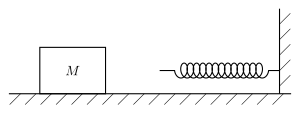
- TG EAPCET 2023Set eng-2023-05-13-FN1 markMCQQ.A block of mass M moving on a frictionless horizontal surface collides with a spring of spring constant K, as shown in the figure. If the spring compresses by a length L, then the maximum momentum of the block after the collision is (A) Zero (B) KML2 (C) LMK (D) 2MKL2
›Reveal solutionSolution
The block loses all its kinetic energy to the spring at maximum compression, then regains it symmetrically, so its maximum momentum after collision equals the initial momentum, which is LMK — option (C).
The key concept is energy conservation in a frictionless system. The block collides with the spring, compresses it, and then the spring pushes the block back. Since there's no friction, mechanical energy is conserved: the block's kinetic energy transforms entirely into spring potential energy at maximum compression, and then back into kinetic energy as the spring expands. The maximum momentum after the collision occurs when the block leaves the spring with its original speed (but opposite direction), so we just need to find the initial momentum from the given compression.
- At maximum compression, the block is momentarily at rest, so all its initial kinetic energy has been converted into elastic potential energy of the spring. Let the initial speed of the block be v0. Then:
21Mv02=21KL2
Cancel the 21:
Mv02=KL2
- Solve for the initial speed:
v0=MKL2=LMK
- The initial momentum is: p0=Mv0=M⋅LMK=LMK …
- TG EAPCET 2022Set eng-2022-07-19-AN1 markMCQQ.Particle A moving with a velocity v=10 m/s experienced a head on collision with a stationary particle B of the same mass. As a result of collision, the kinetic energy of the system decreased by 1%. The speed of particle A after collision is (A) 10 m/s (B) 0.05 m/s (C) 5 m/s (D) 102 m/s
›Reveal solutionSolution
Momentum + energy conservation for equal masses give vA+vB=10 and vA2+vB2=99; the moving particle emerges at ≈0.05 m/s.
Both particles have equal mass m. Take the initial speed of A as 10 m/s and B at rest.
Momentum conservation:
m(10)=mvA+mvB⟹vA+vB=10
Kinetic energy (decreased by 1%, so final =0.99 of initial):
21mvA2+21mvB2=0.99(21m(10)2)⟹vA2+vB2=99
From these, 2vAvB=(vA+vB)2−(vA2+vB2)=100−99=1, so vAvB=0.5.
Thus vA,vB are roots of t2−10t+0.5=0:
t=210±100−2=210±98≈9.95 or 0.05 …
- TG EAPCET 2021Set ap-2021-08-10-AN1 markMCQQ.A shell of mass 20 g is fired by a gun of mass 100 kg. If the muzzle speed of the shell is 6 km/min., what is the recoil speed of the gun? (A) 1 cm/s (B) 2 cm/s (C) 3 cm/s (D) 4 cm/s
›Reveal solutionSolution
The recoil speed of the gun is found by applying conservation of momentum to the gun-shell system. Converting units carefully gives a recoil speed of 2 cm/s, so the correct option is (B).
Concept and Intuition
When a gun fires a shell, the total momentum of the gun + shell system is conserved if no external horizontal forces act (like friction). Before firing, both are at rest, so total momentum = 0. After firing, the shell moves forward and the gun recoils backward. Their momenta must be equal in magnitude and opposite in direction:
mshellvshell=mgunvgun
The key trap: units. The shell’s speed is given in km/min, but the answer choices are in cm/s. We must convert everything to a consistent system (e.g., kg, m, s or g, cm, s).
Step-by-step solution
-
Write down given data
- Mass of shell: ms=20 g
- Mass of gun: mg=100 kg=100000 g (since 1 kg = 1000 g)
- Muzzle speed of shell: vs=6 km/min
-
Convert shell speed to cm/s
- 1 km=1000 m=100000 cm
- 1 min=60 s
- So vs=6×60 s100000 cm=6×60100000=6×610000=10000 cm/s (Check: 6×100000/60=600000/60=10000)
-
Apply conservation of momentum
Initial momentum = 0.
Final momentum: msvs+mgvg=0 (taking forward as positive, so vg will be negative).
Magnitude relation:
msvs=mg∣vg∣
Solve for ∣vg∣:
∣vg∣=mgmsvs=100000 g20 g×10000 cm/s
- Simplify …
-
- TG EAPCET 2021Set ap-2021-08-10-AN1 markMCQQ.A car of mass 1000 kg collides with a horizontally mounted spring and comes to rest. If the speed of the car just before the collision was 10 m/s and spring constant k=104 N/m, then what is the maximum compression of the spring (A) 1010 m (B) 1010 m (C) 210 m (D) 10 m
›Reveal solutionSolution
The problem is solved by equating the car’s kinetic energy to the spring’s elastic potential energy at maximum compression. The result is 1010 m, which matches option (A).
The key idea is energy conservation: when the car collides with the spring and comes to rest, all its kinetic energy has been transferred into the spring’s stored elastic potential energy. No energy is lost (ideal spring, no friction), so we can set 21mv2=21kx2 and solve for x, the maximum compression.
- Write the energy conservation equation The car’s kinetic energy just before impact is
KE=21mv2
The spring’s potential energy at maximum compression x is
PE=21kx2
Because the car comes to rest, all kinetic energy becomes spring potential energy:
21mv2=21kx2
- Cancel the common factor 21 This simplifies to
mv2=kx2
- Solve for x
x2=kmv2⇒x=vkm
- Plug in the given values m=1000 kg, v=10 m/s, k=104 N/m …
- TG EAPCET 2021Set ap-2021-08-10-FN1 markMCQQ.A car of mass 1000 kg collides with a horizontally mounted spring and comes to rest. If the speed of the car just before the collision was 10 m/s and spring constant k=104 N/m, then what is the maximum compression of the spring (A) 1010 m (B) 1010 m (C) 210 m (D) 10 m
›Reveal solutionSolution
The car’s kinetic energy is completely converted into the spring’s elastic potential energy. Using energy conservation, the maximum compression is x=kmv2=1041000⋅102=10 m, which matches option (A).
Concept & Intuition
When the car hits the spring, it slows down as the spring compresses. If we ignore friction and other losses, the car’s kinetic energy just before impact is entirely stored as elastic potential energy in the spring at the moment of maximum compression (when the car momentarily stops). This is a classic conservation of mechanical energy problem:
21mv2=21kx2
where x is the maximum compression. The mass m, speed v, and spring constant k are given, so we can solve directly for x.
Step-by-step solution
- Write the energy conservation equation The car’s kinetic energy before collision:
KE=21mv2
The spring’s potential energy at maximum compression:
PE=21kx2
Setting them equal (no energy loss):
21mv2=21kx2
- Cancel the common factor 21
mv2=kx2
- Solve for x
x2=kmv2⇒x=kmv2
- Plug in the numbers …
- TG EAPCET 2021Set eng-2021-08-05-FN1 markMCQQ.A small block of mass 200g is placed on a horizontal slab at a height of 2m above the floor. The block is pressed against a horizontal spring fixed at one end to compress the spring through 10.0cm. Upon releasing, the block moves horizontally till it leaves the spring. Calculate the horizontal distance covered by the block after leaving the slab and just before hitting the ground. The spring constant is 50N/m. (Assume g=10m/s2). (A) 0.99m (B) 0.55m (C) 0.44m (D) 0.33m
›Reveal solutionSolution
Spring energy → block's kinetic energy gives launch speed v=2.5 m/s; projectile fall from 2 m takes 0.4 s, so horizontal range =vt=1.0 m≈0.99 m, option (A).
Launch speed from the spring
Convert the stored spring energy to kinetic energy (m=0.2 kg, k=50 N/m, x=0.10 m):
21kx2=21mv2 ⇒ v2=mkx2=0.250×(0.10)2=0.20.5=2.5,
v=2.5≈1.58 m/s.
Projectile off the edge of the slab
The block leaves the slab horizontally at height h=2 m. Time to fall: …
🎓Unlock everything free for 14 days
- ✓Full step-by-step solutions
- ✓Concept-first explanations
- ✓Methods, shortcuts & mistakes
- ✓PYQ mapping + timed mock tests
Full access for 14 days. No credit card required.