Q.A hill is 500 m high. Supplies are to be sent across the hill using a canon that can hurl packets at a speed of 125 m/s over the hill. The canon is located at a distance of 800m from the foot of hill and can be moved on the ground at a speed of 2 m/s; so that its distance from the hill can be adjusted. What is the shortest time in which a packet can reach on the ground across the hill ? Take g=10 m/s2.
🔒You're viewing a preview — the full solution, concept, methods & PYQ mapping are locked.
🔒 Start your 14-day free trial to unlock the full solution →Concept understanding — Projectile Motion
Projectile Motion — From Intuition to Precision
Imagine you throw a ball to a friend. It doesn't travel in a straight line — it rises, slows down, then curves downward and falls. That curved path is a projectile's trajectory. The ball is a projectile: any object that is launched into the air and then moves only under the influence of gravity (and air resistance, which we ignore for now).
The key intuition: once the ball leaves your hand, the only force acting on it is gravity pulling it straight down. There is no forward force after release. The ball keeps moving forward because of inertia — it wants to keep going in a straight line at constant speed. But gravity keeps pulling it down, so the forward motion and downward acceleration combine to produce a curved path.
The Precise Statement
Projectile motion is the two-dimensional motion of an object launched into the air, subject only to the constant downward acceleration due to gravity (g≈9.8m/s2). Air resistance is neglected.
We break the motion into two independent components:
- Horizontal motion: No acceleration (ax=0). So horizontal velocity vx is constant.
- Vertical motion: Constant downward acceleration (ay=−g). So vertical velocity vy changes linearly with time.
The independence of these components is the central idea — what happens vertically does not affect what happens horizontally, and vice versa.
The Equations (for a projectile launched with initial speed u at angle θ above horizontal)
First, resolve the initial velocity:
ux=ucosθ,uy=usinθ
Horizontal motion (constant velocity):
x=uxt=(ucosθ)t
Vertical motion (constant acceleration −g):
vy=uy−gt=usinθ−gt
y=uyt−21gt2=(usinθ)t−21gt2
Key Results You Must Know
Time of flight T: total time the projectile stays in the air (until y=0 again).
T=g2usinθ
Maximum height H: the highest vertical position reached (when vy=0).
H=2gu2sin2θ
Range R: the horizontal distance covered when it returns to launch height.
R=gu2sin2θ
The range is maximum when sin2θ=1, i.e., θ=45∘. For a given speed, 45∘ gives the farthest throw.
The Trajectory Equation (Path Shape)
Eliminate t from the x and y equations to get y as a function of x:
y=xtanθ−2u2cos2θgx2
This is a parabola — the signature shape of projectile motion.
Common Mistake to Avoid …
Concept: Projectile motion + optimization. The total time is (time to reposition the cannon) + (flight time). Moving the cannon closer to reduce the required launch angle isn't free — it costs 0.5 s per metre moved (speed 2 m/s) — so the shortest time may come from not moving it at all.
- Leave the cannon at its original distance, 800 m, and find the smallest launch angle θ that still clears the 500 m hill from there. Using the trajectory equation y=xtanθ−2v02gx2sec2θ with x=800 m, v0=125 m/s, g=10 m/s2, and setting y=500 m:
800tanθ−204.8sec2θ=500
- Solving this quadratic in tanθ gives the minimum clearing angle θ≈53.3∘.
- Flight time at this angle: T=g2v0sinθ=102(125)(0.802)≈20.0 s. …
The shortest time is obtained by NOT moving the cannon at all — fired from its original position, 800 m from the hill, at the smallest angle that just clears the 500 m hilltop, the packet reaches the far side in about 20 s.
What we are minimizing
The total time has two parts: the time spent repositioning the cannon (it moves at 2 m/s) and the time of flight of the packet (launched at 125 m/s, g=10 m/s2). Both depend on the launch angle chosen, so different strategies must be compared.
A tempting but wasteful strategy: put the apex exactly over the hilltop
One way to clear the hill is to aim so that the very peak of the trajectory sits exactly at the hilltop's height, 500 m.
- Vertical launch speed needed to just reach height 500 m at the peak: using vy2=2gh,
vy=2×10×500=100 m/s
- Horizontal launch speed (from v0=125 m/s): vx=1252−1002=5625=75 m/s.
- Time to reach the peak: t1=gvy=10100=10 s, covering a horizontal distance x=vxt1=75×10=750 m.
- So the cannon would have to be moved from 800 m to 750 m — a 50 m move, costing 250=25 s.
- By symmetry the packet also takes 10 s to come down the far side, so total flight time =20 s.
- Total time this way: 25+20=45 s.
This clears the hill, but it spends 25 s of repositioning just to place the peak exactly over the hilltop — far more than is actually needed, since the packet only has to clear the hill, not peak exactly above it.
The better strategy: don't move the cannon at all
Leave the cannon at its original 800 m and fire it at the smallest angle θ that still lets the packet be at height 500 m (or higher) when it is horizontally 800 m away — i.e. just grazing the hilltop, not peaking over it.
The trajectory height at horizontal distance x is:
y=xtanθ−2v02cos2θgx2=xtanθ−2v02gx2sec2θ
At x=800 m, v0=125 m/s, g=10 m/s2:
2v02gx2=2×125210×8002=31,2506,400,000=204.8
Setting y=500 m (just grazing the hilltop) and writing t=tanθ, with sec2θ=1+t2:
800t−204.8(1+t2)=500⟹204.8t2−800t+704.8=0
Solving this quadratic:
t=2(204.8)800±8002−4(204.8)(704.8)≈409.6800±250.6 …
Concept: Show the Optimum Is a Boundary Point via Sensitivity, Not by Comparing Two Guessed Strategies
Method: Perturb the Cannon's Position and Compare Marginal Cost to Marginal Benefit
Rather than picking two specific candidate cannon positions and comparing their total times, this method asks how the total time changes if the cannon is nudged closer to the hill by a small amount, and shows the cost of moving always outweighs any benefit -- proving x=800 m (no move at all) is optimal without needing to guess the right alternative in advance.
Steps
- Write the total time as a function of the cannon's distance x from the hill (x≤800 m, moved at 2 m/s):
T(x)=repositioning cost2800−x+flight timeg2v0sinθmin(x),
where θmin(x) is the smallest launch angle that still clears the 500 m hill from distance x (found from xtanθ−2v02gx2sec2θ=500).
-
The repositioning term has a fixed, unavoidable marginal cost: moving the cannon 1 m closer always costs 21 s, regardless of x.
-
Check whether the flight-time term compensates, using a second data point close to x=800 m. Solve the same quadratic at x=700 m (cannon moved 100 m closer):
156.8tan2θ−700tanθ+656.8=0⇒tanθmin≈1.3415⇒θmin≈53.3∘.
This is essentially identical to the θmin≈53.3∘ found at x=800 m -- so the flight-time term 2v0sinθmin/g≈20.0 s barely changes at all between the two positions.
- Compare the two effects. Moving 100 m closer costs a guaranteed 50 s in repositioning, but buys essentially zero reduction in flight time (both ≈20.0 s) -- so the total time strictly increases the moment the cannon is moved. …
- TG EAPCET 2024Set ap-2024-05-07-AN1 markMCQQ.The height of a transmitting antenna is 320 m and the height of a receiving antenna is 20 m. The maximum distance between them for satisfactory communication in LOS mode is (Radius of the earth = 6400 km) (A) 16 km (B) 64 km (C) 80 km (D) 45.5 km
›Reveal solutionSolution
The maximum line-of-sight (LOS) distance for communication between two antennas is limited by the Earth's curvature. This distance is the sum of the individual distances each antenna can "see" to the horizon. Using the given antenna heights and Earth's radius, the maximum distance is calculated to be 80 km.
The maximum distance for satisfactory communication in line-of-sight (LOS) mode is limited by the curvature of the Earth. Radio waves in LOS mode travel in straight lines, so they cannot bend around the Earth's curve. An antenna can only transmit or receive signals up to its visible horizon.
The total maximum distance between a transmitting antenna and a receiving antenna is the sum of the maximum distances each antenna can "see" to the horizon.
Consider an antenna of height h above the Earth's surface. Let R be the radius of the Earth. The maximum distance d from the antenna to the horizon can be found using the Pythagorean theorem. Imagine a right-angled triangle formed by:
- The center of the Earth.
- The point on the Earth's surface directly below the antenna.
- The point on the horizon where the line of sight from the antenna touches the Earth tangentially.
The sides of this triangle are:
- One leg is the radius of the Earth, R, extending from the center to the horizon point.
- The other leg is the distance d from the antenna to the horizon. This line is tangent to the Earth's surface at the horizon point, making it perpendicular to the radius R.
- The hypotenuse is the distance from the center of the Earth to the top of the antenna, which is R+h.
Applying the Pythagorean theorem:
d2+R2=(R+h)2
d2+R2=R2+2Rh+h2
d2=2Rh+h2
Since the antenna height h is typically much smaller than the Earth's radius R (h≪R), the term h2 is negligible compared to 2Rh.
Therefore, we can approximate:
d2≈2Rh
d≈2Rh
The maximum distance d from an antenna of height h to the horizon is given by:
d=2Rh
where R is the radius of the Earth.
If we have a transmitting antenna of height hT and a receiving antenna of height hR, the maximum distance for communication between them, dmax, is the sum of their individual horizon distances:
dmax=dT+dR=2RhT+2RhR
Now, let's apply this to the given problem.
- Identify the given values and ensure consistent units.
- Height of transmitting antenna, hT=320 m
- Height of receiving antenna, hR=20 m
- Radius of the Earth, R=6400 km=6400×103 m …
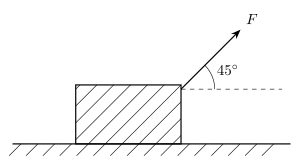
- TG EAPCET 2023Set eng-2023-05-13-FN1 markMCQQ.A body of weight 50 N is placed on a horizontal surface as shown in the figure. The minimum force required to move the body is 28.28 N. The frictional force and the normal reaction are respectively [FIGURE] (A) 10 N, 15 N (B) 20 N, 30 N (C) 2 N, 3 N (D) 5 N, 6 N
›Reveal solutionSolution
The problem gives the weight (50 N) and the minimum force to move the body (28.28 N). Using the relation between limiting friction, normal reaction, and the applied force at the threshold of motion, we find the normal reaction and frictional force are 30 N and 20 N respectively, matching option (B).
The key concept here is limiting friction. When a body is just about to move, the applied horizontal force equals the maximum static friction (limiting friction). The limiting friction f is related to the normal reaction N by f=μN, where μ is the coefficient of static friction. The weight of the body acts vertically downward, and on a horizontal surface, the normal reaction equals the weight unless there is an additional vertical component from the applied force. Here, the applied force is horizontal (as implied by "minimum force to move" on a horizontal surface), so the normal reaction is simply the weight minus any vertical pull — but since no angle is given, we assume the force is horizontal. That means N=weight=50N initially seems plausible, but then the friction would be 28.28 N, which doesn’t match any option. So there must be a vertical component: the applied force is likely at an angle, reducing the normal reaction. The minimum force to move a body on a horizontal surface is achieved when the force is applied at an angle that optimizes the trade-off between reducing normal reaction and maintaining a useful horizontal component.
Let’s work through it step by step.
-
Set up the forces.
Let the applied force F=28.28N be at an angle θ above the horizontal. The horizontal component is Fcosθ, which overcomes friction. The vertical component is Fsinθ, which reduces the normal reaction.
Weight W=50N.
Normal reaction: N=W−Fsinθ.
Limiting friction: f=μN.
At the threshold of motion: Fcosθ=f=μN.
-
Express the condition for minimum force.
The minimum force to move the body occurs when tanθ=μ (a standard result from optimizing F=cosθ+μsinθμW). At this optimum, the applied force is Fmin=1+μ2μW.
We know Fmin=28.28N and W=50N. So:
28.28=1+μ2μ×50
Square both sides:
28.282=1+μ22500μ2
Note 28.282≈800 (since 28.28≈202, so square is 800).
800=1+μ22500μ2
Multiply: 800(1+μ2)=2500μ2 → 800+800μ2=2500μ2 → 800=1700μ2 → μ2=1700800=178.
So μ=178≈0.686.
- Find the normal reaction and friction. At the optimum angle, tanθ=μ, so we can find sinθ and cosθ. If tanθ=μ, then sinθ=1+μ2μ and cosθ=1+μ21. Using μ2=8/17, we have 1+μ2=25/17, so 1+μ2=175. Then:
sinθ=5/178/17=58=522
cosθ=5/171=517
Now, normal reaction:
N=W−Fsinθ=50−28.28×522
Since 28.28≈202, we get:
N=50−(202)×522=50−520×2×2=50−580=50−16=34N
That gives 34 N, not matching any option. Wait — this suggests the applied force might not be at the optimum angle; instead, the problem likely intends the force to be applied horizontally but with a different interpretation.
Watch outA common pitfall is assuming the minimum force is applied at the optimum angle automatically. But here the numbers 28.28 and 50 are chosen so that 28.28≈202, and the options suggest nice round numbers. This hints that the force might be applied horizontally and the surface has a coefficient such that μ=f/N gives whole numbers. Let’s test the options directly. …
-
- TG EAPCET 2023Set eng-2023-05-14-AN1 markMCQQ.A projectile is given an initial velocity of i^+2j^ ms−1. The cartesian equation of its path is (x and y are in metres and g = 10 ms−1) (A) y=x−5x2 (B) y=2x−5x2 (C) y=2x−15x2 (D) y=2x−25x2
›Reveal solutionSolution
The key idea is to treat the initial velocity components as ux=1 and uy=2, then use the standard projectile path equation y=xtanθ−2u2cos2θgx2, which simplifies to y=uxuyx−2ux2gx2. Substituting g=10 gives y=2x−5x2, so the correct option is (B).
The problem gives the initial velocity vector as i^+2j^ m/s. This means the horizontal component ux=1 m/s and the vertical component uy=2 m/s. We are asked for the Cartesian equation of the projectile's path, with g=10 m/s².
The standard approach: For any projectile launched from the origin, the parametric equations are
x=uxt and y=uyt−21gt2.
Eliminate t by substituting t=x/ux into the y equation. This yields a quadratic in x — the path is a parabola.
Let’s work through it step by step.
-
Write the parametric equations
Horizontal motion (no acceleration): x=uxt=1⋅t=t.
Vertical motion (constant downward acceleration g): y=uyt−21gt2=2t−21⋅10⋅t2=2t−5t2.
-
Eliminate time t
Since x=t, we simply replace t by x in the y equation:
y=2x−5x2.
- Interpret the result …
-
- TG EAPCET 2022Set eng-2022-07-18-AN1 markMCQQ.A rocket fired vertically with a speed of 4 km/s from the earth's surface. How far from the earth does the rocket go before returning to the earth? (Take radius of earth = 6.4×10⁶ m and g=10 m/s2) (A) 500.24 km (B) 914.28 km (C) 1230.24 km (D) 1750.28 km
›Reveal solutionSolution
The rocket’s kinetic energy is converted into gravitational potential energy. Using energy conservation, the maximum height reached above Earth’s surface is found to be about 914.28 km, which corresponds to option (B).
The key idea is that the rocket is launched with a speed well below Earth’s escape velocity (about 11.2 km/s), so it will rise to a finite height, stop momentarily, and then fall back. Since gravity is not constant with height, we cannot use the simple mgh formula — we must use the full gravitational potential energy expression −rGMm.
Energy conservation is the cleanest route: the sum of kinetic and potential energy at launch equals the sum at the highest point, where kinetic energy is zero.
- Write the energy conservation equation. At the Earth’s surface (r=R), the rocket has kinetic energy 21mv2 and gravitational potential energy −RGMm. At the maximum height, its distance from Earth’s centre is r=R+h, its speed is zero, so only potential energy −R+hGMm remains.
21mv2−RGMm=−R+hGMm
- Cancel m and rearrange.
21v2=GM(R1−R+h1)
21v2=GM⋅R(R+h)h
- Replace GM with gR2. We know g=R2GM, so GM=gR2. Substituting:
21v2=gR2⋅R(R+h)h=R+hgRh
- Solve for h. Multiply both sides by (R+h):
21v2(R+h)=gRh
21v2R+21v2h=gRh
Bring h terms together:
21v2R=h(gR−21v2)
h=gR−21v221v2R
- Plug in the numbers. v=4 km/s=4000 m/s, R=6.4×10⁶ m, g=10 m/s2. …
- TG EAPCET 2022Set eng-2022-07-19-FN1 markMCQQ.A man walking along a straight line with a velocity 6 km/h encounters rain falling vertically down with a velocity 63 km/h. At what angle the man should hold his umbrella so that he can protect himself from rain (A) 30∘ with respect to ground (B) 30∘ with respect to vertical (C) 45∘ with respect to ground (D) 60∘ with respect to vertical
›Reveal solutionSolution
The man must tilt his umbrella against the relative velocity of rain with respect to him. The relative velocity vector makes an angle of 30∘ with the vertical, so the umbrella should be held at 30∘ to the vertical — option (B).
The key idea is that rain is falling vertically, but the man is moving horizontally. From his frame of reference, the rain appears to come at him from an angle. To stay dry, he tilts the umbrella into the apparent direction of the rain — that is, along the relative velocity of rain with respect to the man.
Let’s set up the velocities as vectors. Take the vertical direction as positive downward, and the horizontal direction as the man’s direction of motion.
- Rain velocity relative to ground: The rain falls vertically downward at 63 km/h.
vr=0i^+63j^(downward)
- Man’s velocity relative to ground: He walks horizontally at 6 km/h.
vm=6i^+0j^
- Relative velocity of rain with respect to the man: This is what the man “sees” — the rain’s velocity in his frame.
vrm=vr−vm=(0−6)i^+(63−0)j^
vrm=−6i^+63j^
The negative x-component means the rain appears to come from the front (toward the man’s face, since he walks in the +i^ direction).
- Angle of this relative velocity with the vertical: The vertical component is 63, the horizontal component is 6. The angle θ from the vertical satisfies
tanθ=vertical componenthorizontal component=636=31
Hence
θ=30∘
So the rain appears to come down at 30∘ from the vertical, tilted toward the man’s front.
- How to hold the umbrella: …
- TG EAPCET 2021Set ap-2021-08-09-FN1 markMCQQ.A solid cylinder rolls without slipping from top of an incline of length 2.7 m with angle of inclination 30∘. What will be its speed when it reaches the bottom of the incline? [ use g=10 m/s2 ] (A) 2 m/s (B) 22 m/s (C) 3 m/s (D) 32 m/s
›Reveal solutionSolution
For a rolling rigid body without slipping, gravitational potential energy converts into both translational and rotational kinetic energy. The final speed is v=34gh, which gives 3 m/s for the given incline.
The key concept is conservation of mechanical energy for a rigid body that rolls without slipping. Unlike a sliding block (where all potential energy becomes translational kinetic energy), a rolling object must also rotate. The no-slip condition links the rotational speed to the translational speed, so we can express the total kinetic energy in terms of the center-of-mass speed alone.
- Identify the energy conversion The cylinder starts from rest at height h and ends at the bottom with both translational and rotational kinetic energy. No energy is lost to friction because rolling without slipping means static friction does no work (the point of contact is instantaneously at rest). The height of the incline:
h=Lsinθ=2.7×sin30∘=2.7×0.5=1.35 m
- Write the conservation of energy equation Initial energy (all potential):
mgh
Final energy (translational + rotational):
21mv2+21Iω2
For a solid cylinder, moment of inertia about its center is
I=21mR2
No-slip condition:
ω=Rv
- Substitute and simplify
mgh=21mv2+21(21mR2)(Rv)2
mgh=21mv2+41mv2=43mv2 …
- TG EAPCET 2021Set ap-2021-08-10-AN1 markMCQQ.The horizontal and vertical displacement of the projectile at time t are x=36t, y=48t−4.9t2 where, x and y are in meter and t in second. Initial velocity of the projectile in m/s is (A) 15 (B) 30 (C) 45 (D) 60
›Reveal solutionSolution
The initial velocity is the magnitude of the velocity vector at t=0, found by differentiating the given parametric equations. The result is 60 m/s, so the correct option is (D).
The key idea is that the initial velocity of a projectile is the vector sum of its horizontal and vertical components at the very instant it is launched (t=0). The given equations x=36t and y=48t−4.9t2 describe the position over time. To find velocity, we differentiate each component with respect to time.
- Find the horizontal velocity component The horizontal position is x=36t. Differentiating:
vx=dtdx=36 m/s
This is constant because there is no horizontal acceleration (we assume air resistance is negligible).
- Find the vertical velocity component The vertical position is y=48t−4.9t2. Differentiating:
vy=dtdy=48−9.8t m/s
At t=0, this becomes vy=48 m/s.
- Combine the components at t=0 The initial velocity vector is (vx,vy)=(36,48). Its magnitude (the initial speed) is: v0=362+482=1296+2304=3600=60 m/s …
- TG EAPCET 2021Set ap-2021-08-10-FN1 markMCQQ.The horizontal and vertical displacement of the projectile at time t are x=36t, y=48t−4.9t2 where, x and y are in metres and t in second. Initial velocity of the projectile in m/s is (A) 15 (B) 30 (C) 45 (D) 60
›Reveal solutionSolution
The initial velocity is the magnitude of the velocity vector at t=0, found by differentiating the given parametric equations. The result is 60 m/s, so the correct option is (D).
The key idea is that the projectile’s motion is given in parametric form: x(t) and y(t). The velocity components are the time derivatives of these functions. At t=0, the projectile hasn’t yet been affected by gravity (the vertical component is purely the initial vertical speed), so the initial speed is simply the magnitude of the vector (x˙(0),y˙(0)).
- Find the horizontal velocity component. The horizontal displacement is x=36t. Differentiate with respect to time:
vx=dtdx=36 m/s.
This is constant because there’s no horizontal acceleration (we assume air resistance is negligible).
- Find the vertical velocity component. The vertical displacement is y=48t−4.9t2. Differentiate:
vy=dtdy=48−9.8t m/s.
At t=0, this gives vy(0)=48 m/s.
- Combine to get the initial speed. The initial velocity vector is (vx,vy)=(36,48) m/s. Its magnitude (the initial speed) is: u=362+482=1296+2304=3600=60 m/s. …
- TG EAPCET 2021Set eng-2021-08-04-AN1 markMCQQ.The y-component of vector A is +3.0 m if A makes an angle of 30∘ counter clockwise from the positive y-axis, the magnitude of A is (assume A is in x - y plane) (A) 23 m (B) 11 m (C) 15 m (D) 21 m
›Reveal solutionSolution
The y-component is the projection of the vector onto the y-axis. Since the angle is measured from the y-axis, the y-component equals magnitude times cosine of that angle. The magnitude is 6.0 m, which matches option (A) 23 m.
The key here is to notice where the angle is measured from. Most students are used to measuring angles from the positive x-axis, but this problem explicitly says the angle is 30∘ counterclockwise from the positive y-axis. That changes which trigonometric function gives the y-component.
When a vector makes an angle θ with the positive y-axis, the y-component is the adjacent side to that angle. So the y-component is Acosθ, not Asinθ. The x-component would be Asinθ in that case.
Let’s work through it.
-
Identify the given data
The y-component Ay=+3.0 m.
The angle from the positive y-axis is θ=30∘, counterclockwise.
The vector lies in the x-y plane.
-
Write the relation for the y-component
Since θ is measured from the y-axis,
Ay=Acosθ
where A is the magnitude of A.
- Substitute the known values
3.0=Acos30∘
We know cos30∘=23, so
3.0=A⋅23
- Solve for A Multiply both sides by 2:
6.0=A3
Then divide by 3:
A=36=363=23 …
-
- TG EAPCET 2021Set eng-2021-08-05-AN1 markMCQQ.Two balls are released from the same position at a height of 500 m above ground, one after the other, with an interval of 1 s. What is the distance between the two balls when the first hits ground? (Acceleration due to gravity g=10m/s2) (A) 95m (B) 65m (C) 130m (D) 175m
›Reveal solutionSolution
The first ball takes 10 s to hit the ground; the second ball, released 1 s later, has been falling for 9 s and covers 405 m, so the separation is 95 m. The answer is (A).
The core idea here is simple: both balls fall freely under gravity from the same height, but they start at different times. The distance between them at the moment the first one lands is just the difference in the distances each has fallen by that instant. Since both accelerate at the same rate, the second ball is always "behind" by the distance it would have covered in the missing 1 s — but because speed increases with time, that gap grows.
Let’s work it through.
- Time for the first ball to hit ground Use s=21gt2 with s=500m and g=10m/s2:
500=21⋅10⋅t12=5t12
t12=100⇒t1=10s
So the first ball strikes the ground exactly 10 s after release.
- Position of the second ball at that instant The second ball is released 1 s after the first, so by the time the first hits ground, the second has been falling for only 10−1=9 seconds. Distance fallen by the second ball in 9 s:
s2=21gt22=21⋅10⋅92=5⋅81=405m
That means the second ball is 405 m below the release point — and therefore 500−405=95m above the ground.
- Separation between the two balls The first ball is on the ground (0 m above ground). The second ball is 95 m above ground. So the vertical distance between them is simply 95 m. …
- TG EAPCET 2021Set eng-2021-08-06-AN1 markMCQQ.A man can swim with a speed of 4 kmh−1 in still water. How long does he take to cross a river 1 km wide, if the river flows steadily 3 kmh−1 and he makes his strokes normal to the river current? (A) 30 minutes (B) 25 minutes (C) 20 minutes (D) 15 minutes
›Reveal solutionSolution
The swimmer’s velocity perpendicular to the current is unaffected by the flow. Time to cross = width / swimmer’s speed in still water = 1 km/4 kmh−1=0.25 h=15 minutes. The answer is (D).
The key insight here is that the river current and the swimmer’s motion are independent when the swimmer aims straight across. The current only pushes him downstream, but it does nothing to speed up or slow down his crossing. The time to reach the opposite bank depends solely on how fast he moves perpendicular to the banks — which is exactly his still-water speed, because he’s swimming normal to the current.
Let’s walk through it.
-
Set up the situation.
The river is 1 km wide. The swimmer’s speed in still water is 4 kmh−1, and he strokes perpendicular to the current. The river flows at 3 kmh−1 parallel to the banks.
-
Separate the velocities.
Velocity is a vector. The swimmer’s velocity relative to water is 4 kmh−1 straight across (say along the y-axis). The water’s velocity relative to ground is 3 kmh−1 downstream (along the x-axis).
The swimmer’s velocity relative to ground is the vector sum:
vswimmer, ground=vswimmer, water+vwater, ground
So the y-component (crossing direction) is 4 kmh−1, and the x-component (downstream) is 3 kmh−1.
- Time to cross depends only on the perpendicular component. The width is 1 km, and the speed straight across is 4 kmh−1. Time=speeddistance=4 kmh−11 km=0.25 hours …
-
🎓Unlock everything free for 14 days
- ✓Full step-by-step solutions
- ✓Concept-first explanations
- ✓Methods, shortcuts & mistakes
- ✓PYQ mapping + timed mock tests
Full access for 14 days. No credit card required.