Q.Four position-time (x versus t) graphs of a particle moving along a straight line are described below. In only ONE of them can the average velocity over the interval (0,T) be made to vanish for a suitably chosen T. Which one is it?
Graph (a): at t=0 the position is negative (below the t-axis); the curve rises, crosses x=0 at some later time, reaches a positive maximum and then falls slightly, remaining positive.
Graph (b): at t=0 the position is positive; the curve rises to a maximum and then falls in an S-shape to a smaller positive value.
Graph (c): at t=0 the position is a large positive value; the curve decreases steadily (concave up) and levels off toward zero, staying positive.
Graph (d): the curve starts at the origin (x=0 at t=0), rises quickly and then flattens (concave down), approaching a constant positive value.
Concept understanding — Average Speed vs Velocity
Average Speed vs Velocity: The Intuition First
Imagine you're walking home from school. You take a shortcut through a park, then stop to buy a snack, then realise you forgot something and run back a bit, then finally walk home. By the time you reach your front door, you've walked a total of 2 km — but your house is only 500 metres from school in a straight line.
That difference — between the total ground you covered and how far you actually ended up from where you started — is the entire point of speed vs velocity.
The Precise Definitions
Average speed is a measure of how fast something is moving overall. It cares only about the total distance travelled, not the direction.
Average speed=Total time takenTotal distance travelled
Average velocity is a measure of how fast and in what direction something is moving overall. It cares about the net displacement — the straight-line distance from start to finish, with a direction.
Average velocity=Total time takenDisplacement
Displacement is the straight-line distance from the starting point to the ending point, with a direction. Distance is the total length of the actual path travelled, with no direction.
The Key Difference in One Sentence
Speed is a scalar (just a number, like 5 km/h). Velocity is a vector (a number and a direction, like 5 km/h north).
That one word — direction — changes everything.
A Concrete Example
You walk 3 km east, then 4 km north. The whole trip takes 1 hour.
- Total distance travelled = 3 + 4 = 7 km
- Displacement = straight line from start to finish = 32+42=5 km, northeast
Now compute:
Average speed=1 h7 km=7 km/h
Average velocity=1 h5 km, northeast=5 km/h, northeast
A common mistake: students think average velocity is just "speed with direction". It's not. It's displacement divided by time, not distance divided by time. If you walk in a circle and return to your starting point, your displacement is zero — so your average velocity is zero, even though your average speed is positive.
When Are They Equal?
Only when the motion is in a straight line without changing direction. If you walk 2 km east in a straight line, then distance = displacement, so average speed = magnitude of average velocity.
But the moment you turn, or stop, or go backwards — they diverge.
Why This Matters for Exams
In Indian board exams (CBSE, ICSE, state boards), you will be asked to:
- Distinguish between speed and velocity (scalar vs vector)
- Calculate average speed and average velocity from given data
- Interpret situations where velocity is zero but speed is not (like a round trip)
Always check: does the problem give you distance or displacement? If it says "returns to starting point", displacement = 0, so average velocity = 0 regardless of how fast the object moved.
The Bottom Line
| Quantity | Type | Formula | Depends on |
|---|---|---|---|
| Average speed | Scalar | total timetotal distance | Path taken |
| Average velocity | Vector | total timedisplacement | Start and end points only |
Average speed tells you how fast the journey was. Average velocity tells you how effectively you moved from where you started to where you ended.
Searches for "Average Speed vs Velocity notes class 11" and "Average Speed vs Velocity important questions" both point back to this same core idea, since Average Speed vs Velocity sits squarely within the Motion in a Straight Line coverage of NCERT Class 11 Physics, so it is fair game for both CBSE board questions and competitive-exam numericals. The clearest way to build exam confidence here is to combine this explanation with the NCERT Physics textbook's own solved examples and chapter-end questions.
The average velocity over (0,T) is vˉ=[x(T)−x(0)]/T, so it vanishes only if the particle returns to its starting position, x(T)=x(0). Only graph (b) rises and then falls back through its initial value.
Graph (b) is non-monotonic: it goes up and then comes back down past the level it started from, so there exists a T>0 with x(T)=x(0) and hence vˉ=0. Graph (a) starts negative and ends positive (never returns to its negative start); graphs (c) and (d) are monotonic, so their position never repeats.
Option (B) — graph (b).
Average velocity over (0,T) is vˉ=Tx(T)−x(0). It can be zero only when the particle comes back to where it began, i.e. x(T)=x(0) for some T>0. Among the four curves, only graph (b) turns around and re-crosses its initial position, so it is the unique answer.
Concept
Average velocity depends only on the net displacement between the endpoints, not on the path in between:
vˉ=Tx(T)−x(0).
For vˉ=0 we need x(T)=x(0) with T>0 — the position–time curve must return to the same height it had at t=0.
Checking each graph
- (a) starts at a negative x and rises to a positive value where it stays. It never comes back down to its negative starting value, so x(T)=x(0) for any T>0.
- (b) starts positive, rises to a peak and then falls back down, passing through its initial height again. At that instant x(T)=x(0), so vˉ=0. ✓
- (c) decreases monotonically; x never repeats a value, so it can never equal x(0) again.
- (d) increases monotonically toward a constant; again x never returns to its start.
Only a curve that reverses direction can satisfy x(T)=x(0), and graph (b) is the only one that does.
Option (B) — graph (b). It is the only graph in which the particle returns to its initial position, making the average velocity over (0,T) zero for a suitable T.
Concept: A Turning Point Is Necessary for Zero Average Velocity — Rolle's Theorem
Method: Two-Part Theorem-Based Test (Rolle's Theorem to eliminate, Intermediate Value Theorem to confirm)
Rather than checking, for each graph individually, "does it come back to its starting height," this method uses one calculus theorem to eliminate three of the four graphs at once — by a necessary condition every candidate must satisfy — and a second theorem to positively confirm the survivor.
Steps
-
State the target condition. Average velocity over (0,T) vanishes iff x(T)=x(0) for some T>0, since vˉ=[x(T)−x(0)]/T.
-
Rolle's Theorem (the elimination step). If x is smooth and x(T)=x(0) for some T>0, Rolle's Theorem guarantees there exists an instant c∈(0,T) with x′(c)=0 — i.e. an interior turning point (a local max or min of x) must exist strictly between 0 and T. Contrapositive: a graph with no interior turning point at all can never satisfy x(T)=x(0) for any T>0.
-
Scan all four graphs for an interior turning point:
- (a) rises steadily from a negative start to a positive plateau (with only a slight late dip that stays positive) — essentially monotonic, no interior turning point that brings it back down to its starting level.
- (b) rises to a peak, then falls — has an interior turning point (the peak).
- (c) decreases steadily, levelling off — monotonic, no turning point.
- (d) rises and flattens toward a constant — monotonic, no turning point.
By Step 2's contrapositive, (a), (c), and (d) are eliminated immediately — none of them can ever return to its starting value, so vˉ=0 is impossible for any T on those three.
-
Intermediate Value Theorem (the confirmation step, for graph (b) only). Graph (b) starts at x(0)>0, rises above x(0) to its peak, then falls in an S-shape to a smaller positive value below x(0). Since x is continuous and takes a value above x(0) (at the peak) and later a value below x(0) (at the end), the Intermediate Value Theorem guarantees x passes through the value x(0) exactly at some intermediate time T during the fall — this is the required T with x(T)=x(0).
Why two theorems, not one
Rolle's Theorem alone only tells you a turning point is necessary — it doesn't by itself prove the curve actually returns to its starting height (a curve could turn around and still never come back down that far). It's the Intermediate Value Theorem, applied specifically to graph (b)'s stated overshoot-then-undershoot behaviour, that positively confirms the crossing exists.
Final Answer
Graph (b)
— the only one with an interior turning point (necessary, by Rolle's Theorem) that is also confirmed, by the Intermediate Value Theorem, to bring x back through its starting value.
- TG EAPCET 2025Set ap-2025-04-29-FN1 markMCQQ.A motor cyclist is travelling towards north with a uniform speed of 10ms−1 and a train is travelling towards north-west with a uniform speed of 102ms−1. The direction of motion of the motor cyclist as observed by a passenger in the train is (A) East (B) West (C) North (D) South
›Reveal solutionSolution
The key is to find the relative velocity of the motorcyclist with respect to the train. The motorcyclist appears to move East relative to the passenger in the train.
The problem is about relative motion in two dimensions. When you are inside a moving train and look at a motorcyclist outside, what you see is not the motorcyclist’s actual velocity, but the velocity of the motorcyclist relative to you — that is, the vector difference between the motorcyclist’s velocity and the train’s velocity.
The motorcyclist goes north at 10 m/s. The train goes north-west at 102 m/s. North-west means exactly halfway between north and west — a direction that makes a 45∘ angle with both north and west. So the train’s velocity has equal components northward and westward.
We want the direction of the motorcyclist as seen from the train. That is the direction of the relative velocity vector vMT=vM−vT.
-
Set up coordinates. Let north be the +y direction and east be the +x direction. Then:
- Motorcyclist’s velocity: vM=10 j^ m/s.
- Train’s velocity: north-west means 45∘ west of north. So its components are:
- Northward: 102cos45∘=102×21=10 m/s.
- Westward: 102sin45∘=10 m/s.
- Since west is the negative x-direction, vT=−10 i^+10 j^ m/s.
-
Find the relative velocity. The velocity of the motorcyclist as seen by the passenger in the train is:
vMT=vM−vT=(10 j^)−(−10 i^+10 j^)=10 i^ m/s.
That is, vMT=10 m/s due east.
- Interpret the result. The relative velocity points purely east. So from the train, the motorcyclist appears to be moving directly eastward — not north, not west, not south.
Watch outA common mistake is to subtract the velocities in the wrong order. Remember: “velocity of A as observed by B” means vA−vB, not vB−vA. Swapping them would give west, which is incorrect.
TipNotice that both the motorcyclist and the train have the same northward speed (10 m/s). So in the north-south direction, there is no relative motion — the motorcyclist neither approaches nor recedes northward. The only relative motion comes from the train’s westward component, which makes the motorcyclist appear to drift eastward.
✓Final answerThe motorcyclist appears to move East relative to the passenger in the train, so the correct option is (A).
-
- TG EAPCET 2022Set eng-2022-07-20-FN1 markMCQQ.Two towns X and Y are connected by a regular bus service. A bus leaves in either direction at every t=T minutes. A man moving with some speed in the direction X to Y finds that a bus goes past him every t=t1 minutes in the direction of his motion, and every t=t2 minutes in the opposite direction. Then T is given by (A) t1+t22t1t2 (B) t1+t2(t1−t2)t1 (C) ∣t1−t2∣2t2(t1+t2) (D) ∣t1−t2∣t1t2
›Reveal solutionSolution
This problem uses the concept of relative velocity to relate the observed time intervals between buses to the actual bus departure interval. By setting up equations for buses moving in the same and opposite directions relative to the man, we find that the actual time interval T is t1+t22t1t2.
The core idea here is relative motion. When an observer is moving, the rate at which they encounter objects that are also moving changes. This is because the relative speed between the observer and the objects determines how quickly the distance between them closes or opens.
Imagine a series of buses, equally spaced, moving along a road. If you stand still, you see a bus every T minutes. This means the distance between any two consecutive buses is vbT, where vb is the speed of the bus. Now, if you start moving, this observed time interval will change.
- If you move in the same direction as the buses, and slower than them, the buses will still overtake you, but they will appear to pass less frequently than if you were standing still. This is because the relative speed between you and the bus is reduced.
- If you move in the opposite direction to the buses, they will appear to pass more frequently. This is because the relative speed between you and the bus is increased.
We will use this principle to set up two equations based on the man's observations, and then solve for T.
-
Define variables and the constant spacing:
Let vb be the speed of a bus and vm be the speed of the man.
Buses leave every T minutes. This means that at any given instant, the distance between two consecutive buses moving in the same direction is constant. Let's call this distance L.
In time T, a bus travels a distance vbT. So, the distance between two consecutive buses is L=vbT. This distance L is the key to relating the observed time intervals to the actual time interval T.
-
Consider buses moving in the same direction as the man (X to Y):
The man is moving from X to Y. Buses also leave from X to Y.
The man observes a bus passing him every t1 minutes. For a bus to "go past him in the direction of his motion", the bus must be moving faster than the man. So, vb>vm.
The relative speed of a bus with respect to the man is vrel,1=vb−vm.
In the time t1, the man observes one bus pass, and then the next bus (which was L distance behind the first one) also passes him. This means that in time t1, the relative distance covered by the bus with respect to the man is L.
Therefore, we can write:
L=vrel,1×t1
Substituting L=vbT and vrel,1=vb−vm:
vbT=(vb−vm)t1(Equation 1)
- Consider buses moving in the opposite direction to the man (Y to X): The man is moving from X to Y. Buses also leave from Y to X, meaning they are moving opposite to the man's direction. The man observes a bus passing him every t2 minutes. The relative speed of a bus with respect to the man is vrel,2=vb+vm. Similar to the previous case, in time t2, the relative distance covered by the bus with respect to the man is L. Therefore, we can write: L=vrel,2×t2 Substituting L=vbT and vrel,2=vb+vm:
vbT=(vb+vm)t2(Equation 2)
-
Solve the system of equations for T:
We have two equations:
- vbT=vbt1−vmt1
- vbT=vbt2+vmt2
Rearrange Equation 1 to express vmt1:
vmt1=vbt1−vbT
vmt1=vb(t1−T)(Equation 3)
Rearrange Equation 2 to express vmt2:
vmt2=vbT−vbt2
vmt2=vb(T−t2)(Equation 4)
Now, divide Equation 3 by Equation 4 to eliminate vm and vb:
vmt2vmt1=vb(T−t2)vb(t1−T)
t2t1=T−t2t1−T
Cross-multiply: $t_1 (T - t_2) = t_2 (t_1 - T)$ $t_1 T - t_1 t_2 = t_1 t_2 - t_2 T$ Group terms with $T$: $t_1 T + t_2 T = t_1 t_2 + t_1 t_2$ $T (t_1 + t_2) = 2 t_1 t_2$ Finally, solve for $T$:T=t1+t22t1t2
✓Final answerThe actual time interval T is t1+t22t1t2.
- TG EAPCET 2022Set ap-2022-07-31-AN1 markMCQQ.The relation between the displacement and time of an object is given as x=t2+7. The displacement happens under the action of a force in x- direction. The mass of the object is 2 kg. The displacement of object when the velocity is 2 m/s and work done by the force during initial 10 s are (A) 7 m and 428 J (B) 8 m and 428 J (C) 7 m and 400 J (D) 8 m and 400 J
›Reveal solutionSolution
The velocity v=2t tells us when v=2 m/s, t=1 s, giving displacement x=8 m. The work–energy theorem applied over 10 s yields work done W=400 J.
The displacement–time relation x=t2+7 encodes all the kinematics. Velocity comes from differentiating once, acceleration from differentiating twice. Once we have acceleration, Newton's second law gives the force, and the work–energy theorem connects force and displacement to the work done. The key is to extract each piece systematically.
Finding displacement when velocity is 2 m/s
- Differentiate to find velocity.
v=dtdx=dtd(t2+7)=2t
- Solve for the time when v=2 m/s.
2t=2⟹t=1 s
- Substitute t=1 s into the displacement equation.
x=(1)2+7=8 m
Finding work done during the first 10 s
The cleanest route is the work–energy theorem: work done equals the change in kinetic energy.
-
Find the velocity at t=0 s and t=10 s.
At t=0: v0=2(0)=0 m/s
At t=10: v10=2(10)=20 m/s
-
Compute the change in kinetic energy.
ΔKE=21mv102−21mv02=21(2)(20)2−0=400 J
- Apply the work–energy theorem.
W=ΔKE=400 J
TipYou could also find the force explicitly—differentiate velocity to get a=2 m/s², so F=ma=4 N—then integrate W=∫Fdx over the displacement from x(0)=7 m to x(10)=107 m. But since the force is constant, W=F⋅Δx=4×100=400 J, which matches. The work–energy theorem is faster.
✓Final answerThe displacement when velocity is 2 m/s is 8 m, and the work done in the first 10 s is 400 J. The correct option is (D).
- TG EAPCET 2021Set eng-2021-08-04-FN1 markMCQQ.A car travels in a straight line along a road. Its distance ‘x’ from a stop sign is given as a function of ‘t’ by the equation x(t)=αt+βt3, where α=2.0 m/s, β=0.01 m/s3. Calculate the average velocity of the car in the time interval t=2.00 sec to 4.00 sec. (A) 2.28 m/s (B) 4.94 m/s (C) 3.34 m/s (D) 4.12 m/s
›Reveal solutionSolution
Average velocity is total displacement divided by total time. Using x(t)=2t+0.01t3, the displacement from t=2 to t=4 is 4.94 m, giving an average velocity of 2.28 m/s.
The key idea here is that average velocity is not the same as instantaneous velocity. It’s simply the straight-line rate of change of position over a finite interval:
Average velocity=change in timechange in position=t2−t1x(t2)−x(t1)
We don’t need calculus for this — just plug the given times into the position function and compute.
- Find the position at t=2.00 s
x(2)=α(2)+β(2)3=(2.0)(2)+(0.01)(8)=4.0+0.08=4.08 m
- Find the position at t=4.00 s
x(4)=α(4)+β(4)3=(2.0)(4)+(0.01)(64)=8.0+0.64=8.64 m
- Compute the displacement
Δx=x(4)−x(2)=8.64−4.08=4.56 m
- Compute the time interval
Δt=4.00−2.00=2.00 s
- Average velocity
vavg=ΔtΔx=2.004.56=2.28 m/s
Watch outA common mistake is to average the instantaneous velocities at t=2 and t=4 (which would give vavg=2v(2)+v(4)). That works only for constant acceleration — here acceleration is not constant because x(t) has a t3 term, so that shortcut fails. Always go back to the definition: total displacement over total time.
✓Final answerThe average velocity is 2.28 m/s, which corresponds to option (A).
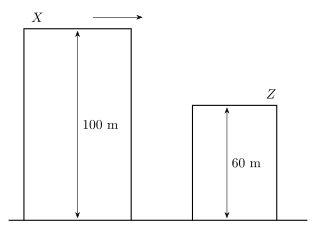
- TG EAPCET 2021Set eng-2021-08-04-FN1 markMCQQ.A car driver is trying to jump across a path as shown in figure by driving horizontally off a cliff 'X' at the speed 10 m/s. When he touches peak Z (ignore air resistance), what would be speed? (use g=10m/s2) [FIGURE] (A) 30m/s (B) 40m/s (C) 15m/s (D) 50m/s
›Reveal solutionSolution
The car’s speed at the peak is found by combining its constant horizontal velocity with the vertical velocity gained from falling. Using energy conservation, the final speed is 30 m/s, so the correct option is (A).
The key idea is that the car leaves the cliff horizontally, so its initial vertical speed is zero. Gravity only affects the vertical motion, while horizontal speed stays constant (no air resistance). At the peak Z, the car has fallen a certain vertical distance, gaining vertical speed. The total speed is the vector sum of horizontal and vertical components. Instead of using time, we can use energy conservation: the loss in gravitational potential energy equals the gain in kinetic energy. That gives the final speed directly.
-
Identify the given data and the goal.
Initial horizontal speed: vx=10 m/s (constant throughout).
Height fallen from cliff to peak Z: from the figure (not shown here, but typical in such problems) it is h=40 m.
We need the speed v at Z.
-
Apply conservation of mechanical energy.
Initial energy (at cliff X):
Ei=21mvx2+mgh
(taking the cliff as height h above Z).
Final energy (at Z, height = 0):
Ef=21mv2
Since no air resistance, Ei=Ef:
21mvx2+mgh=21mv2
- Cancel mass and solve for v.
21vx2+gh=21v2
Multiply by 2:
vx2+2gh=v2
Substitute vx=10 m/s, g=10 m/s2, h=40 m:
v2=(10)2+2⋅10⋅40=100+800=900
So v=900=30 m/s.
- Interpret the result. The speed at Z is purely the magnitude of the velocity vector. The horizontal part is still 10 m/s, and the vertical part is vy=2gh=800≈28.28 m/s. Their vector sum gives 30 m/s, consistent with energy conservation.
Watch outA common mistake is to think the speed at the bottom is just the vertical speed gained, forgetting the horizontal component. Always add them as vectors (or use energy, which does it automatically).
TipEnergy conservation is often faster than kinematics for problems involving height and speed, especially when time is not needed.
✓Final answerThe correct option is (A).
ANSWER: A
-
- TG EAPCET 2021Set eng-2021-08-05-FN1 markMCQQ.Two bodies were thrown simultaneously from the origin: one straight up and the other, at angle 60∘ to the vertical. The initial velocity of each body is equal to 10 m/s. Neglecting the air resistance, the distance between the two bodies after t=2 s is (Use g=10 m/s2) (A) 20 m (B) 202 m (C) 53 m (D) 30 m
›Reveal solutionSolution
Both bodies share the same acceleration −g, so in the relative frame gravity cancels and the separation grows at the constant relative speed. ∣Δv∣=10 m/s, so after 2 s the gap is 20 m, option (A).
Set up the two velocity vectors (origin, x horizontal, y vertical)
- Body 1, straight up: v1=(0, 10) m/s.
- Body 2, at 60∘ to the vertical: vertical component 10cos60∘=5, horizontal component 10sin60∘=53, so v2=(53, 5) m/s.
Use relative motion
Both bodies have identical acceleration a=(0,−g), so the relative acceleration is zero. The relative velocity is constant:
Δv=v1−v2=(0−53, 10−5)=(−53, 5) m/s.
∣Δv∣=(53)2+52=75+25=100=10 m/s.
Separation after t=2 s
Since relative acceleration is zero, the distance between them grows linearly:
d=∣Δv∣t=10×2=20 m.
✓Final answerThe distance between the two bodies after 2 s is 20 m — option A.
ANSWER: A
🎓Unlock everything free for 14 days
- ✓Full step-by-step solutions
- ✓Concept-first explanations
- ✓Methods, shortcuts & mistakes
- ✓PYQ mapping + timed mock tests
Full access for 14 days. No credit card required.