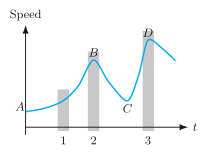
Q.Figure 2.15 gives a speed-time graph of a particle in motion along a constant direction. Three equal intervals of time are shown. In which interval is the average acceleration greatest in magnitude? In which interval is the average speed greatest? Choosing the positive direction as the constant direction of motion, give the signs of v and a in the three intervals. What are the accelerations at the points A, B, C and D?
🔒You're viewing a preview — the full solution, concept, methods & PYQ mapping are locked.
🔒 Start your 14-day free trial to unlock the full solution →Concept understanding — Instantaneous Velocity
Instantaneous Velocity: From "How Fast" to "How Fast Right Now"
You already know average velocity. If a car travels 120 km in 2 hours, its average velocity is 60 km/h. That tells you the overall rate, but it hides everything that happened in between — the traffic jams, the sudden bursts of speed, the moments the car was completely stopped.
Now imagine you want to know the car's velocity at exactly 10:15 AM, not averaged over an hour or a minute. That's instantaneous velocity — the velocity at a single instant of time.
The Intuition: Zooming In
Think of a speedometer needle. When you drive, the needle doesn't stay fixed at 60 km/h. It jumps up when you accelerate, drops when you brake. At any given moment, the needle points to a specific number. That number is your instantaneous speed (velocity, if direction matters).
But here's the puzzle: at a single instant, the car hasn't moved any distance. How can you have a speed if Δt=0? You can't divide by zero.
The trick is to shrink the time interval smaller and smaller, and see what the average velocity approaches.
The Precise Definition
Let s(t) be the position of an object at time t. The average velocity over a time interval [t,t+h] is:
vavg=hs(t+h)−s(t)
Now, let h get closer and closer to 0 (but never equal to 0). If the average velocity settles down to a single number as h→0, that number is the instantaneous velocity at time t:
v(t)=limh→0hs(t+h)−s(t)
v(t)=limh→0hs(t+h)−s(t)
This limit is exactly the derivative of position with respect to time. In calculus notation: v(t)=s′(t).
A Concrete Example
Suppose a ball is dropped from rest, and its height (in meters) after t seconds is s(t)=4.9t2 (ignoring air resistance).
Average velocity from t=2 to t=2.1 seconds:
vavg=0.14.9(2.1)2−4.9(2)2=0.14.9(4.41−4)=0.14.9×0.41=20.09 m/s
Average velocity from t=2 to t=2.01:
vavg=0.014.9(2.01)2−4.9(2)2=0.014.9(4.0401−4)=19.649 m/s
Average velocity from t=2 to t=2.001:
vavg=0.0014.9(2.001)2−4.9(2)2=19.6049 m/s
The numbers are converging to 19.6 m/s. That's the instantaneous velocity at t=2 seconds.
Using the derivative: v(t)=9.8t, so v(2)=19.6 m/s. Matches perfectly.
Key Takeaways for Exams
| Concept | Meaning | Formula |
|---|---|---|
| Average velocity | Total displacement ÷ total time | ΔtΔs |
| Instantaneous velocity | Velocity at a single moment | limh→0hs(t+h)−s(t) |
Average acceleration =Δ(speed)/Δt is largest where the speed changes most steeply — the fall from the high peak B to the trough C (interval 2). Average speed is largest where the curve sits highest — interval 3, near the tall peak D. Since motion is always in the + direction, v>0 throughout; a follows whether speed rises or falls. At the peaks and troughs A, B, C, D the curve is momentarily flat, so acceleration is zero. …
On a speed-time graph, the slope is the acceleration and the height is the speed. The steepest slope over an equal interval is the fall from peak B to trough C (interval 2), so the greatest average acceleration magnitude is there; the highest part of the curve is around peak D (interval 3), so the greatest average speed is there. Motion stays in one direction, so v>0 always; a is positive while speed rises and negative while it falls; and at the turning points A, B, C, D the slope is zero, so a=0.
Concept
For a speed-time graph of motion in a fixed direction:
aˉ=ΔtΔv=(slope of the chord),speedˉ=Δtarea under curve (how high the curve sits).
The three intervals have equal duration, so comparisons reduce to comparing the change in speed (for acceleration) and the typical height (for speed).
Greatest average acceleration
- Interval 1: speed rises A → B (a moderate increase).
- Interval 2: speed falls from the high peak B down to the trough C — the largest change in speed over an equal time, hence the steepest chord.
- Interval 3: speed rises C → D.
The biggest magnitude of Δv/Δt occurs in interval 2.
Greatest average speed
The average speed over an interval corresponds to how high the curve lies there. The curve reaches its highest values near the tall second peak D, which is in interval 3. So the average speed is greatest in interval 3.
Signs of v and a
The particle moves in a constant (positive) direction, so its velocity is positive at all times:
v>0 in intervals 1, 2 and 3.
Acceleration has the sign of the slope of the speed-time curve:
- Interval 1 (speed increasing A → B): a>0. …
Concept: Two Independent Readings of a Speed-Time Graph — Rise vs. Height
Method: Separate "Steepest" from "Highest" as Two Logically Distinct Criteria (they need not pick out the same interval)
It is tempting to assume that whichever interval is visually the "most dramatic" wins both comparisons — largest average acceleration and largest average speed. This method makes explicit why that assumption is wrong: average acceleration depends only on the difference between the speed at the start and end of an interval (aˉ=Δv/Δt), while average speed depends on how high the curve sits throughout the interval (its area, roughly its typical height). These are independent properties of a curve, and in this graph they genuinely point to two different intervals.
Steps
- State the two formulas being compared, side by side:
aˉ=Δtvend−vstart(a DIFFERENCE — ignores the curve’s absolute height entirely)speed=Δtarea under the curve(a HEIGHT/AREA quantity — ignores the slope entirely)
Two curves can have identical endpoint heights (same Δv, hence same aˉ) while one sits much higher throughout the interval than the other (very different speed) — the two measures simply answer different questions.
-
Apply the difference criterion (acceleration) to the three intervals. Interval 1 (A→B) is a rise to the first maximum — a moderate net change. Interval 2 (B→C) is the fall from that first maximum all the way down to the local minimum — since B is a genuine peak and C a genuine trough immediately following it, this interval captures the single sharpest reversal in the whole curve, i.e. the largest ∣Δv∣ over an equal time window. Interval 3 (C→D) is only the early part of the climb toward the second, higher maximum D — not the whole climb — so its ∣Δv∣ over the same short window is smaller than interval 2's sharp drop, even though D itself ends up higher than B. Interval 2 has the greatest average acceleration magnitude.
-
Apply the height criterion (speed) to the three intervals, independently of Step 2. Interval 1 sits low (climbing from a small starting value). Interval 2 sits high only briefly, near B, before dropping toward the low trough C — its typical height over the interval is pulled down by the trough end. Interval 3, by contrast, is on the approach to the taller second maximum D, which — being higher than B — keeps the curve's height elevated over that window even though the endpoint hasn't yet been reached. Interval 3 has the greatest average speed. …
Showing the 12 most recent of 13 on this concept.
- TG EAPCET 2025Set eng-2025-05-02-FN1 markMCQQ.The driver of a bus moving with a velocity of 72 kmph observes a boy walking across the road at a distance of 50 m in front of the bus and decelerates the bus at 5ms−2 by applying brakes and is just able to avoid an accident. The reaction time of the driver is (A) 4s (B) 3.5s (C) 0.5s (D) 4.5s
›Reveal solutionSolution
The driver’s reaction time is the delay before braking begins; during that time the bus travels at constant speed, and the remaining distance must be exactly enough for the deceleration to stop the bus. Solving gives a reaction time of 0.5 s, so option (C) is correct.
The key idea is that the driver does not brake instantly — there is a reaction time during which the bus continues at its initial speed. Only after that delay does the bus decelerate. The total distance from the driver’s first sight of the boy to the bus’s final stop is 50 m. Part of that distance is covered at constant speed during the reaction time, and the rest is covered while braking to a halt. We need to find the reaction time such that the bus just stops before reaching the boy.
- Convert the initial speed to m/s The bus moves at 72 km/h.
72 hkm=72×36001000=20 m/s.
So u=20 m/s.
- Let the reaction time be tr seconds During this time, the bus travels at constant speed u and covers a distance
dreaction=u⋅tr=20tr m.
- After the reaction time, the driver applies brakes The bus decelerates at a=−5 m/s2 (negative because it’s slowing down). The initial speed for the braking phase is still u=20 m/s, and the final speed is 0. Using the equation of motion v2=u2+2as for the braking distance s:
0=(20)2+2(−5)s⇒0=400−10s⇒s=40 m.
So the bus needs 40 m to stop once brakes are applied.
- The total distance from the driver’s first sight to the boy is 50 m …
- TG EAPCET 2025Set eng-2025-05-04-AN1 markMCQQ.For a particle moving along a straight line path, the displacements in third and fifth seconds of its motion are 10 m and 18 m respectively. The speed of the particle at time t=4s is (A) 32ms−1 (B) 8ms−1 (C) 12ms−1 (D) 16ms−1
›Reveal solutionSolution
The problem involves constant acceleration motion; using the formula for displacement in the nth second, we find acceleration a=4m/s2 and initial velocity u=0, so speed at t=4s is 16m/s — option (D).
We are told the particle moves along a straight line, and the displacements in the third and fifth seconds are given. This is a classic constant-acceleration kinematics problem. The key is to use the formula for displacement during a specific second, which directly relates the given data to the initial velocity and acceleration.
Why this approach works:
For uniformly accelerated motion, the displacement in the nth second is sn=u+2a(2n−1). This formula comes from subtracting the distance traveled in (n−1) seconds from that in n seconds. It gives us two equations in u and a, which we can solve.
Let’s work through it step by step.
- Write the formula for displacement in the nth second. For constant acceleration a and initial velocity u, the displacement in the nth second is:
sn=u+2a(2n−1)
This is derived from sn=[un+21an2]−[u(n−1)+21a(n−1)2].
- Apply to the third second (n=3). Given s3=10m:
10=u+2a(2⋅3−1)=u+2a(5)
So:
10=u+25a(Equation 1)
- Apply to the fifth second (n=5). Given s5=18m:
18=u+2a(2⋅5−1)=u+2a(9)
So:
18=u+29a(Equation 2)
- Solve the system of equations. Subtract Equation 1 from Equation 2:
(18−10)=(u+29a)−(u+25a)
8=24a=2a
Hence:
a=4m/s2
- Find the initial velocity u. …
- TG EAPCET 2025Set eng-2025-05-04-FN1 markMCQQ.For a particle moving along a straight line path, the displacements in third and fifth seconds of its motion are 10 m and 18 m respectively. The speed of the particle at time t=4 s is (A) 32 ms−1 (B) 12 ms−1 (C) 16 ms−1 (D) 8 ms−1
›Reveal solutionSolution
Using sn=u+2a(2n−1): the 3rd and 5th-second displacements give a=4 ms−2, u=0, so v(4)=u+at=16 ms−1.
The displacement in the nth second of uniformly accelerated motion is
sn=u+2a(2n−1).
Third second (n=3): s3=u+2a(5)=u+2.5a=10.
Fifth second (n=5): s5=u+2a(9)=u+4.5a=18.
Subtracting the two equations: …
- TG EAPCET 2025Set ap-2025-04-29-AN1 markMCQQ.When a bullet is fired with a velocity of 150ms−1 at a target of thickness 50cm, it emerges with a velocity of 100ms−1. If another bullet of same mass is fired with same velocity at a second target of thickness 80cm, then the velocity with which the bullet emerges from the second target is (Retarding forces are equal in both the cases) (A) 60ms−1 (B) 75ms−1 (C) 50ms−1 (D) 40ms−1
›Reveal solutionSolution
The retarding force does constant work per unit thickness, so the loss in kinetic energy is proportional to the thickness. Using the work–energy theorem for both targets gives the emerging speed as 50m/s.
The key idea is that the retarding force is the same in both cases, and it acts over a known distance (the thickness of the target). The work done by this force equals the loss in kinetic energy of the bullet. Since the force is constant, the work done is simply force times distance, so the kinetic energy lost is directly proportional to the thickness of the target.
We don’t need to know the mass or the force explicitly — we can work with the change in v2, which is proportional to the distance travelled under a constant retarding force.
- First target — thickness d1=50 cm=0.5 m. Initial speed u=150 m/s, final speed v1=100 m/s. Loss in kinetic energy:
21m(1502−1002)=21m(22500−10000)=21m(12500)
This loss equals the work done by the retarding force F over distance d1:
Fd1=21m(12500)
- Second target — thickness d2=80 cm=0.8 m. Same initial speed u=150 m/s, let the emerging speed be v2. Loss in kinetic energy:
21m(1502−v22)=21m(22500−v22)
This equals the work done over distance d2:
Fd2=21m(22500−v22)
- Divide the two equations to eliminate F and m:
- TG EAPCET 2023Set eng-2023-05-12-AN1 markMCQQ.A person walks in such a way that he covers equal distance in each step. The person takes 2 steps forward towards east, then takes a right turn and walks 4 steps towards south, then takes a right turn and walks 6 steps towards west and then takes a right turn and walks further. The direction of his final position after a total of 20 steps walk with respect to his initial position is (A) North-West (B) 60∘ West of South (C) 60∘ South of West (D) South-East
›Reveal solutionSolution
Track the four legs on a grid; the walker ends at (−4,+4) — equal parts west and north — i.e. North-West.
Set up coordinates. Take east as +x, north as +y; each step is one unit. He starts facing east, and each "right turn" rotates his heading east→south→west→north.
Steps used so far: 2+4+6=12, so the fourth leg is 20−12=8 steps, heading north.
Leg-by-leg positions:
- Start: (0,0)
- East 2 steps: (2,0)
- South 4 steps: (2,−4)
- West 6 steps: (−4,−4)
- North 8 steps: (−4,+4) …
- TG EAPCET 2022Set eng-2022-07-18-FN1 markMCQQ.A body starts from the rest and acquires a velocity of 10 m/s in 2s. What is the acceleration of the body and the distance travelled (A) 5 m/s2 and 10 m (B) 5 m/s2 and 5 m (C) 5 m/s2 and 6 m (D) 6 m/s2 and 5 m
›Reveal solutionSolution
Using the equations of motion for constant acceleration from rest, the acceleration is 5 m/s2 and the distance travelled is 10 m. The correct option is (A).
The problem gives a body starting from rest (initial velocity u=0), reaching a velocity v=10 m/s in time t=2 s. We need the acceleration and the distance travelled. Since the body starts from rest and we assume constant acceleration (the most natural reading for such a problem), we can use the standard kinematic equations.
Why this works:
When acceleration is constant, velocity changes uniformly with time, and distance is the area under the velocity–time graph (or the average velocity times time). Starting from rest simplifies the formulas because u=0.
- Find acceleration The definition of acceleration (for constant acceleration) is
a=tv−u
Here u=0, v=10 m/s, t=2 s:
a=210−0=5 m/s2
- Find distance travelled Using the equation s=ut+21at2 with u=0:
s=0⋅2+21⋅5⋅(2)2=21⋅5⋅4=10 m
Alternatively, average velocity is 2u+v=20+10=5 m/s, and distance = average velocity × time = 5×2=10 m. …
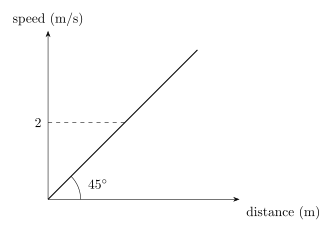
- TG EAPCET 2021Set ap-2021-08-09-FN1 markMCQQ.The speed distance graph is shown below. At what instant of time (in sec) the speed becomes 4 m/s? [FIGURE] (A) t=ln(2) (B) t=ln(4) (C) t=ln(8) (D) t=ln(6)
›Reveal solutionSolution
The speed–distance graph is a straight line of slope 1, so dxdv=1. Using the chain rule dtdv=dxdv⋅v=v and integrating gives v=4 m/s at t=ln2, option (A).
Reading the graph
The graph plots speed v against distance x as a straight line: the speed starts at v=2 m/s at x=0 and rises with slope 1, so
v=2+x,dxdv=1.
The chain-rule connection
Speed, distance and time are linked by
dtdv=dxdv⋅dtdx=dxdv⋅v,
since dtdx=v.
Step-by-step solution
- From the graph dxdv=1, so …
- TG EAPCET 2021Set ap-2021-08-10-AN1 markMCQQ.The length of minute hand in a clock is 4.5 cm. If the tip of the minute hand moves from 6 AM to 6.30 AM, the average velocity of the tip is. (A) 5×10⁻³ cm/s (B) 50×10−3 cm/s (C) 0.5×10⁻³ cm/s (D) 0.005×10⁻³ cm/s
›Reveal solutionSolution
Average velocity is displacement divided by time. The tip’s displacement is the straight‑line distance from start to end (the chord of a 180° arc), not the path length. With radius 4.5 cm and time 30 min = 1800 s, the average velocity is 18002×4.5=0.005 cm/s = 5×10⁻³ cm/s. The correct option is (A).
Concept & Intuition
Many students mistakenly compute average speed (total path length / time) instead of average velocity (displacement / time). Velocity is a vector; its magnitude depends only on the straight‑line distance between the initial and final positions, not on how far the tip actually travelled along the arc. From 6:00 to 6:30, the minute hand rotates exactly 180°, so the tip’s start and end points are opposite ends of a diameter. The displacement is therefore the diameter of the circle: 2×radius.
Step‑by‑step solution
- Identify the time interval From 6:00 AM to 6:30 AM is exactly 30 minutes. Convert to seconds:
Δt=30×60=1800 s.
- Determine the displacement At 6:00, the minute hand points straight up (12 o’clock). At 6:30, it points straight down (6 o’clock). These two positions are diametrically opposite. The displacement is the straight‑line distance between them, which is the diameter of the circle traced by the tip:
displacement=2×radius=2×4.5=9 cm.
- Compute average velocity Average velocity is a vector quantity:
average velocity=timedisplacement.
Its magnitude is:
- TG EAPCET 2021Set ap-2021-08-10-AN1 markMCQQ.A body moves along the sides of an equilateral triangle of side 20 cm and comes back to the initial point after one round. Then the distance and displacement of the body respectively are (A) 60 cm and 20 cm (B) 60 cm and 0 cm (C) 0 cm and 60 cm (D) 60 cm and 60 cm
›Reveal solutionSolution
Distance is the total path length traveled (60 cm), while displacement is the net change in position from start to finish (0 cm because the body returns to its starting point). The correct option is (B).
The key idea here is the difference between distance (a scalar quantity that measures the total ground covered) and displacement (a vector quantity that measures the straight-line change in position from start to end). When an object returns to its starting point, the displacement is zero regardless of the path taken.
-
Understand the motion: The body moves along the sides of an equilateral triangle with each side = 20 cm. It starts at one vertex, goes along one side, then the next, then the third, and returns exactly to the starting vertex after one full round.
-
Calculate the distance: Distance is the sum of the lengths of all sides traveled. Since the body goes around all three sides:
Distance=20 cm+20 cm+20 cm=60 cm.
- Calculate the displacement: Displacement depends only on the initial and final positions. The body starts at a point and ends at the same point after one round. Therefore, the net change in position is zero: Displacement=0 cm.…
-
- TG EAPCET 2021Set ap-2021-08-10-FN1 markMCQQ.The length of minute hand in a clock is 4.5 cm. If the tip of the minute hand moves from 6 AM to 6.30 AM, the average velocity of the tip is, (A) 5×10⁻³ cm/s (B) 50×10−3 cm/s (C) 0.5×10⁻³ cm/s (D) 0.005×10⁻³ cm/s
›Reveal solutionSolution
Average velocity is displacement divided by time, not distance. The minute hand tip moves in a circular arc from 6 AM to 6:30 AM, so its displacement is the straight-line distance between the two positions — the diameter of the circle. With radius 4.5 cm, displacement = 9 cm, time = 1800 s, so average velocity = 0.005 cm/s = 5×10⁻³ cm/s. The correct option is (A).
Concept & Intuition
The classic pitfall here is confusing average speed with average velocity.
- Average speed = total path length / time. The tip traces a semicircle of radius 4.5 cm, so path length = πr≈14.14 cm.
- Average velocity = displacement / time. Displacement is the straight-line vector from start to finish — here, from the 6 AM position (pointing straight down) to the 6:30 AM position (pointing straight up). That’s exactly the diameter of the clock face: 2r=9 cm.
Since the question asks for average velocity, we must use displacement, not distance.
Step-by-step solution
-
Identify the positions
At 6:00 AM, the minute hand points directly at the 6 (straight down). At 6:30 AM, it points directly at the 12 (straight up). These two positions are opposite ends of a vertical line through the center.
-
Find the displacement
Displacement is the straight-line distance between start and end points. Since they are diametrically opposite,
displacement=2×radius=2×4.5 cm=9 cm.
- Find the time interval From 6:00 AM to 6:30 AM is exactly 30 minutes. Convert to seconds:
Δt=30×60=1800 s.
- Compute average velocity
- TG EAPCET 2021Set ap-2021-08-10-FN1 markMCQQ.A body moves along the sides of an equilateral triangle of side 20 cm and comes back to the initial point after one round. Then the distance and displacement of the body respectively are (A) 60 cm and 20 cm (B) 60 cm and 0 cm (C) 0 cm and 60 cm (D) 60 cm and 60 cm
›Reveal solutionSolution
Distance is the total path length traveled (60 cm), displacement is the net change in position from start to finish (0 cm because the body returns to its starting point). The correct option is (B).
Concept and Intuition
The key distinction here is between distance (a scalar: how much ground was covered, regardless of direction) and displacement (a vector: the straight‑line separation between the starting point and the ending point, with direction).
When a body moves along a closed path and returns exactly to where it began, the displacement is always zero — no matter how long or twisty the path. The distance, however, is simply the sum of the lengths of all the sides traversed.
Step‑by‑Step Reasoning
-
Identify the path
The body moves along the sides of an equilateral triangle. Each side is given as 20 cm. It goes around once and comes back to the initial point.
-
Compute the distance
Distance is the total length of the path traveled. The body covers all three sides:
Distance=20 cm+20 cm+20 cm=60 cm.
- Compute the displacement Displacement is the vector from the starting point to the ending point. Since the body returns to the exact same point after one round, the start and end coincide. Therefore the displacement vector has zero magnitude:
-
- TG EAPCET 2021Set eng-2021-08-06-FN1 markMCQQ.Consider a series of measurements of the length of a box in an experiment. The readings are 2.4 m, 2.5 m, 2.6 m, 2.8 m, 3.0 m. What would be the relative error? (A) 0.110 (B) 0.089 (C) 0.079 (D) 0.072
›Reveal solutionSolution
Mean =2.66 m; mean absolute error =0.192 m; relative error =2.660.192≈0.072.
Mean reading.
xˉ=52.4+2.5+2.6+2.8+3.0=513.3=2.66 m.
Absolute deviations from the mean.
0.26, 0.16, 0.06, 0.14, 0.34.
Mean absolute error: …
🎓Unlock everything free for 14 days
- ✓Full step-by-step solutions
- ✓Concept-first explanations
- ✓Methods, shortcuts & mistakes
- ✓PYQ mapping + timed mock tests
Full access for 14 days. No credit card required.