Commerce · Ch 3 — Entrepreneurship Development
Role of Entrepreneurs in Relation to their Enterprise
Role of Entrepreneurs in Relation to their Enterprise
In relation to their own enterprise, entrepreneurs are, all at once, the composer of the musical score, the conductor of the orchestra and a one-man band. Depending on their background, individual entrepreneurs may lean towards one aspect over another — technicians tend to be preoccupied with production, those from a marketing background with the market, and investor-type entrepreneurs with returns — but a good entrepreneur resists looking at the business from a single narrow perspective. The main elements of the role are set out below.
Opportunity scouting. Entrepreneurial opportunities have to be actively searched for, through personal observation, discovery or invention, through personal and professional networks and experience, or through published reports and surveys. Whereas most of us look at objects with a consumer's mindset (wanting the thing for ourselves), the entrepreneurial mind starts working out the market size, where to procure the product, at what price, and how to win customers from existing players — by selling cheaper, offering more value or giving better service. Opportunities may also be found through research of international, domestic and sectoral or industrial conditions.
Identification of a specific product offering. While an environment scan reveals generalised opportunities, the entrepreneur must zero in on a specific product or service idea. This makes the greatest demand on creativity and innovativeness; even when the generic product is the same, it is possible to differentiate the offering by size, service, add-ons, customisation and so on, so that the value delivered not only meets but exceeds customer expectations.
Feasibility analysis. The chosen idea must be feasible from several perspectives — it must be technically feasible (possible with available technology), economically feasible (achievable at a cost the price can cover), financially viable (within available resources and offering the resource providers a reasonable return on and return of their investment), and commercially viable (with enough sales and growth prospects), while also clearing administrative and legal requirements. It is at this stage that the entrepreneur decides the form of organisation — proprietorship, partnership firm, company or cooperative — and compiles the findings into a business plan to submit to the funding authorities (in the Indian context, typically the State Finance Corporation of the area), which appraise it and, on being satisfied and on receipt of margin money, may sanction the loan.
Roles and functions in relation to the enterprise. One well-known classification (by the development economist Peter Kilby) groups the entrepreneur's roles into four areas:
- Developing exchange relationships — perceiving market opportunities, gaining command over scarce resources, purchasing inputs, and marketing products while responding to competition.
- Political administration — dealing with the public bureaucracy (approvals, concessions, taxes), managing human relations within the firm, and managing customer and supplier relations.
- Management control — managing finance and managing production. …
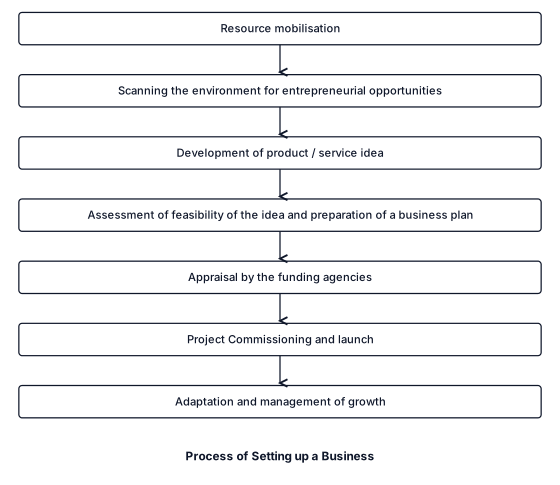
Drawn by us to help you understand the concept clearly, and verified to make sure it's accurate. For exams, practice from your textbook's own diagram.
Our own recreation of the book's flow chart of the process of setting up a business. The entrepreneur moves through a sequence of stages — mobilising resources, scanning the environment for opportunities, developing a product or service idea, assessing its feasibility and preparing a business plan, getting the plan appraised by the funding agencies, commissioning and laun …