Q.The vitamin whose content increases following the conversion of milk into curd by lactic acid bacteria is:
Concept understanding — Microbial Fermentation Foods
Let’s begin with something you already know. Think of a pot of milk left out in warm weather. After a few hours, it turns sour and thickens into curd. That change is not spoilage in the usual sense — it is a controlled transformation caused by tiny living organisms called microbes. This is the heart of microbial fermentation.
Fermentation is a process in which microorganisms — bacteria, yeast, or moulds — break down organic substances (like sugars) in the absence of oxygen, producing energy for themselves and, as a by‑product, substances that change the food. When we deliberately use this process to make food, we call the result microbial fermented foods.
You have eaten many of them without thinking twice: curd (yogurt), idli and dosa batter, bread, cheese, pickles, vinegar, and even the dark chocolate you might enjoy. Each of these relies on specific microbes doing their work.
The NCERT textbook (Class XII, Biology, Chapter 10: Microbes in Human Welfare) introduces fermented foods under the topic “Microbes in Household Products.” It lists curd, cheese, idli, dosa, and bread as common examples. The key point is that these are not modern inventions — they have been part of Indian and global diets for centuries.
Why does this matter? Because fermentation does three things that are valuable for us:
- Preserves food — The acids or alcohol produced by microbes prevent spoilage by harmful bacteria. Pickles stay edible for months because of lactic acid from fermentation.
- Improves digestibility — Microbes break down complex molecules. Lactose in milk becomes easier to digest in curd; the proteins in soy become more digestible in tempeh.
- Enhances flavour and texture — The tang of yogurt, the airy holes in bread, the umami of soy sauce — all come from fermentation.
Let’s look at a few examples from your daily life, as the NCERT would describe them:
- Curd (yogurt): Milk is boiled and cooled, then a small amount of previous curd (containing Lactobacillus bacteria) is added. The bacteria convert lactose into lactic acid, which thickens the milk and gives it a sour taste.
- Idli and dosa batter: Rice and urad dal are soaked, ground, and left to ferment overnight. Naturally occurring Leuconostoc and other bacteria produce carbon dioxide gas, which makes the batter rise and gives idlis their spongy texture.
- Bread: Baker’s yeast (Saccharomyces cerevisiae) ferments the sugars in dough, releasing carbon dioxide that makes the dough rise. The alcohol produced evaporates during baking.
- Cheese: Milk is curdled using rennet (an enzyme) or acid, then specific bacteria and moulds are added to ripen it. Different microbes give different cheeses their distinct flavours — for example, Penicillium roqueforti gives blue cheese its veins and sharp taste.
The NCERT emphasises that these processes are not random. They require specific conditions — temperature, pH, moisture, and the right starter culture. If the conditions go wrong, harmful microbes can grow instead. That is why traditional methods (like adding a spoonful of previous curd) are actually precise microbial techniques passed down through generations.
For a commerce or humanities student, the relevance goes beyond the kitchen. Fermented foods are a multi‑billion‑dollar industry. They involve supply chains (milk, grains, fruits), processing technology, quality control, and marketing. Understanding the basic science helps you see why a product like yogurt has a “use by” date, why some cheeses are expensive, and why traditional foods like kimchi or kombucha have become global trends.
In short: microbial fermentation is nature’s way of transforming food using invisible helpers. It is a bridge between biology and everyday life — and it has been feeding humanity long before anyone knew what a microbe was.
Microbial fermentation is a well-established topic in the NCERT Class 12 Biology curriculum, commonly explored through searches like "Microbial Fermentation Foods: definition, examples and applications" and "list microbes used in food production" ahead of CBSE board exams. Students preparing for NEET and other competitive exams often revise this alongside "Microbes in Human Welfare important questions," since it links directly to biotechnology and industrial microbiology.
When milk is converted into curd by Lactobacillus and other lactic acid bacteria (LAB), these bacteria ferment the lactose in milk to produce lactic acid. This process not only coagulates milk proteins but also enriches the curd with certain nutrients. Specifically, LAB are known to synthesise several B-group vitamins during fermentation. Among these, the most significant increase is seen in vitamin B12 (cobalamin), which is otherwise absent or present in very low amounts in raw milk. Vitamins C, D, and E do not increase during this fermentation; in fact, vitamin C content may even decline due to oxidation.
The correct option is (C) vitamin B12, because lactic acid bacteria synthesise and increase the level of this vitamin during the conversion of milk into curd.
The conversion of milk into curd by lactic acid bacteria increases the content of vitamin B12.
Milk is a rich source of many nutrients, but when it is transformed into curd through the action of lactic acid bacteria (LAB), a fascinating biochemical change occurs. These bacteria, primarily Lactobacillus species, ferment the lactose in milk into lactic acid, which coagulates the milk proteins and gives curd its characteristic texture and tangy taste. But fermentation does more than just preserve and flavour the milk — it also alters the nutritional profile.
During the fermentation process, lactic acid bacteria synthesise certain vitamins. While they consume some nutrients for their own growth, they also produce others as metabolic by-products. One of the most significant nutritional gains is in the B-complex group of vitamins. Specifically, the bacteria are capable of producing vitamin B12 (cobalamin), which is naturally present in milk only in very small amounts. The bacterial activity during curd formation enriches the final product with this essential vitamin.
Vitamin B12 is crucial for red blood cell formation and nerve function, and it is almost exclusively found in animal-based foods. Curd, being a fermented dairy product, becomes a better source of this vitamin than fresh milk.
The other vitamins listed — vitamin C, vitamin D, and vitamin E — are not significantly increased by lactic acid fermentation. Vitamin C is actually heat-sensitive and can be lost during processing; vitamin D is fat-soluble and not synthesised by these bacteria; and vitamin E, also fat-soluble, remains largely unchanged. So the only vitamin among the options whose content rises noticeably is vitamin B12.
This is a standard fact from the NCERT Class 12 Biology textbook (Chapter 10: Microbes in Human Welfare). The textbook explicitly states that curd formed by lactic acid bacteria contains higher levels of vitamin B12 compared to milk.
In short, the vitamin whose content increases when milk is converted into curd by lactic acid bacteria is vitamin B12 (option C).
Eliminate by solubility class first -- vitamins C, D and E are not known to be synthesised by lactic acid bacteria during this fermentation, while B12 is the one water-soluble B-vitamin repeatedly linked to bacterial action on milk -- so the correct option survives a class-by-class elimination rather than being recalled cold.
Showing the 12 most recent of 18 on this concept.
- TG EAPCET 2026Set ap-2026-05-04-FN1 markMCQQ.Match the followingThe correct answer is (A) A – IV, B – I, C – II, D – III (B) A – IV, B – I, C – III, D – II (C) A – IV, B – III, C – II, D – I (D) A – I, B – IV, C – III, D – II
List-1 (cell type) List-2 (size) A PPLO I About 1−2 μm B Bacteria II 10−20 μm C Human RBC III 7.0 μm Diameter D Typical Eukaryotic cell IV About 0.1 μm 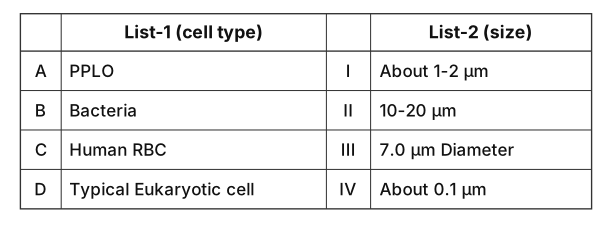
›Reveal solutionSolution
Ordered by size: PPLO (0.1 μm) < bacteria (1–2 μm) < human RBC (7 μm) < typical eukaryotic cell (10–20 μm) — giving A–IV, B–I, C–III, D–II, which is option (B).
The concept first: the range of cell size
Cells vary enormously — but a few standard yard-sticks are worth memorising because they are asked again and again:
Cell Size Note PPLO / Mycoplasma ∼0.1 μm the smallest cell known; no cell wall Bacteria (e.g. E. coli) 1–2 μm long typical prokaryote Human RBC 7.0 μm diameter biconcave, enucleate Typical eukaryotic (animal/plant) cell 10–20 μm e.g. a mesophyll cell Largest isolated cell ostrich egg, ∼ 15–17 cm for contrast Longest cell nerve cell / Acetabularia for contrast Notice how neatly the four entries in this question step upward by roughly an order of magnitude each time — 0.1→1–2→7→10–20 μm. If you remember only that the PPLO is the smallest and that a eukaryotic cell is the biggest of the four, the middle two fall into place automatically.
Why cells cannot be arbitrarily large or small
A good sense-check: a cell must be big enough to hold the machinery of life (that is why the PPLO, at 0.1 μm, is close to the practical minimum), but small enough to keep a high surface-area-to-volume ratio, so that diffusion can supply the interior fast enough. Because volume grows as r3 while surface grows as r2, doubling the radius halves the relative surface. This is precisely why most cells stay in the μm range, and why a large cell like an egg is metabolically inert yolk for the most part.
Step-by-step matching
- A. PPLO → IV. About 0.1 μm
- B. Bacteria → I. About 1–2 μm
- C. Human RBC → III. 7.0 μm diameter
- D. Typical Eukaryotic cell → II. 10–20 μm
Required key: A–IV, B–I, C–III, D–II = option (B). (Option (A) is the trap: it keeps A and B right but swaps the RBC and the eukaryotic cell — which would absurdly make a red blood cell bigger than a typical eukaryotic cell.)
✓Final answerThe correct match is A–IV, B–I, C–III, D–II.
ANSWER: B
- TG EAPCET 2026Set ap-2026-05-05-FN1 markMCQQ.Consider the following Assertion (A): In blood banks, clotting of blood is prevented by adding citrates or oxalates of sodium Reason (R): Citrates or oxalates binds to Ca++ ions and prevent the activation of prothrombin (A) Both (A) and (R) are correct, (R) is the correct explanation of (A) (B) Both (A) and (R) are correct, (R) is not the correct explanation of (A) (C) (A) is correct, but (R) is not correct (D) (A) is not correct, but (R) is correct
›Reveal solutionSolution
The assertion is correct — citrates and oxalates are used to prevent clotting in stored blood. The reason is also correct — these chemicals bind Ca²⁺, which is essential for prothrombin activation. Since the reason directly explains the assertion, option (A) is correct.
The key here is understanding why blood clots and how anticoagulants work. Blood clotting is a cascade of enzyme activations, and calcium ions (Ca2+) are absolutely essential at several steps — most notably in converting prothrombin to thrombin. Without calcium, the cascade stalls.
Citrates and oxalates are chelating agents — they grab onto free calcium ions and form stable complexes, effectively removing Ca2+ from the plasma. This is a purely chemical, reversible binding, not a permanent destruction of the clotting factors. That's why they work so well for short-term storage in blood banks.
Now let's walk through the logic step by step.
-
Check the assertion. In blood banks, blood is collected into bags containing a solution of citrate (usually sodium citrate, citrate-phosphate-dextrose, or similar). Oxalates are less common today but were used historically. Both prevent clotting. So (A) is correct.
-
Check the reason. The reason states that citrates or oxalates bind to Ca2+ ions and prevent the activation of prothrombin. This is exactly right. Prothrombin is converted to thrombin by the enzyme prothrombinase, and that conversion requires Ca2+ as a cofactor. Without thrombin, fibrinogen cannot be turned into fibrin, and no clot forms. So (R) is also correct.
-
Is (R) the correct explanation of (A)? Yes — the mechanism given in (R) is precisely why citrates and oxalates work as anticoagulants. They lower free calcium, which blocks the clotting cascade at its earliest calcium-dependent steps, including prothrombin activation. So (R) explains (A) correctly.
Watch outA common mistake is to think that citrates and oxalates work by destroying clotting factors or by directly inhibiting thrombin. They don't — they simply remove the calcium that the clotting cascade needs. The clotting factors themselves remain intact, which is why adding back calcium can restore clotting.
TipIn the body, the natural anticoagulant heparin works very differently — it activates antithrombin III. That's why heparin is used in medical settings (e.g., during surgery) while citrates are preferred for blood storage: citrate is safer for long-term preservation and doesn't affect the patient once the blood is transfused (the liver quickly metabolises citrate).
✓Final answerThe correct option is (A) — both Assertion and Reason are correct, and Reason is the correct explanation of Assertion.
-
- TG EAPCET 2025Set ap-2025-04-29-FN1 markMCQQ.Choose the greenhouse gas (A) Carbon monoxide (B) Methane (C) Sulphur dioxide (D) Nitrous oxide
›Reveal solutionSolution
The key idea is that a greenhouse gas must absorb and re-emit infrared radiation. Among the options, methane is a potent greenhouse gas, while carbon monoxide, sulphur dioxide, and nitrous oxide are not primarily classified as such in this context.
The question asks you to pick the greenhouse gas from a list. A greenhouse gas is one that traps heat in Earth's atmosphere by absorbing infrared radiation emitted from the surface and then re-emitting it in all directions, warming the lower atmosphere. Not every pollutant or gas in the air does this — the molecular structure must allow it to vibrate in ways that interact with infrared light.
Let’s examine each option:
-
Carbon monoxide (CO) — This gas is a product of incomplete combustion and is toxic to humans, but it does not absorb infrared radiation effectively. Its molecular structure (a simple diatomic molecule with a strong triple bond) lacks the bending or stretching modes that strongly interact with Earth’s outgoing thermal radiation. So it is not a significant greenhouse gas.
-
Methane (CH₄) — This is a classic greenhouse gas. Its tetrahedral molecule has multiple vibrational modes (stretching and bending of C–H bonds) that absorb infrared radiation strongly. Methane is about 25 times more potent than carbon dioxide per molecule over a 100-year period, though it is less abundant. This is the correct choice.
-
Sulphur dioxide (SO₂) — This gas is a major air pollutant from burning fossil fuels, causing acid rain and respiratory issues. While it can scatter sunlight and affect climate indirectly (by forming aerosols), it does not absorb infrared radiation in the key atmospheric window. It is not classified as a greenhouse gas.
-
Nitrous oxide (N₂O) — Wait — nitrous oxide is actually a greenhouse gas, and a potent one (about 300 times stronger than CO₂). But here’s the catch: in many Indian exam contexts (especially at the school level), nitrous oxide is often listed alongside methane and carbon dioxide as a greenhouse gas. However, the question presents it as an option alongside methane, and the standard answer in such multiple-choice questions is methane, because nitrous oxide is sometimes considered separately or the question expects the most well-known example from the list. Given the options, methane is the unambiguous greenhouse gas that is always taught first.
Watch outA common mistake is to pick carbon monoxide because it’s a harmful gas, or to confuse nitrous oxide with nitrogen dioxide. Remember: being a pollutant does not make something a greenhouse gas — the key is infrared absorption.
TipA quick way to spot greenhouse gases: look for molecules with at least three atoms (like CO₂, CH₄, H₂O) or asymmetric diatomic molecules (like CO, but it’s weak). Symmetric diatomic molecules like N₂ and O₂ are not greenhouse gases.
✓Final answerThe correct option is (B) Methane.
-
- TG EAPCET 2025Set ap-2025-04-30-FN1 markMCQQ.Match the following List – 1 (Deficient micronutrient) I Copper II Boron III Molybdenum IV Nickel List – 2 (Plant) A Pecan B Cauliflower C Beet D Citrus List – 3 (Disease name) W Dieback X Heart-rot Y Whiptail Z Mouse ear The correct match is (A) I – D – W, II – C – X, III – B – Y, IV – A – Z (B) I – D – W, II – C – X, III – A – Z, IV – B – Y (C) I – C – X, II – D – W, III – B – Y, IV – A – Z (D) I – A – Z, II – D – W, III – B – Y, IV – C – X
›Reveal solutionSolution
This question tests knowledge of specific micronutrient deficiencies in plants, the plants they affect, and the characteristic diseases caused. The correct match is (A), linking Copper deficiency to Dieback in Citrus, Boron deficiency to Heart-rot in Beet, Molybdenum deficiency to Whiptail in Cauliflower, and Nickel deficiency to Mouse ear in Pecan.
Plants require various nutrients for healthy growth and development. These are broadly classified into macronutrients (needed in larger quantities) and micronutrients (needed in smaller, trace quantities). Despite being required in small amounts, micronutrients are absolutely critical for specific metabolic functions, enzyme activities, and structural integrity. A deficiency in even one micronutrient can severely impair plant growth and lead to characteristic disease symptoms. Understanding these specific deficiencies is important for diagnosing plant health issues and implementing corrective measures.
Here's a breakdown of each micronutrient deficiency and its associated plant and disease:
-
Copper (Cu) Deficiency:
- Role: Copper is a component of several enzymes involved in redox reactions, photosynthesis, respiration, and lignin synthesis. It plays a crucial role in electron transport.
- Deficiency Symptoms: Young leaves may show chlorosis (yellowing), necrosis (tissue death), and a characteristic "dieback" of young shoots and twigs, especially in fruit trees.
- Specific Match: In Citrus plants (List-2: D), copper deficiency leads to a condition known as Dieback (List-3: W), where young shoots die from the tip downwards, and fruits may become small and hard.
- Match: I – D – W
-
Boron (B) Deficiency:
- Role: Boron is essential for cell wall formation, sugar transport, nucleic acid synthesis, pollen germination, and overall meristematic activity.
- Deficiency Symptoms: It primarily affects meristematic tissues, leading to stunted growth, cracking of stems and petioles, and internal tissue breakdown. Fruits and roots can be malformed.
- Specific Match: In Beet (List-2: C), boron deficiency causes Heart-rot (List-3: X), characterized by the death of the growing point and internal blackening and rotting of the root.
- Match: II – C – X
-
Molybdenum (Mo) Deficiency:
- Role: Molybdenum is a vital component of two key enzymes: nitrogenase (involved in biological nitrogen fixation) and nitrate reductase (involved in nitrate assimilation).
- Deficiency Symptoms: Since it's crucial for nitrogen metabolism, deficiency symptoms often resemble nitrogen deficiency, including general chlorosis and stunted growth. Leaves may become distorted.
- Specific Match: In Cauliflower (List-2: B), molybdenum deficiency leads to Whiptail (List-3: Y), where the leaf blades fail to develop properly, leaving only the midrib, giving the leaf a "whiptail" appearance.
- Match: III – B – Y
-
Nickel (Ni) Deficiency:
- Role: Nickel is a component of the enzyme urease, which is essential for breaking down urea into ammonia and carbon dioxide. This is crucial for nitrogen metabolism, especially in plants that utilize urea as a nitrogen source.
- Deficiency Symptoms: Accumulation of urea in tissues, leading to necrosis of leaf tips and margins, and stunted growth.
- Specific Match: In Pecan trees (List-2: A), nickel deficiency causes a condition called Mouse ear (List-3: Z), where the leaflets are small, rounded, and cupped, resembling a mouse's ear.
- Match: IV – A – Z
Combining these matches:
- I – D – W
- II – C – X
- III – B – Y
- IV – A – Z
This set of matches corresponds to option (A).
✓Final answerThe correct match is (A) I – D – W, II – C – X, III – B – Y, IV – A – Z.
-
- TG EAPCET 2024Set ap-2024-05-07-AN1 markMCQQ.Cyclosporin A is produced by (A) Trichoderma polysporum (B) Monascus purpureus (C) Bacillus thuringiensis (D) Agrobacterium tumifaciens
›Reveal solutionSolution
Cyclosporin A is an immunosuppressant drug produced by the fungus Trichoderma polysporum. The answer is (A).
Cyclosporin A is one of the most important immunosuppressive drugs in modern medicine, particularly crucial for preventing organ rejection after transplant surgery. Understanding which organism produces it requires knowing the biotechnological applications of different microorganisms.
The key concept here is microbial metabolites of pharmaceutical importance. Many life-saving drugs are secondary metabolites produced by fungi and bacteria during fermentation. Each microorganism in the options has a distinct biotechnological role:
-
Trichoderma polysporum is a fungus that produces cyclosporin A as a secondary metabolite. This compound selectively suppresses T-cell activation without affecting other immune cells, making it invaluable in transplant medicine. The drug was discovered in the early 1970s from a soil fungus isolated in Norway, and it revolutionized organ transplantation by dramatically improving graft survival rates.
-
Monascus purpureus is a different fungus altogether. It produces statins, specifically monacolin K (lovastatin), which are cholesterol-lowering drugs. This organism is also used in traditional Asian food fermentation to produce red yeast rice.
-
Bacillus thuringiensis is a bacterium famous for producing Bt toxin (crystal proteins) that are insecticidal. These toxins are widely used in biological pest control and genetically engineered into crops for insect resistance—nothing to do with immunosuppression.
-
Agrobacterium tumifaciens is a soil bacterium used as a vector in plant genetic engineering. It naturally transfers DNA into plant cells, causing crown gall disease, but has been harnessed to create transgenic plants. It produces no pharmaceutical compounds.
TipRemember the pattern: Trichoderma → Cyclosporin (immunosuppressant), Monascus → Statins (cholesterol), Bacillus thuringiensis → Bt toxin (insecticide), Agrobacterium → genetic engineering tool.
✓Final answerThe correct option is (A) Trichoderma polysporum.
-
- TG EAPCET 2023Set ap-2023-05-10-AN1 markMCQQ.Identify the correct statements A) Cell wall with two thin overlapping shells - Desmid B) Flagella produce spinning movement - Noctiluca C) Anterior part of the cell bears invagination - Euglena D) Saprophytic Protista - Mucor (A) B, C & D (B) A, B & C (C) A, C & D (D) A, B & D
›Reveal solutionSolution
The question tests knowledge of protist characteristics; only statements A, B, and C are correct, so the answer is option (B).
This problem asks you to match each organism with its described feature. The key is to recall specific structural and functional traits of these protists — not just general biology, but the precise details that distinguish them. Let’s examine each statement carefully.
-
Statement A: “Cell wall with two thin overlapping shells – Desmid”
Desmids are a group of green algae (often classified under Protista in older systems). Their cell wall is indeed made of two halves (semicells) that overlap at a central constriction, like a pillbox. This is a classic identifying feature.
→ True.
-
Statement B: “Flagella produce spinning movement – Noctiluca”
Noctiluca is a dinoflagellate (a marine protist). It has a single flagellum that is thick and contractile, and its movement is a slow, spinning or tumbling motion, not a smooth swim. The flagellum’s action creates a characteristic rotation.
→ True.
-
Statement C: “Anterior part of the cell bears invagination – Euglena”
Euglena has a flask-shaped invagination at the anterior end called the reservoir (or gullet), from which the flagellum emerges. This is a well-known structural feature.
→ True.
-
Statement D: “Saprophytic Protista – Mucor”
Mucor is a fungus (a zygomycete), not a protist. It is saprophytic, but it belongs to Kingdom Fungi. The question asks for “Saprophytic Protista,” so this is a mismatch.
→ False.
Watch outA common mistake is to classify Mucor as a protist because it is sometimes grouped with slime molds in older textbooks. However, modern classification places it firmly in Fungi.
Since A, B, and C are correct, the answer is the option listing those three.
✓Final answerThe correct option is (B).
ANSWER: B
-
- TG EAPCET 2023Set ap-2023-05-11-AN1 markMCQQ.Match the three columns and identify the correct combination Group-I
- Puccinia
- Alternaria
- Albugo Group-II P. White spots in Brassica Q. Leaf rust in Wheat R. Early Blight in potato Group-III X. Basidiomycetes Y. Phycomycetes Z. Deuteromycetes (A) 1 - R - X, 2 - Q - Z, 3 - P - Y (B) 1 - Q - X, 2 - R - Z, 3 - P - Y (C) 1 - Q - Z, 2 - P - X, 3 - R - Y (D) 1 - Q - Y, 2 - R - X, 3 - P - Z
›Reveal solutionSolution
Match each fungal genus with its disease and taxonomic class: Puccinia causes wheat rust (Basidiomycetes), Alternaria causes potato blight (Deuteromycetes), and Albugo causes white rust in Brassica (Phycomycetes). The answer is (B).
This question tests your knowledge of three things simultaneously: which fungus causes which plant disease, and what taxonomic group each fungus belongs to. The key is recognizing the signature diseases and the diagnostic features of each fungal class.
Let me work through each genus systematically.
Matching the fungi
1. Puccinia – Leaf rust in Wheat – Basidiomycetes
Puccinia graminis is the classic rust fungus that attacks wheat and other cereals. Rust fungi are named for the rusty-brown pustules of spores they produce on leaves and stems. All rust fungi belong to Basidiomycetes because they produce basidiospores as part of their complex life cycle (which often involves five different spore types and two host plants). The teleutospores germinate to form basidia, the defining structure of this class.
So: 1 → Q → X
2. Alternaria – Early Blight in potato – Deuteromycetes
Alternaria solani causes early blight of potato and tomato, producing characteristic dark, concentric-ring lesions on leaves ("target spot"). Alternaria belongs to Deuteromycetes (also called Fungi Imperfecti), the artificial group for fungi that reproduce only asexually through conidia. No sexual stage has been observed, which is why they're placed in this catch-all category. The conidia of Alternaria are distinctive: dark, multicelled, and club-shaped with a "beak."
So: 2 → R → Z
3. Albugo – White spots in Brassica – Phycomycetes
Albugo candida causes white rust (or white blister) on crucifers like mustard, cabbage, and radish. Despite the name "rust," it's completely unrelated to Puccinia. The white pustules are masses of asexual sporangia that burst through the leaf surface. Albugo belongs to Phycomycetes (now more properly called Oomycetes, though the older term persists in many syllabi). These are the "algal fungi" with coenocytic hyphae (no cross-walls) and motile zoospores—features that set them apart from true fungi.
So: 3 → P → Y
TipRemember the mnemonic: Puccinia = Pustules (rust), Alternaria = Asexual (Deutero), Albugo = Algal fungi (Phycomycetes).
Putting it all together: 1-Q-X, 2-R-Z, 3-P-Y.
✓Final answerThe correct combination is (B): 1 - Q - X, 2 - R - Z, 3 - P - Y.
- TG EAPCET 2023Set ap-2023-05-11-AN1 markMCQQ.The extra food is stored in this form in eukaryotic, multicellular heterotrophs. (A) Starch (B) Glucose (C) Glycogen (D) Amino acids
›Reveal solutionSolution
The key idea is that eukaryotic, multicellular heterotrophs (like animals and fungi) store excess glucose as glycogen, a highly branched polymer, not as starch (plants) or free glucose (unstable). The correct answer is (C).
Concept & Intuition
The question asks about the storage form of energy in a specific group: eukaryotic, multicellular heterotrophs.
- Eukaryotic = cells have a nucleus (animals, fungi, plants).
- Multicellular = many cells working together.
- Heterotrophs = cannot make their own food; they consume organic molecules.
This group includes animals (including humans) and fungi (like mushrooms). Both need to store excess glucose for later use, but they cannot store it as free glucose (which would disrupt osmotic balance and be chemically reactive). Instead, they polymerize glucose into a compact, insoluble storage molecule.
The classic pitfall is confusing starch (plant storage) with glycogen (animal/fungal storage). Both are glucose polymers, but their structure and branching differ.
Step-by-Step Reasoning
-
Identify the group’s characteristics
The phrase “eukaryotic, multicellular heterotrophs” points directly to animals and fungi. Plants are eukaryotic and multicellular but are autotrophs (make their own food). Bacteria are prokaryotic. So we are looking for the storage molecule used by animals and fungi.
-
Eliminate options that don’t fit
- (B) Glucose: Free glucose is never stored in large amounts; it’s kept as a blood sugar (in animals) or used immediately. Storing it would cause osmotic damage.
- (D) Amino acids: These are building blocks of proteins, not a primary energy storage form. Excess amino acids are deaminated and converted to fat or glycogen, but they are not stored as amino acids.
-
Distinguish between starch and glycogen
- (A) Starch is the storage polysaccharide in plants (e.g., potatoes, rice). It is a mix of amylose (unbranched) and amylopectin (branched).
- (C) Glycogen is the storage polysaccharide in animals and fungi. It is more highly branched than starch, allowing rapid release of glucose when needed.
-
Confirm with biological examples
- In humans, glycogen is stored in the liver and muscles.
- In fungi (e.g., yeast), glycogen granules are found in the cytoplasm.
- No multicellular heterotroph stores starch as its primary energy reserve.
Watch outA common mistake is to pick starch because it’s a familiar “stored sugar.” But starch is plant-specific. Remember: animals store glycogen, plants store starch.
TipA mnemonic: “Animals have ‘glyco-gen’ — glycogen; plants have ‘starch’ in their ‘garden’.”
✓Final answerThe correct option is (C).
ANSWER: C
- TG EAPCET 2023Set ap-2023-05-11-FN1 markMCQQ.Choose the correct statements I. Like fossil plants Pongamia produce petrol due to the presence of hydrocarbons II. Chlorella is a single cell protein III. Branch of Botany deals with the study of different tissues and internal details of plant organs is morphology IV. Azolla, Nostoc and Anabaena help in recycling of nutrients as Biofertilizers. (A) III, IV (B) I, II, IV (C) II, III (D) I, III
›Reveal solutionSolution
Statement III describes anatomy (not morphology), so it is false. Statements I, II and IV are correct, giving option (B).
This question tests a set of standard botany facts. Evaluate each statement on its own.
Statement I — Pongamia and hydrocarbons.
Pongamia pinnata is a recognised petro-crop (hydrocarbon-yielding plant): its seeds are rich in hydrocarbon-type oil that serves as a petroleum/biofuel substitute, in the same spirit that ancient fossil plants gave rise to petroleum. In the syllabus sense this statement is treated as correct.
Statement II — Chlorella as single-cell protein.
Chlorella is a unicellular green alga cultured for its high protein content and is a classic example of a single-cell protein (SCP). Correct.
Statement III — morphology vs anatomy.
The branch of botany that studies the different tissues and the internal details of plant organs is anatomy, not morphology. Morphology deals with external form and structure. The statement mislabels this branch, so it is incorrect.
Statement IV — biofertilizers.
Azolla (a water fern that harbours the nitrogen-fixing cyanobacterium Anabaena), Nostoc and Anabaena are all nitrogen-fixers used as biofertilizers, enriching the soil and recycling nutrients. Correct.
The correct statements are therefore I, II and IV.
✓Final answerCorrect statements: I, II and IV — option (B).
- TG EAPCET 2023Set ap-2023-05-11-FN1 markMCQQ.Arrange the following in ascending order (I) Number of stop codons (II) Number of sense codons (III) Number of types of amino acids (IV) Number of types of Nucleosides (A) III, IV, I, II (B) I, II, IV, III (C) III, II, I, IV (D) I, IV, III, II
›Reveal solutionSolution
This question requires recalling the fundamental counts related to the genetic code and nucleic acid components. We will determine the number of stop codons, sense codons, types of amino acids, and types of nucleosides, then arrange them in ascending order. The final order is I, IV, III, II.
The genetic code is a set of rules by which information encoded in genetic material (DNA or RNA sequences) is translated into proteins (amino acid sequences) by living cells. Understanding the components of this code and the building blocks of nucleic acids is crucial for solving this problem. We need to determine the specific counts for each item listed and then arrange them from smallest to largest.
-
Determine the number of stop codons (I).
The genetic code contains specific codons that do not code for any amino acid but instead signal the termination of protein synthesis. These are known as stop codons or nonsense codons. There are three such codons:
- UAA (Ochre)
- UAG (Amber)
- UGA (Opal) Therefore, the number of stop codons is 3.
-
Determine the number of sense codons (II).
A codon is a sequence of three nucleotides that forms a unit of genomic information encoding a particular amino acid or signaling the termination of protein synthesis. Since there are 4 different bases (A, U, G, C) in mRNA, the total number of possible three-nucleotide codons is 4×4×4=43.
43=64
Sense codons are those that code for an amino acid. To find the number of sense codons, we subtract the number of stop codons from the total number of codons.Number of sense codons=Total codons−Stop codons
Number of sense codons=64−3=61
Therefore, the number of sense codons is $\mathbf{61}$.3. Determine the number of types of amino acids (III).
Proteins in living organisms are primarily made up of a standard set of amino acids. While there are many amino acids in nature, the genetic code typically specifies 20 common types of amino acids that are incorporated into proteins during translation.
Therefore, the number of types of amino acids is 20.
-
Determine the number of types of Nucleosides (IV).
A nucleoside is a structural subunit of nucleic acids, consisting of a nitrogenous base covalently attached to a pentose sugar (either ribose in RNA or deoxyribose in DNA).
The nitrogenous bases are Adenine (A), Guanine (G), Cytosine (C), Thymine (T), and Uracil (U).
- In DNA, the bases are A, G, C, T, and the sugar is deoxyribose. This gives four types of deoxyribonucleosides: deoxyadenosine, deoxyguanosine, deoxycytidine, and deoxythymidine.
- In RNA, the bases are A, G, C, U, and the sugar is ribose. This gives four types of ribonucleosides: adenosine, guanosine, cytidine, and uridine. Considering all distinct combinations of bases and sugars found in biological nucleic acids, we have:
- Adenosine (A + ribose)
- Guanosine (G + ribose)
- Cytidine (C + ribose)
- Uridine (U + ribose)
- Deoxyadenosine (A + deoxyribose)
- Deoxyguanosine (G + deoxyribose)
- Deoxycytidine (C + deoxyribose)
- Deoxythymidine (T + deoxyribose) These are 8 distinct types of nucleosides. Therefore, the number of types of nucleosides is 8.
-
Arrange in ascending order.
Now we have the numerical values for each item:
- (I) Number of stop codons = 3
- (II) Number of sense codons = 61
- (III) Number of types of amino acids = 20
- (IV) Number of types of Nucleosides = 8
Arranging these in ascending order (smallest to largest):
3<8<20<61
This corresponds to:
(I) < (IV) < (III) < (II)
So, the ascending order is I, IV, III, II.
✓Final answerThe correct ascending order is I, IV, III, II, which corresponds to option (D).
-
- TG EAPCET 2022Set ap-2022-07-30-FN1 markMCQQ.What is the character of the organism from which first antibiotic was discovered? (A) Exogenous production of sexual spores (B) Endogenous production of asexual spores (C) Presence of two nucleated cells during sexual reproduction (D) Synthesizes its own food
›Reveal solutionSolution
The first antibiotic, penicillin, came from the mould Penicillium — an Ascomycete. The distinguishing character among the options is the dikaryotic (two-nucleated) cell stage during sexual reproduction. Correct option is (C).
Working
The first antibiotic was penicillin, discovered by Alexander Fleming (1928) from Penicillium notatum, a member of the Ascomycetes (sac fungi).
Evaluating each option:
- (A) Exogenous production of sexual spores — its exogenous conidia are asexual, not sexual. Incorrect.
- (B) Endogenous production of asexual spores — the conidia are produced exogenously at the tips of conidiophores, not endogenously. Incorrect.
- (C) Presence of two nucleated cells during sexual reproduction — Ascomycetes pass through a dikaryon stage (n+n, two nuclei per cell) after plasmogamy and before karyogamy. This is a defining feature of the group. Correct.
- (D) Synthesises its own food — Penicillium is a heterotroph (saprophyte); it does not photosynthesise. Incorrect.
✓Final answerThe characteristic is the two-nucleated (dikaryotic) cell during sexual reproduction. Correct option is (C).
ANSWER: C
- TG EAPCET 2022Set ap-2022-07-31-FN1 markMCQQ.Assertion (A): LAB grows in milk and converts into curd. Reason (R): LAB produce antibiotics that coagulate and digest the milk proteins also. The correct option among the following is: (A) (A) is true. (R) is true and (R) is the correct explanation for (A) (B) (A) is true. (R) is true but (R) is not the correct explanation for (A) (C) (A) is true but (R) is false (D) (A) is false but (R) is true
›Reveal solutionSolution
Lactic acid bacteria really do turn milk into curd (Assertion true), but they do it by fermenting lactose into lactic acid, which coagulates casein — not by producing antibiotics. The Reason is false: option (C).
The concept first
Milk is a colloid: casein micelles stay dispersed because they carry a net negative charge at milk's natural pH (~6.6) and repel one another.
When a starter of LAB (Lactobacillus) is added to warm milk, the bacteria ferment the milk sugar:
LactoseLABLactic acid+energy
The accumulating lactic acid drops the pH toward casein's isoelectric point (~4.6). At that pH the micelles lose their charge, stop repelling each other, aggregate, and the milk sets into curd. The partially coagulated protein is also easier to digest — which is why curd is gentler on the stomach than milk.
As a bonus, LAB increase vitamin B12 content, and in our stomach they help check disease-causing microbes — but that last effect is competition and acid production, not antibiotic manufacture.
Step-by-step
Step 1 — Test the Assertion. "LAB grows in milk and converts into curd." This is exactly how curd is made at home and industrially. A is TRUE.
Step 2 — Test the Reason. "LAB produce antibiotics that coagulate and digest the milk proteins also."
- Antibiotics are chemicals produced by microbes to kill or retard other microbes (penicillin from Penicillium, streptomycin from Streptomyces). They have no role in setting curd.
- The coagulating agent here is lactic acid, a fermentation product, not an antibiotic.
R is FALSE.
Step 3 — Why the trap works. Students remember the true fact that "LAB check disease-causing microbes in the stomach" and slide from there to "LAB make antibiotics". Keep the two ideas separate: acid curdles milk; acid + competition suppresses pathogens; antibiotics come from fungi and actinomycetes.
Step 4 — Map to the options. A true, R false → (C).
✓Final answerA is true; R is false because curdling is caused by lactic acid, not by antibiotics.
ANSWER: C
🎓Unlock everything free for 14 days
- ✓Full step-by-step solutions
- ✓Concept-first explanations
- ✓Methods, shortcuts & mistakes
- ✓PYQ mapping + timed mock tests
Full access for 14 days. No credit card required.