Q.Name the states involved in Ganga action plan.
🔒You're viewing a preview — the full solution, concept, methods & PYQ mapping are locked.
🔒 Start your 14-day free trial to unlock the full solution →Concept understanding — Biochemical Oxygen Demand
Imagine you have a glass of clean drinking water and a glass of water from a muddy, smelly pond. If you left both out in the sun for a few days, the pond water would turn foul and cloudy much faster. Why? Because the pond water is full of organic waste — dead leaves, sewage, or leftover food — that tiny bacteria in the water start to eat. As these bacteria feed, they breathe oxygen, just like we do. The more waste there is, the more bacteria grow, and the more oxygen they consume from the water.
That consumption of oxygen by bacteria is the core idea behind Biochemical Oxygen Demand, or BOD.
What BOD actually measures
BOD is a measure of the amount of dissolved oxygen that microorganisms (mainly bacteria) need to break down organic matter present in a water sample over a specific time, usually 5 days, at a fixed temperature (20°C). Think of it as the "appetite" of the water for oxygen. If the water has a high BOD, it means there is a lot of organic waste for bacteria to decompose, so they will use up a large amount of oxygen.
The NCERT textbook for Class 12 Biology (Chapter 16: Environmental Issues) states it clearly: "Biochemical Oxygen Demand (BOD) refers to the amount of the oxygen that would be consumed if all the organic matter in one liter of water were oxidised by bacteria." The key point is that BOD is not a measure of the waste itself, but of the oxygen required to clean that waste biologically.
Why BOD matters in the real world
BOD is the single most important indicator of organic pollution in rivers, lakes, and wastewater. Here is why it matters:
- It tells you how polluted the water is. Clean river water typically has a low BOD (say, under 5 mg/L). Sewage water, on the other hand, has a very high BOD (often 200–600 mg/L). The higher the BOD, the dirtier the water.
- It predicts the health of aquatic life. Fish and other aquatic animals need dissolved oxygen to survive. When BOD is very high, bacteria use up so much oxygen that there is little left for fish. This can lead to "dead zones" where nothing can live.
- It guides wastewater treatment. Before sewage or industrial effluent is released into a river, treatment plants must reduce its BOD to a safe level. The government sets legal limits for BOD in treated water. If a factory releases water with high BOD, it is breaking the law. …
The Ganga Action Plan (GAP) was launched in 1985 to improve the water quality of the river Ganga, which was receiving a huge untreated sewage and industrial-effluent load from towns along its course, raising its biochemical oxygen demand and depleting dissolved oxygen.
The NCERT chapter text itself does not name any specific states or towns -- it only says the Ganga Action Plan was initiated "to save these major rivers of our country from pollution." Beyond the book, the real-world Ganga Action Plan's first phase (1985) is well known to have concentrated on three states:
- Uttar Pradesh — cities such as Kanpur and Varanasi
- Bihar — cities such as Patna
- West Bengal — cities around Kolkata, on the Hooghly distributary …
The Ganga Action Plan (1985) initially covered Uttar Pradesh, Bihar, and West Bengal — the three states through which the Ganga flows in its most polluted stretches — before expanding in later phases.
The Ganga Action Plan was launched in 1985 as India's first major river-cleaning initiative, born out of urgent concern over the deteriorating condition of the Ganga. The river, sacred to millions and a lifeline for nearly half a billion people, had become severely polluted by untreated sewage, industrial effluents, and ritual waste. The plan aimed to intercept, divert, and treat this pollution before it reached the river.
In its first phase (GAP-I), the programme focused on the three states where pollution was most acute and where the Ganga carried the heaviest load of urban and industrial waste:
- Uttar Pradesh — home to major pilgrimage and industrial cities like Varanasi, Kanpur, and Allahabad (now Prayagraj), which discharged enormous quantities of untreated sewage and tannery effluents directly into the river.
- Bihar — covering stretches around Patna and other urban centres where domestic and industrial waste added to the pollution burden.
- West Bengal — including Kolkata and surrounding areas, where the Hooghly (a distributary of the Ganga) faced severe contamination from both municipal sewage and industrial discharge. …
A different angle: trace the Ganga's course on a map and mark where the major polluting cities sit, instead of recalling a list of state names.
Following the river downstream from its Himalayan origin: it enters the plains and passes major urban centres — Kanpur and Varanasi (Uttar Pradesh), then Patna (Bihar), then on to Kolkata on the Hooghly distributary (West Bengal) before reaching the Bay of Bengal. …
Showing the 12 most recent of 25 on this concept.
- TG EAPCET 2026Set ap-2026-05-04-FN1 markMCQQ.In A gamete chromosome number is 2. In B chromosome number in meiocyte is four times higher than A. In C the chromosome number in gamete is three times higher than B. Identify A, B and C respectively (A) A → Fruit fly, B → Butterfly, C → Potato (B) A → Haplopappus, B → Fruit fly, C → Potato (C) A → Rice, B → Fruit fly, C → Onion (D) A → Haplopappus, B → Fruit fly, C → Onion
›Reveal solutionSolution
Using gamete (haploid, n) and meiocyte (diploid, 2n) chromosome numbers step by step: A's gamete = 2 → A = Haplopappus; B's meiocyte = 4 × 2 = 8 → B = Fruit fly; C's gamete = 3 × 8 = 24 → C = Potato. The correct option is (B).
The key is to track chromosome numbers carefully, using the definitions of gamete (a haploid cell, chromosome number n) and meiocyte (the diploid cell that undergoes meiosis, chromosome number 2n), and to apply each stated multiplier to the single number most recently given for the previous organism.
-
Organism A. Its gamete chromosome number is given directly as 2, so n = 2 for A. The classic textbook organism with this very low haploid number is Haplopappus gracilis (n = 2, 2n = 4). So A = Haplopappus.
-
Organism B. "Chromosome number in meiocyte [of B] is four times higher than [the number given for] A" — the only number given for A is its gamete number, 2. So B's meiocyte (diploid, 2n) number = 4 × 2 = 8. A diploid number of 2n = 8 is exactly the chromosome number of the fruit fly, Drosophila melanogaster (2n = 8, n = 4). So B = Fruit fly.
-
Organism C. "Chromosome number in gamete [of C] is three times higher than [the number given for] B" — the number just established for B is its meiocyte number, 8. So C's gamete (haploid, n) number = 3 × 8 = 24. A haploid number of n = 24 matches potato, Solanum tuberosum (n = 24, 2n = 48). So C = Potato. …
-
- TG EAPCET 2026Set ap-2026-05-04-FN1 markMCQQ.Scavangers of sea (A) Lampreys (B) Hag fishes (C) Silver fishes (D) Ascidians
›Reveal solutionSolution
Scavengers of the sea are organisms that feed on dead and decaying matter. Among the given options, hag fishes are the correct answer because they are known to feed on dead or dying fish on the ocean floor.
The question asks you to identify which of the listed animals are scavengers of the sea. A scavenger is an organism that primarily consumes dead or decaying organic matter rather than hunting live prey. This is a common ecological role, especially in marine environments, where dead animals sink to the bottom and become food for specialized feeders.
Let’s examine each option:
-
Lampreys – These are jawless fish that are mostly parasitic. They attach to live fish and suck their blood and body fluids. Some species are free-living as adults, but they are not known for scavenging dead matter. They are predators or parasites, not scavengers.
-
Hag fishes – These are also jawless fish, but they are well-known scavengers. They enter dead or dying fish through the mouth or gills and consume the flesh from the inside. They are often called “slime eels” and play a key role in cleaning the ocean floor of carcasses. This matches the description of a sea scavenger. …
-
- TG EAPCET 2026Set ap-2026-05-04-FN1 markMCQQ.Deficiency of the blood clotting factor VIII results is (A) Haemophilia – A (B) Haemophilia – B (C) Haemophilia – C (D) Colour blindness
›Reveal solutionSolution
Deficiency of blood clotting factor VIII is the cause of Haemophilia A, a genetic disorder characterised by impaired blood clotting. The correct option is (A).
Blood clotting, or coagulation, is a vital process that prevents excessive blood loss when a blood vessel is injured. This complex process involves a cascade of reactions where various proteins, known as clotting factors, work together to form a stable blood clot. When one of these factors is deficient or non-functional, the clotting process is disrupted, leading to prolonged bleeding. Haemophilia is a group of genetic disorders characterised by such deficiencies.
Here's a breakdown of the different types of haemophilia and their associated factor deficiencies:
-
Understanding Haemophilia A: Haemophilia A is the most common type of haemophilia. It is caused by a deficiency or defect in Factor VIII (anti-haemophilic factor), which is crucial for the intrinsic pathway of blood coagulation. Without sufficient functional Factor VIII, the coagulation cascade cannot proceed effectively, leading to prolonged bleeding episodes.
-
Understanding Haemophilia B: Haemophilia B, also known as Christmas disease, is the second most common type. It results from a deficiency or defect in Factor IX (plasma thromboplastin component). Like Factor VIII, Factor IX is essential for the intrinsic pathway of coagulation. …
-
- TG EAPCET 2026Set ap-2026-05-05-FN1 markMCQQ.Arrange the correct order of chemical composition of living tissues / cells in terms of percentage of the total cellular mass in descending order (A) H2O>CH2O> Nucleic acids > Proteins > Lipids (B) H2O> Nucleic acids >CH2O> Proteins > Lipids (C) H2O> Proteins > Nucleic acids >CH2O> Lipids (D) H2O> Nucleic acids > Lipids >CH2O> Proteins
›Reveal solutionSolution
The dominant component of a living cell by mass is water, followed by proteins, then nucleic acids, then carbohydrates, and finally lipids. The correct descending order is option (C).
The question asks for the descending order of chemical composition by percentage of total cellular mass. This is a factual, data-driven question from cell biology — but it’s also deeply intuitive if you think about what a cell actually does and is made of.
Water is the universal solvent and medium of life, making up about 70–85% of a typical cell’s mass. That’s always first. After water, the next most abundant class is proteins — they are the workhorses: enzymes, structural proteins, transporters, and signalling molecules. Proteins typically account for about 10–15% of cellular mass.
Nucleic acids (DNA and RNA) come next, but they are far less massive than proteins. DNA is a single (or a few) molecules per cell; RNA is more abundant but still less than proteins. Carbohydrates (like glucose, glycogen, and structural sugars) are present but in smaller amounts — often used for energy storage or structural roles, but not as massive as proteins or nucleic acids. Lipids (fats, phospholipids, cholesterol) are essential for membranes and energy storage, but they make up the smallest fraction of total cellular mass (typically 2–5%).
So the order is: Water > Proteins > Nucleic acids > Carbohydrates > Lipids.
Now let’s check each option:
-
Option (A): H2O>CH2O> Nucleic acids > Proteins > Lipids
This puts carbohydrates before nucleic acids and proteins — incorrect. Proteins are far more abundant than carbohydrates.
-
Option (B): H2O> Nucleic acids >CH2O> Proteins > Lipids
This puts nucleic acids before proteins — incorrect. Proteins outmass nucleic acids.
-
Option (C): H2O> Proteins > Nucleic acids >CH2O> Lipids …
-
- TG EAPCET 2026Set ap-2026-05-05-FN1 markMCQQ.Match the following List-1 List-2 A. Rise in sea levels I. Eutrophication B. Increase of pollutant at successive trophic levels II. Biological oxygen demand C. Enrichment with nutrients III. Greenhouse effect D. Water hyacinth IV. Biomagnification V. Terror of Bengal The correct answer is (A) A – III, B – IV, C – I, D – V (B) A – III, B – IV, C – II, D – V (C) A – V, B – I, C – IV, D – III (D) A – II, B – III, C – I, D – IV
›Reveal solutionSolution
This question asks us to match environmental phenomena with their correct scientific terms or common names. The key is to understand the underlying concepts for each item in List-1 and connect them to the most appropriate term in List-2. The correct match is A – III, B – IV, C – I, D – V.
The question requires us to correctly associate various environmental issues and terms. To do this, we need to understand the core concept behind each item in List-1 and find its corresponding definition, cause, or common name in List-2. This involves knowledge of environmental science, particularly topics like global warming, pollution, and invasive species.
Let's break down each item and find its match:
-
A. Rise in sea levels
- Concept: The primary cause of a rise in sea levels is global warming. Global warming, in turn, is largely driven by the enhanced greenhouse effect. The increased concentration of greenhouse gases in the atmosphere traps more heat, leading to higher global temperatures. This causes two main effects that contribute to sea level rise:
- Thermal expansion of ocean water: As water warms, it expands, taking up more space.
- Melting of glaciers and ice sheets: Ice on land melts and flows into the oceans.
- Match: Therefore, "Rise in sea levels" is directly linked to the Greenhouse effect (III).
- Concept: The primary cause of a rise in sea levels is global warming. Global warming, in turn, is largely driven by the enhanced greenhouse effect. The increased concentration of greenhouse gases in the atmosphere traps more heat, leading to higher global temperatures. This causes two main effects that contribute to sea level rise:
-
B. Increase of pollutant at successive trophic levels
- Concept: This phenomenon describes how certain non-biodegradable pollutants (like DDT or mercury) accumulate in organisms and become more concentrated as they move up the food chain. Organisms at higher trophic levels consume many organisms from lower levels, accumulating the pollutants present in each.
- Match: This process is known as Biomagnification (IV). It's a critical environmental concern because top predators can accumulate dangerously high levels of toxins.
-
C. Enrichment with nutrients
- Concept: When a water body (like a lake or pond) receives an excessive input of nutrients, particularly nitrates and phosphates, it leads to a rapid increase in the growth of algae and aquatic plants. This overgrowth, often called an algal bloom, eventually dies and decomposes, consuming large amounts of dissolved oxygen in the water. This depletion of oxygen harms other aquatic life. …
-
- TG EAPCET 2025Set ap-2025-04-29-AN1 markMCQQ.Cyanobacteria fixing atmospheric nitrogen are I. Oscillatoria and Anabaena II. Azospirillum and Nostoc III. Azotobacter and Rivularia IV. Nostoc and Oscillatoria (A) I & IV (B) I & II (C) III & IV (D) II & III
›Reveal solutionSolution
The key idea is to recall which cyanobacteria (blue-green algae) are known to fix atmospheric nitrogen. The correct pairs are Oscillatoria and Anabaena (I) and Nostoc and Oscillatoria (IV), so the answer is option (A) I & IV.
The question tests your knowledge of nitrogen-fixing cyanobacteria — a classic topic in biology. Cyanobacteria are prokaryotic organisms capable of photosynthesis, and some of them have specialized cells called heterocysts that provide an anaerobic environment for the enzyme nitrogenase to fix atmospheric nitrogen (N2) into ammonia. Not all cyanobacteria fix nitrogen; only certain genera do.
Let’s evaluate each statement:
-
Statement I: Oscillatoria and Anabaena
- Anabaena is a well-known nitrogen-fixing cyanobacterium, often found in symbiotic associations (e.g., with Azolla). It forms heterocysts.
- Oscillatoria is also a cyanobacterium that can fix nitrogen, though it is less commonly emphasized. Many species of Oscillatoria have heterocysts and fix N2.
- So, this pair is correct.
-
Statement II: Azospirillum and Nostoc
- Nostoc is a classic nitrogen-fixing cyanobacterium (heterocystous).
- Azospirillum is not a cyanobacterium; it is a free-living, aerobic, nitrogen-fixing bacterium (a proteobacterium) that associates with grass roots. It belongs to a different group entirely.
- Since the question specifically asks for cyanobacteria, this pair is incorrect.
-
Statement III: Azotobacter and Rivularia
- Rivularia is a cyanobacterium, and some species can fix nitrogen. …
-
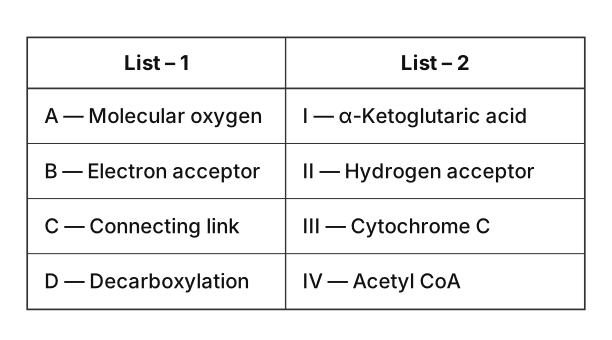
- TG EAPCET 2025Set ap-2025-04-29-AN1 markMCQQ.Match the following and choose the correct option from the lists given below List-1 List-2 A. Molecular oxygen I. α-Ketoglutaric acid B. Electron acceptor II. Hydrogen acceptor C. Connecting link III. Cytochrome C D. Decarboxylation IV. Acetyl CoA (A) A – I, B – III, C – IV, D – II (B) A – III, B – I, C – II, D – IV (C) A – II, B – III, C – IV, D – I (D) A – IV, B – III, C – I, D – II
›Reveal solutionSolution
Match each term in cellular respiration to its correct role: molecular oxygen is the final hydrogen/electron acceptor, cytochrome c is an electron carrier, acetyl CoA links glycolysis to the Krebs cycle, and α-ketoglutaric acid undergoes decarboxylation. The answer is (C).
This question tests your understanding of the key players in cellular respiration—specifically their roles in the electron transport chain, the Krebs cycle, and the metabolic pathways that extract energy from glucose.
The strategy is to identify what each term in List-1 actually does in the cell, then match it to the most accurate descriptor in List-2.
Matching each term
-
A. Molecular oxygen → II. Hydrogen acceptor
Molecular oxygen (O2) serves as the terminal electron acceptor in the electron transport chain. When electrons pass through the chain, they reduce oxygen to water. Since accepting electrons often means accepting hydrogen atoms (protons + electrons), oxygen is correctly described as a hydrogen acceptor:
O2+4H++4e−→2H2O
-
B. Electron acceptor → III. Cytochrome C
Cytochrome c is a mobile electron carrier protein in the inner mitochondrial membrane. It accepts electrons from Complex III and donates them to Complex IV in the electron transport chain. While oxygen is the final electron acceptor, cytochrome c is an intermediate electron acceptor—a carrier that shuttles electrons along the chain.
-
C. Connecting link → IV. Acetyl CoA
Acetyl CoA is the pivotal molecule that connects glycolysis (which occurs in the cytoplasm and produces pyruvate) to the Krebs cycle (which occurs in the mitochondrial matrix). Pyruvate is oxidatively decarboxylated to form acetyl CoA, which then enters the Krebs cycle. This makes acetyl CoA the metabolic bridge between these two major pathways.
-
D. Decarboxylation → I. α-Ketoglutaric acid …
-
- TG EAPCET 2025Set ap-2025-04-29-AN1 markMCQQ.Consider the following statements Statement-I: When compared to UV-A rays, UV-B and UV-C rays are more harmful to organisms Statement-II: Oriented locomotor movement of an organism towards or away from the direction of light is called phototaxis The correct answer is (A) Both statements I and II are true (B) Both statements I and II are false (C) Statement I is true, but statement II is false (D) Statement I is false, but statement II is true
›Reveal solutionSolution
UV-B and UV-C rays are more energetic and thus more harmful than UV-A rays. Phototaxis correctly describes an organism's directed movement towards or away from light. Both statements are true.
Understanding UV Radiation and Organism Movement
This question tests your knowledge of two distinct biological concepts: the properties and effects of different types of ultraviolet (UV) radiation, and the definition of a specific type of oriented movement in organisms.
For Statement I (UV Radiation):
Ultraviolet (UV) radiation is a form of electromagnetic radiation with wavelengths shorter than visible light. It is categorized into three main types based on wavelength: UV-A, UV-B, and UV-C. The key principle here is that shorter wavelength corresponds to higher energy per photon. Higher energy photons have a greater capacity to cause damage to biological molecules like DNA and proteins, leading to cellular damage, mutations, and other harmful effects.
For Statement II (Phototaxis):
Organisms exhibit various types of movements in response to environmental stimuli. These movements can be random or directed. A taxis is a directed movement of an organism towards or away from a specific stimulus. When the stimulus is light, this directed movement has a specific name.
- Evaluating Statement I: Harmfulness of UV rays
- UV radiation is classified by wavelength:
- UV-A: 315-400 nm (longest wavelength, lowest energy)
- UV-B: 280-315 nm (medium wavelength, medium energy)
- UV-C: 100-280 nm (shortest wavelength, highest energy)
- Since energy is inversely proportional to wavelength (E=hc/λ), UV-C rays have the highest energy, followed by UV-B, and then UV-A.
- Higher energy photons are more effective at breaking chemical bonds and causing damage to biological molecules (like DNA and proteins) within cells. This damage can lead to mutations, cell death, and various health problems.
- While UV-A can cause skin aging and contribute to skin cancer, UV-B is the primary cause of sunburn and is strongly linked to skin cancer. UV-C is the most dangerous, but fortunately, almost all UV-C radiation from the sun is absorbed by the ozone layer and oxygen in the Earth's atmosphere before it reaches the surface.
- Therefore, UV-B and UV-C rays are indeed more harmful to organisms than UV-A rays due to their higher energy content.
- Statement I is true. …
- UV radiation is classified by wavelength:
- Evaluating Statement I: Harmfulness of UV rays
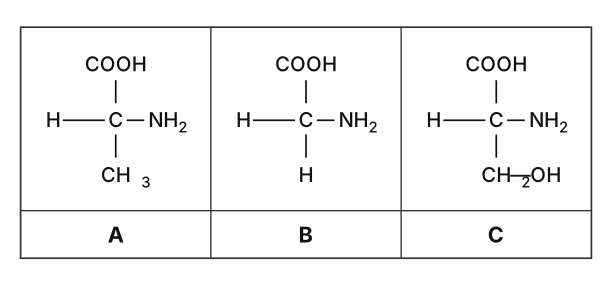
- TG EAPCET 2025Set ap-2025-04-30-FN1 markMCQQ.Identify the amino acids given below and select the correct option A: COOH at top, H−∣C−NH2 in the middle, CH3 below B: COOH at top, H−∣C−NH2 in the middle, H below C: COOH at top, H−∣C−NH2 in the middle, CH2−OH below (A) A - Glycine, B - Serine, C - Alanine (B) A - Alanine, B - Serine, C - Glycine (C) A - Alanine, B - Glycine, C - Serine (D) A - Serine, B - Alanine, C - Glycine
›Reveal solutionSolution
The identity of an amino acid is determined by its side chain (R-group). By identifying the R-groups in the given structures, we find that A is Alanine, B is Glycine, and C is Serine, making option (C) the correct choice.
The fundamental building blocks of proteins are amino acids. All alpha-amino acids share a common basic structure: a central carbon atom (called the alpha-carbon, Cα) bonded to an amino group (−NH2), a carboxyl group (−COOH), a hydrogen atom (−H), and a unique side chain, also known as the R-group. It is this R-group that differentiates one amino acid from another, giving each its specific chemical properties and biological role.
To identify the given amino acids, we need to look at the R-group attached to the alpha-carbon in each structure.
-
Analyze Structure A:
The structure shows a COOH group, an NH2 group, and an H atom attached to the central carbon. The fourth group, which is the R-group, is CH3.
ImportantThe amino acid with a methyl group (−CH3) as its R-group is Alanine.
-
Analyze Structure B:
Similar to structure A, this also has the standard COOH, NH2, and H groups on the central carbon. The R-group in this case is simply another hydrogen atom (−H).
ImportantThe amino acid with a hydrogen atom (−H) as its R-group is Glycine. It is the simplest amino acid and the only one that is not chiral.
-
Analyze Structure C: …
-
- TG EAPCET 2025Set ap-2025-04-30-FN1 markMCQQ.Volume of air remained in lungs after normal expiration is known as (A) Vital capacity (B) Residual volume (C) Functional residual capacity (D) Expiratory reserve volume
›Reveal solutionSolution
The volume of air that stays in the lungs after a normal, quiet expiration is the functional residual capacity (FRC). It is the sum of the expiratory reserve volume and the residual volume.
The key here is to understand the difference between a normal (quiet) breath and a forced (maximal) breath. Many lung volumes are defined by how hard you breathe out. The question specifically says "after normal expiration" — that is, after you have breathed out the amount you would without trying. That leftover air is not just one volume; it is a combination of two.
Let’s walk through the definitions step by step.
-
Start with a normal breath in and out.
When you breathe in and out quietly, the air that moves in and out is the tidal volume (TV). After you finish a normal, relaxed exhale, your lungs are not empty. There is still air inside, keeping the alveoli from collapsing.
-
Now, what if you try to force out more air after that normal exhale?
The extra air you can push out with a maximal effort is the expiratory reserve volume (ERV). So after a normal expiration, you still have the ERV sitting in your lungs, plus some air that you can never voluntarily push out.
-
The air that remains even after a forced, maximal expiration is the residual volume (RV).
This is the permanent, non-negotiable air that keeps the lungs inflated. You cannot exhale it no matter how hard you try.
-
Therefore, after a normal (not forced) expiration, the air left in the lungs is:
ERV+RV
This sum has its own name: the functional residual capacity (FRC). …
-
- TG EAPCET 2024Set ap-2024-05-08-FN1 markMCQQ.Match the following List - I A Pyriform shaped gametes B Auxospores C Carpogonium D Hormogonium List - II I Cyanophyceae II Rhodophyceae III Diatoms IV Phaeophyceae (A) A-IV, B-II, C-III, D-I (B) A-II, B-III, C-I, D-IV (C) A-IV, B-III, C-II, D-I (D) A-I, B-II, C-III, D-IV
›Reveal solutionSolution
This question tests your knowledge of specific reproductive structures and cell types across algal groups. The correct match is A-IV, B-III, C-II, D-I, which corresponds to option (C).
The key is to connect each term in List-I with the algal class where it is a defining or characteristic feature. These are not random facts — each structure plays a specific role in the life cycle of that group, and understanding that role makes the match stick.
-
A – Pyriform shaped gametes → IV – Phaeophyceae
Pyriform means pear-shaped. In brown algae (Phaeophyceae), the motile gametes (both male and female) are typically pyriform, with two laterally attached flagella — one tinsel type and one whiplash type. This shape is a hallmark of brown algal reproduction. Green algae often have spherical or ovoid gametes, and red algae have non-flagellated gametes entirely.
-
B – Auxospores → III – Diatoms
Auxospores are special reproductive cells found only in diatoms (Bacillariophyceae). Diatoms have a rigid silica frustule that gets smaller with each vegetative division. To restore their original size, they form an auxospore — a naked, expanding cell that then secretes a new, larger frustule. No other algal group uses auxospores.
-
C – Carpogonium → II – Rhodophyceae
The carpogonium is the female reproductive structure in red algae (Rhodophyceae). It is a flask-shaped cell with a long, hair-like extension called the trichogyne, which captures male gametes (spermatia). This is a unique and defining feature of red algae — no other algal group has a carpogonium.
-
D – Hormogonium → I – Cyanophyceae …
-
- TG EAPCET 2023Set ap-2023-05-10-FN1 markMCQQ.Match the following Table - I A Potassium B Sulphur C Molybdenum D Zinc Table - II I Constituent of ferredoxin II Necessary in stomatal movement III Needed for auxin synthesis IV Component of nitrogenase (A) A - III, B - I, C - II, D - IV (B) A - I, B - IV, C - II, D - III (C) A - II, B - I, C - IV, D - III (D) A - III, B - I, C - IV, D - II
›Reveal solutionSolution
This question tests knowledge of the specific roles of various essential elements in plant physiology. We will match each element to its primary function, finding that Potassium is crucial for stomatal movement, Sulphur is a constituent of ferredoxin, Molybdenum is a component of nitrogenase, and Zinc is needed for auxin synthesis, leading to option (C).
The growth and development of plants depend on a continuous supply of essential mineral nutrients from the soil. These nutrients are broadly classified into macronutrients (required in larger amounts) and micronutrients (required in smaller amounts), but both are equally vital for various metabolic processes. Each element plays one or more specific roles, often acting as components of enzymes, structural elements, or regulators of physiological processes. Understanding these specific functions is key to solving this type of matching question.
Let's break down the function of each element listed in Table-I and match it with the correct description from Table-II.
-
Potassium (A):
Potassium is a macronutrient that plays a crucial role in maintaining the turgor of cells and regulating the opening and closing of stomata. It is involved in osmoregulation, activating many enzymes, and maintaining the anion-cation balance in cells. Its most prominent role related to the options is in stomatal movement.
- Therefore, Potassium (A) matches with II (Necessary in stomatal movement).
-
Sulphur (B):
Sulphur is a macronutrient and a vital constituent of several amino acids, such as cysteine and methionine. These amino acids are building blocks for proteins. Sulphur is also a component of several vitamins (e.g., thiamine, biotin, coenzyme A) and electron carriers like ferredoxin, which is important in photosynthesis and nitrogen fixation.
- Therefore, Sulphur (B) matches with I (Constituent of ferredoxin).
-
Molybdenum (C): …
-
🎓Unlock everything free for 14 days
- ✓Full step-by-step solutions
- ✓Concept-first explanations
- ✓Methods, shortcuts & mistakes
- ✓PYQ mapping + timed mock tests
Full access for 14 days. No credit card required.