Question of 35
Q.Explain the purification of sulphide ore by Froth floatation method.
Telangana TsbieTelangana Board of Intermediate Education 2020Subjective· 4mImportance★★★★★
0% · 0/35 Questions
You're viewing a preview — the full solution, concept, methods & PYQ mapping are locked.
Start your 14-day free trial to unlock the full solution →Froth floatation separates sulphide ore particles from gangue by exploiting their different wettability: the ore is carried up in a froth by air bubbles while the gangue sinks.
Froth floatation is a method of concentration (enrichment) used specifically for sulphide ores (e.g., galena PbS, zinc blende ZnS, copper pyrites CuFeS₂), which relies on the difference in the wetting properties of the ore particles and the gangue (unwanted rocky/earthy impurities) by oil and water.
Procedure:
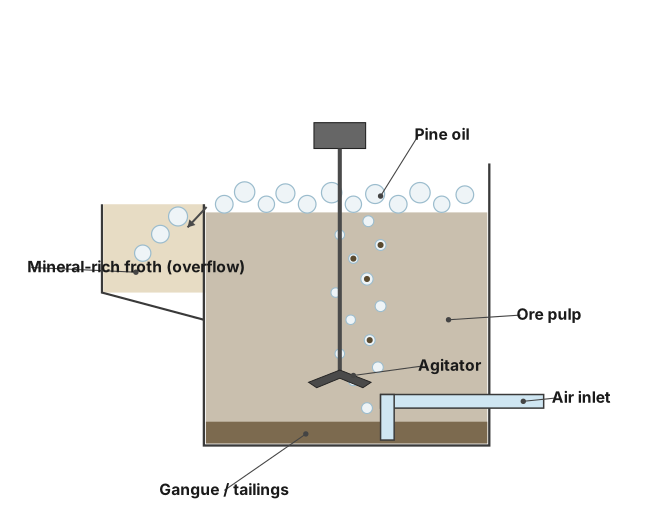
- The finely powdered sulphide ore is mixed with water to form a suspension (pulp) in a large floatation tank.
- A small quantity of a collector (frothing/oil agent, such as pine oil, fatty acids, or xanthates) is added. Collectors enhance the non-wettability of the mineral (ore) particles.
- Air is blown vigorously through this suspension using compressed air/mechanical agitators.
- The sulphide ore particles are preferentially wetted by the oil/collector (they are hydrophobic to water) and get attached to the air bubbles; they rise and collect as a froth (foam) on the surface of the tank.
- The gangue particles are preferentially wetted by water (hydrophilic) and remain in the tank as a settled suspension (they do not rise with the froth).
- The froth carrying the concentrated ore particles is skimmed off the surface and collected separately, giving the concentrated ore.
Additional agents:
- Froth stabilizers (e.g., cresols, aniline) stabilize the froth. …
Unlock everything free for 14 days
- Full step-by-step solutions
- Concept-first explanations
- Methods, shortcuts & mistakes
- PYQ mapping + timed mock tests
Full access for 14 days. No credit card required.