Q.Chlorobenzene is formed by reaction of chlorine with benzene in the presence of AlCl3. Which of the following species attacks the benzene ring in this reaction?
🔒You're viewing a preview — the full solution, concept, methods & PYQ mapping are locked.
🔒 Start your 14-day free trial to unlock the full solution →Concept understanding — Carboxylic Acid Halogenation
Carboxylic Acid Halogenation: The Hell–Volhard–Zelinsky Reaction
Imagine you have a carboxylic acid — say, propanoic acid (CH3CH2COOH). You want to replace one of the hydrogen atoms on the carbon chain with a halogen (like bromine or chlorine). But here's the catch: the carboxylic acid group (−COOH) is already quite reactive. If you just add bromine directly, nothing useful happens — the α-carbon (the carbon right next to the −COOH group) is not reactive enough to attack bromine on its own.
The trick is to activate the α-carbon first. This is exactly what the Hell–Volhard–Zelinsky (HVZ) reaction does.
The Intuition
The −COOH group is electron-withdrawing. That makes the α-carbon slightly positive (electrophilic), but not enough to react with a halogen directly. To make it work, we convert the acid into an acyl halide (like RCOBr) using PBr3 or PCl3. The acyl halide is even more electron-withdrawing, which makes the α-hydrogen more acidic — it can be removed by a base (like a catalytic amount of PBr3 or Br2 itself) to form an enol or enolate intermediate. This enol then attacks a halogen molecule, giving an α-haloacyl halide. Finally, water hydrolyses it back to the α-halo carboxylic acid.
In short: activate → enolize → halogenate → hydrolyse.
The Precise Statement
RCH2COOH2. H2O1. Br2, PBr3RCHBrCOOH
The reaction is regioselective: halogenation occurs exclusively at the α-carbon (the carbon adjacent to the −COOH group). No other position on the chain is halogenated.
Step-by-Step Mechanism
- Formation of acyl bromide The carboxylic acid reacts with PBr3 (or PCl3) to form an acyl bromide:
RCH2COOH+PBr3→RCH2COBr+H3PO3
- Enolization A catalytic amount of PBr3 or Br2 acts as a Lewis acid, making the α-hydrogen more acidic. A base (often Br− from the reaction) abstracts this hydrogen, forming an enol:
RCH2COBr⇌RCH=C(OH)Br
- Halogenation The enol attacks a Br2 molecule, giving the α-bromoacyl bromide:
RCH=C(OH)Br+Br2→RCHBrCOBr+HBr
- Hydrolysis Water hydrolyses the acyl bromide back to the carboxylic acid:
RCHBrCOBr+H2O→RCHBrCOOH+HBr
The PBr3 is catalytic — it is regenerated in the hydrolysis step. Only a small amount is needed.
Why This Matters
The α-halo carboxylic acid is a versatile intermediate. You can:
- Substitute the halogen with OH to get α-hydroxy acids (like lactic acid).
- Substitute with NH3 to get α-amino acids (the building blocks of proteins). …
Why this formula?
Carboxylic Acid Halogenation — The Hell-Volhard-Zelinsky (HVZ) Reaction
Let's start with the core reaction and then unpack why it works the way it does.
The Reaction in a Nutshell
Carboxylic acids undergo α-halogenation (replacement of an α-hydrogen with a halogen) only under specific conditions:
R−CHX2−COOH+BrX2PBrX3 (cat⋅)R−CHBr−COOH+HBr
The key reagents: Br₂ (or Cl₂) + a catalytic amount of PBr₃ (or PCl₃). The product is an α-halo carboxylic acid.
Why Does This Happen? The Step-by-Step Reasoning
1. The Problem: Carboxylic Acids Are Not Enolizable Directly
- A carboxylic acid has a carbonyl group (C=O), but the α-hydrogen is not acidic enough to be removed by a base like OHX−.
- Why? The conjugate base (carboxylate ion, RCOOX−) is more stable than an enolate. So enolate formation is disfavoured.
Key insight: We need to activate the carbonyl first.
2. The Solution: Convert to an Acyl Halide (More Electrophilic)
- PBr₃ reacts with the carboxylic acid to form an acyl bromide:
3R−COOH+PBrX33R−COBr+HX3POX3
- The acyl bromide has a better leaving group (Br⁻ vs OH⁻) and a more electrophilic carbonyl carbon. This makes enolization easier.
3. Enolization of the Acyl Halide
- A small amount of HBr (from the reaction) or Br₂ itself can act as a Lewis acid to polarize the carbonyl.
- The α-hydrogen is now removable by a weak base (like Br⁻ or the enol itself), forming an enol:
R−CHX2−COBrR−CH=C(OH)Br
- This enol is nucleophilic at the α-carbon.
4. Halogenation of the Enol
- The enol attacks Br₂ (or Cl₂) at the α-position:
R−CH=C(OH)Br+BrX2R−CHBr−C(OH)BrX2R−CHBr−COBr+HBr
- The product is an α-bromo acyl bromide.
5. Regeneration of the Acid
- The α-bromo acyl bromide reacts with water (or with another molecule of carboxylic acid) to give the α-bromo carboxylic acid:
R−CHBr−COBr+HX2OR−CHBr−COOH+HBr
- The HBr produced can re-enter the cycle, making the process catalytic in PBr₃.
The Key Formula(e) — Why They Hold
Overall Stoichiometry
R−CHX2−COOH+BrX2PBrX3 (cat⋅)R−CHBr−COOH+HBr
Why this holds:
- One Br₂ molecule provides one Br atom for substitution and one for HBr.
- The catalyst (PBr₃) is not consumed — it is regenerated in the cycle. …
The key idea is electrophilic aromatic substitution — a strong Lewis acid (AlCl3) generates a highly reactive electrophile from chlorine.
- AlCl3 accepts a lone pair from Cl2, polarising the bond and forming a complex: Cl2+AlCl3→Clδ+−Clδ−−AlCl3. …
In the Friedel–Crafts chlorination of benzene, the attacking electrophile is the chlorine cation Cl+, generated by the Lewis acid AlCl3 polarising the Cl2 bond. The correct option is (ii).
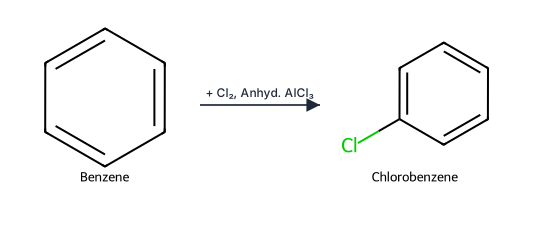
This is a classic electrophilic aromatic substitution (EAS) reaction — the Friedel–Crafts halogenation. Benzene’s π-electron cloud is rich and nucleophilic, but it does not react directly with neutral chlorine gas at room temperature. You need a powerful electrophile to pull electrons away from the ring and form the sigma complex. That’s where the Lewis acid comes in.
The role of AlCl3 is to accept a lone pair from one chlorine atom of Cl2, creating a highly polarised complex. This weakens the Cl–Cl bond so much that it effectively breaks heterolytically, generating a Cl+ ion (or a strongly δ+ chlorine in the complex) that can attack the ring.
Let’s walk through the mechanism step by step.
- Generation of the electrophile AlCl3 is electron-deficient (it has only six electrons in its valence shell). It coordinates to a chlorine atom of Cl2, forming a complex:
Cl2+AlCl3→Clδ+⋯Clδ−⋯AlCl3
The Al–Cl bond in the complex pulls electron density away from the Cl2 molecule. This makes one chlorine strongly electrophilic — essentially a Cl+ equivalent.
- Attack on the benzene ring The π-electrons of benzene attack this electrophilic chlorine, forming a delocalised carbocation intermediate (the arenium ion or sigma complex):
C6H6+Cl+→C6H6Cl+
This step is slow and rate-determining. …
Concept: Electrophilic Aromatic Substitution (EAS) — Role of the Catalyst
Method: Identify the Active Electrophile
In the chlorination of benzene using Cl2 and AlCl3, the catalyst generates a strong electrophile that attacks the electron-rich benzene ring.
Steps:
-
Recognize the reaction type
This is an electrophilic aromatic substitution. Benzene is electron-rich, so it needs a positive or electron-deficient species to attack it.
-
Role of AlCl3
AlCl3 is a Lewis acid. It accepts a lone pair from chlorine in Cl2, polarising the Cl−Cl bond.
-
Formation of the attacking species
The polarisation leads to heterolytic cleavage:
Cl2+AlCl3→Cl++[AlCl4]− …
Common Mistakes & How to Avoid Them
Mistake 1: Choosing Cl− (option (i))
Why students pick it: They see chlorine is involved and assume the negative ion (chloride) is the attacking species, confusing nucleophilic with electrophilic substitution.
Why it’s wrong: Benzene is electron-rich (due to its delocalised π-system). It repels negative species. Chlorobenzene formation is an electrophilic aromatic substitution — the attacking species must be electron-deficient (an electrophile). Cl− is a nucleophile, not an electrophile.
How to avoid: Always check the charge of the attacking species. If benzene is the substrate, the attacking species must be positive or at least neutral but electron-deficient. Memorise: Benzene loves positive things.
Mistake 2: Choosing AlCl3 (option (iii))
Why students pick it: They see AlCl3 is added as a catalyst and assume it directly attacks benzene.
Why it’s wrong: AlCl3 is a Lewis acid — it accepts electrons. Its role is to activate chlorine by forming a complex, not to attack benzene directly. The actual attacking species is generated from this interaction.
How to avoid: Distinguish between catalyst and attacking species. The catalyst helps create the electrophile but does not itself attack the ring. Ask: What does the catalyst do to the reagent? Here, AlCl3 polarises Cl2 to generate Cl+.
Mistake 3: Choosing [AlCl4]− (option (iv))
Why students pick it: They see a negative charge and think it might stabilise something, or confuse it with the attacking species.
Why it’s wrong: [AlCl4]− is a byproduct formed after AlCl3 accepts a chloride ion. It is negatively charged and stable — it does not attack the electron-rich benzene ring.
How to avoid: Track the reaction mechanism step-by-step:
- AlCl3+Cl2→Cl++[AlCl4]−
- Cl+ attacks benzene.
- [AlCl4]− is just a spectator/counterion.
Mistake 4: Not recognising Cl+ as the correct electrophile (option (ii)) …
Showing the 12 most recent of 23 on this concept.
- TG EAPCET 2026Set eng-2026-05-09-FN1 markMCQQ.Identify the reactions which give orthoboric acid from the following I. Acidification of an aqueous solution of borax II. Hydrolysis of diborane III. Hydrolysis of boron trichloride The correct answer is (A) I, II only (B) II, III only (C) I, III only (D) I, II, III
›Reveal solutionSolution
Orthoboric acid (HX3BOX3) is produced from all three listed reactions: acidification of borax, hydrolysis of diborane, and hydrolysis of boron trichloride. The correct answer is (D).
Concept & Intuition
Orthoboric acid is a weak, monobasic Lewis acid that forms whenever boron compounds are treated with water or aqueous acid. Borax is a sodium salt of boric acid; adding a strong acid simply reverses its formation. Diborane and boron trichloride are both electron-deficient boron compounds that react violently with water, each yielding boric acid as the final hydrolysis product. The key is recognizing that all three starting materials contain boron in the +3 oxidation state, which ends up as B(OH)X3 in aqueous solution.
Step-by-step reasoning
- Reaction I: Acidification of borax Borax is NaX2BX4OX7⋅10HX2O. In water it hydrolyzes to give a basic solution containing tetraborate ions. Adding a strong acid (e.g., HCl) shifts the equilibrium to produce orthoboric acid:
NaX2BX4OX7+2HCl+5HX2O4HX3BOX3+2NaCl
This is a standard laboratory preparation of boric acid. So I works.
- Reaction II: Hydrolysis of diborane Diborane (BX2HX6) is highly reactive toward water. The hydrolysis proceeds in two stages: first, each B–H bond reacts with water to give hydrogen gas and boric acid:
BX2HX6+6HX2O2HX3BOX3+6HX2
The reaction is vigorous and quantitative. Hence II works.
- Reaction III: Hydrolysis of boron trichloride …
- TG EAPCET 2026Set eng-2026-05-10-AN1 markMCQQ.In Dettol, chloroxylenol is one component. The IUPAC name of it is (A) 4-Chloro – 3,5-dimethylphenol (B) 3-Chloro – 4,5-dimethylphenol (C) 4-Chloro – 2,5-dimethylphenol (D) 5-Chloro – 2,3-dimethylphenol
›Reveal solutionSolution
Chloroxylenol is a phenol derivative with chlorine and two methyl groups; its systematic IUPAC name is 4-Chloro-3,5-dimethylphenol, which corresponds to option (A).
The key here is to recall the structure of chloroxylenol, the active antiseptic in Dettol. It is a substituted phenol, meaning the parent compound is benzene with an –OH group. The IUPAC rules require us to number the ring so that the –OH gets the lowest possible number (position 1), then name the substituents in alphabetical order with their locants.
Let’s work through the reasoning step by step.
-
Identify the parent compound.
The core is phenol — a benzene ring with a hydroxyl (–OH) group. In IUPAC naming, the –OH carbon is always numbered as position 1.
-
Recall the known structure of chloroxylenol.
Chloroxylenol has the molecular formula CX8HX9ClO. Its common structure has:
- A chlorine atom (chloro) at position 4,
- Two methyl groups at positions 3 and 5,
- The –OH at position 1. This gives the systematic name: 4-chloro-3,5-dimethylphenol.
-
Check the numbering logic.
If we number the ring starting from the –OH carbon as 1, the substituents fall at:
- Carbon 2: hydrogen (no substituent),
- Carbon 3: methyl,
- Carbon 4: chloro,
- Carbon 5: methyl,
- Carbon 6: hydrogen. So the locants are 4 for chloro, and 3 and 5 for the two methyl groups. Alphabetically, “chloro” comes before “dimethyl”, so the name is “4-chloro-3,5-dimethylphenol”.
-
Eliminate the other options.
- (B) 3-Chloro-4,5-dimethylphenol would place chlorine next to the –OH, which is not the actual structure. …
-
- TG EAPCET 2025Set eng-2025-05-02-AN1 markMCQQ.The major product in Reimer – Tiemann reaction is X. The reactants are Y and Z. X, Y and Z are respectively. (Aq = aqueous) (A) 4-hydroxybenzaldehyde (p-HO−CX6HX4−CHO), CHClX3, Aq. NaOH (B) Salicylic acid (2-hydroxybenzoic acid), CClX4, Aq. Ba(OH)X2 (C) Salicylaldehyde (2-hydroxybenzaldehyde), CHClX3, Aq. NaOH (D) Benzoic acid (CX6HX5−COOH), CClX4, Aq. KOH
›Reveal solutionSolution
The Reimer–Tiemann reaction treats phenol with chloroform and aqueous NaOH; dichlorocarbene attacks the phenoxide ring ortho, giving salicylaldehyde as the major product — option (C).
The concept first
The Reimer–Tiemann reaction is an electrophilic aromatic substitution in which the electrophile is a carbene.
- Alkali removes the proton from chloroform:
CHClX3+OHX−CClX3X−+HX2O
- The trichloromethyl anion ejects a chloride to give the electron-deficient dichlorocarbene:
CClX3X−:CClX2+ClX−
- Meanwhile the same alkali converts phenol into phenoxide, in which the negative charge is delocalised onto the ortho and para ring carbons — a far more activated ring than phenol itself.
Step 1 — Attack and hydrolysis
The carbene is captured predominantly at the ortho carbon (the neighbouring −O− effectively hands it over), giving an o-dichloromethyl phenol. The alkaline medium then hydrolyses that −CHClX2 group:
Ar−CHClX22OHX−−2ClX−Ar−CH(OH)X2−HX2OAr−CHO
Step 2 — Name the products and reactants
Overall:
CX6HX5OH(i) CHClX3, aq⋅ NaOH(ii) HX3OX+2-HO−CX6HX4−CHO …
- TG EAPCET 2025Set eng-2025-05-04-AN1 markMCQQ.Composition of siderite ore is (A) FeCO3 (B) ZnCO3 (C) CuCO3.Cu(OH)2 (D) CuFeS2
›Reveal solutionSolution
Siderite is an iron carbonate mineral; its chemical formula is FeCO3, so the correct option is (A).
The question asks for the composition of siderite ore. This is a straightforward recall from mineralogy and chemistry of ores. The key is to know the common names and formulas of important carbonate ores: siderite (iron), smithsonite (zinc), malachite (copper), and chalcopyrite (copper‑iron sulfide). Let’s match each option to its mineral name.
-
Option (A): FeCO3
This is iron(II) carbonate. Its mineral name is siderite. Siderite is an important ore of iron, though less common than hematite or magnetite. The name “siderite” comes from the Greek sideros meaning iron.
-
Option (B): ZnCO3
This is zinc carbonate, known as smithsonite. It is a zinc ore, not siderite.
-
Option (C): CuCO3⋅Cu(OH)2
This is basic copper carbonate, the mineral malachite. It is a copper ore, not siderite.
-
Option (D): CuFeS2 …
-
- TG EAPCET 2025Set eng-2025-05-04-FN1 markMCQQ.What are X and Y in the following reaction sequence? C5H12OCu 573 KC5H10(i) O3(ii) Zn+H2OX+Y (A) O∣CH3CH2CH2C∣H+HCO2H (B) CH3COCH3+CH3CHO (C) O∣CH3CH2CO∣H+CH3CHO (D) CH3COCH2CHO+HCHO
›Reveal solutionSolution
The alcohol C5H12O is 3-methylbutan-1-ol, which on dehydrogenation gives 3-methylbut-1-ene; ozonolysis then yields propanal and formaldehyde, matching option (D).
The key to this problem is working backwards from the molecular formula and the reaction conditions. C5H12O is a saturated alcohol (since it fits CnH2n+2O). The first step — passing it over hot copper at 573 K — is classic dehydrogenation of a primary or secondary alcohol to an aldehyde or ketone, but here the product is C5H10, an alkene. That means the alcohol must have lost not just two hydrogens but also a water molecule — i.e., it underwent dehydration, not simple dehydrogenation. Copper at high temperature can catalyse both, but the formation of an alkene tells us the alcohol is actually being dehydrated. So C5H12O is an alcohol that, on dehydration, gives a pentene (C5H10). The ozonolysis of that pentene then cleaves the double bond, producing two carbonyl compounds X and Y.
Let’s trace the logic step by step.
-
Identify the alcohol structure.
The formula C5H12O could be any pentanol. Dehydration of an alcohol follows Zaitsev’s rule (the more substituted alkene is favoured). But we also need the alkene to give, upon ozonolysis, products that match one of the given options. The options all involve small carbonyls: propanal, acetone, formaldehyde, formic acid, etc. That suggests the alkene is not a straight-chain pentene but a branched one, because ozonolysis of a straight-chain pent-1-ene would give butanal and formaldehyde, while pent-2-ene would give two molecules of propanal — neither of which appears in the options exactly.
The only alcohol that dehydrates to an alkene whose ozonolysis yields the combination in option (D) — CH3COCH2CHO (a diketone? Actually that’s 4-oxopentanal) plus HCHO — is unlikely. Wait, let’s check option (D) carefully: it says CH3COCH2CHO+HCHO. That’s a 5-carbon dialdehyde plus formaldehyde. That would come from a pentene with a terminal double bond and a methyl branch at the 3-position: 3-methylbut-1-ene.
Indeed, 3-methylbutan-1-ol (isoamyl alcohol) on dehydration gives mainly 3-methylbut-1-ene (the less substituted alkene, but possible under certain conditions) or 2-methylbut-2-ene. But the ozonolysis of 3-methylbut-1-ene gives propanal (CH3CH2CHO) and formaldehyde (HCHO) — that’s not option (D). Option (D) has CH3COCH2CHO (which is 4-oxopentanal) and HCHO. That’s a mismatch.
Let’s re-evaluate: Option (D) is written as CH3COCH2CHO+HCHO. That’s a 5-carbon compound — it would come from a pentene with a double bond between C2 and C3 and a methyl branch? Actually, 2-methylbut-1-ene on ozonolysis gives acetone (CH3COCH3) and formaldehyde — that’s option (B) plus something? No, option (B) is CH3COCH3+CH3CHO.
Let’s systematically check each option by working out what alkene would give those ozonolysis products.
-
Ozonolysis logic.
Ozonolysis of an alkene cleaves the double bond, giving two carbonyl compounds. For a terminal alkene (RCH=CH2), the products are an aldehyde (RCHO) and formaldehyde (HCHO). For an internal alkene (RCH=CHR′), the products are two aldehydes (or ketones if the carbon is disubstituted).
So:
- Option (A): CH3CH2CH2CHO (butanal) + HCO2H (formic acid). Formic acid comes from ozonolysis of a terminal alkene only if the terminal carbon is =CH2? No, formic acid would come from =CHOH or something — not standard. Actually, ozonolysis with reductive workup (Zn/H₂O) gives aldehydes, not acids. So (A) is unlikely.
- Option (B): CH3COCH3 (acetone) + CH3CHO (acetaldehyde). This comes from an alkene with a gem-dimethyl group at one end and a methyl at the other: (CH3)2C=CHCH3 (2-methylbut-2-ene). That alkene would come from dehydration of 2-methylbutan-2-ol (tert-pentanol) or 3-methylbutan-2-ol.
- Option (C): CH3CH2CHO (propanal) + CH3CHO (acetaldehyde). This comes from pent-2-ene (CH3CH=CHCH2CH3). That alkene would come from pentan-2-ol or pentan-3-ol.
- Option (D): CH3COCH2CHO (4-oxopentanal) + HCHO (formaldehyde). This is a 5-carbon dialdehyde plus formaldehyde — that would come from a pentene with a terminal double bond and a carbonyl already present? No, that’s impossible from a simple alkene. Wait, CH3COCH2CHO is actually a 5-carbon compound with two carbonyls — that would require the alkene to have had a double bond between C2 and C3 and also a methyl branch? Let’s see: if the alkene is CH3C(=CH2)CH2CH3 (2-methylbut-1-ene), ozonolysis gives CH3COCH2CH3 (butanone) and HCHO — not that. If the alkene is CH3CH=C(CH3)CH3 (2-methylbut-2-ene), we already got acetone + acetaldehyde. So (D) seems odd. But note: CH3COCH2CHO is actually 4-oxopentanal, which has 5 carbons. That could come from ozonolysis of a cyclic alkene? No, the starting material is acyclic. So (D) is likely a distractor.
-
Match the alcohol to the alkene. …
-
- TG EAPCET 2025Set ap-2025-04-29-AN1 markMCQQ.The sequence of reagents required to convert benzoic acid to n-propyl benzene is (A) SOCl2, (C2H5)2Cd, LiAlH4 (B) SOCl2, (C2H5)2Cd, Zn-Hg,HCl (C) SOCl2, C2H5MgBr, Zn|H+ (D) HCl, C2H5MgBr, LiAlH4
›Reveal solutionSolution
The conversion of benzoic acid to n‑propyl benzene requires three functional-group transformations: acid → acid chloride → ketone → alkane. The only sequence that achieves this cleanly is SOCl₂, (C₂H₅)₂Cd, then Zn‑Hg/HCl — option (B).
The problem asks for a sequence of reagents that turns benzoic acid (C₆H₅COOH) into n‑propyl benzene (C₆H₅CH₂CH₂CH₃). The carbon skeleton must increase by two carbons, and the carboxylic acid group must be reduced all the way to an alkyl group. That means we need to add two carbons and then remove the oxygen entirely.
The classic route is: first convert the acid to a more reactive derivative (an acid chloride), then use a dialkylcadmium reagent to add exactly one alkyl group (forming a ketone without over‑alkylation), and finally reduce the carbonyl to a methylene group using Clemmensen reduction (Zn‑Hg/HCl). Let’s check each option against this logic.
-
Convert benzoic acid to benzoyl chloride.
SOCl₂ (thionyl chloride) is the standard reagent for this — it gives clean conversion to the acid chloride with gaseous by‑products (SO₂ and HCl). Options (A), (B), and (C) all start with SOCl₂, which is correct. Option (D) starts with HCl, which would not form the acid chloride efficiently, so (D) is out.
-
Add two carbons to form a ketone.
The acid chloride must react with an organometallic that adds one alkyl group and stops at the ketone stage.
- (C₂H₅)₂Cd (diethylcadmium) is ideal: it is less reactive than Grignard reagents, so it adds only one ethyl group to the acid chloride, giving propiophenone (C₆H₅COCH₂CH₃).
- C₂H₅MgBr (ethylmagnesium bromide) is too reactive — it would add two ethyl groups, giving a tertiary alcohol (C₆H₅C(OH)(C₂H₅)₂) after work‑up, not a ketone. So options (C) and (D), which use the Grignard reagent, are wrong.
- Option (A) uses (C₂H₅)₂Cd, which is correct for this step.
-
Reduce the ketone to an alkane.
Propiophenone (C₆H₅COCH₂CH₃) must be reduced to n‑propyl benzene (C₆H₅CH₂CH₂CH₃). …
-
- TG EAPCET 2024Set ap-2024-05-08-FN1 markMCQQ.The iodine oxide which is used in the estimation of carbon monoxide is (A) I2O4 (B) I2O5 (C) I2O7 (D) I2O
›Reveal solutionSolution
Diiodine pentoxide (I2O5) is the specific iodine oxide used to estimate carbon monoxide (CO) because it quantitatively oxidizes CO to CO2 while being reduced to iodine (I2), which can then be measured. The correct option is (B).
The estimation of carbon monoxide (CO) relies on its reducing properties. To quantify CO, we need a strong oxidizing agent that reacts specifically and quantitatively with it. The reaction should produce a measurable product, allowing us to determine the initial amount of CO.
-
Identifying the suitable iodine oxide:
Among the various oxides of iodine, diiodine pentoxide (I2O5) is a well-known and stable compound that acts as a powerful oxidizing agent, especially when heated. It is specifically employed for the quantitative estimation of carbon monoxide. The other options listed are either less stable, not commonly used for this purpose, or do not exist as stable, well-characterized compounds in the context of this application.
-
The chemical reaction:
When carbon monoxide gas is passed over heated diiodine pentoxide, a redox reaction occurs. Carbon monoxide is oxidized to carbon dioxide (CO2), and diiodine pentoxide is reduced to elemental iodine (I2). The balanced chemical equation for this reaction is:
I2O5(s)+5CO(g)heatI2(s)+5CO2(g)
In this reaction, the oxidation state of iodine changes from $+5$ in $\mathrm{I_2O_5}$ to $0$ in $\mathrm{I_2}$, while the oxidation state of carbon changes from $+2$ in $\mathrm{CO}$ to $+4$ in $\mathrm{CO_2}$.3. Mechanism of estimation: …
-
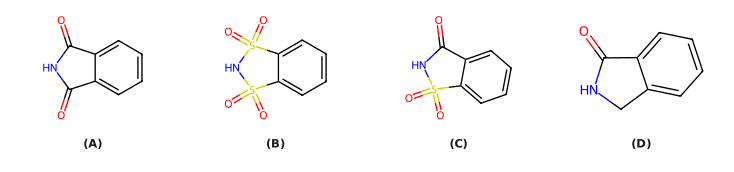
- TG EAPCET 2024Set ap-2024-05-08-FN1 markMCQQ.Which of the following is used as substitute for sucrose? (A) Benzene ring fused to a −CO−NH−CO− ring (phthalimide) (B) Benzene ring fused to a −SO2−NH−SO2− ring (C) Benzene ring fused to a −CO−NH−SO2− ring (saccharin) (D) Benzene ring fused to a −CH2−NH−CO− ring
›Reveal solutionSolution
The sugar substitute is saccharin — a benzene ring ortho-fused to a ring containing −CO−NH−SO2−. Only option (C) shows one carbonyl and one sulphonyl bridged by NH, so (C) is correct.
The concept first: artificial sweeteners
An artificial sweetening agent is a compound that stimulates the sweet-taste receptors intensely but supplies no (or negligible) calories and is not metabolised — so it can replace sucrose (cane sugar) for diabetics and for people watching their calorie intake. The standard family is:
Sweetener Sweetness vs sucrose Note Saccharin (o-sulphobenzimide) ≈550× the first artificial sweetener; excreted unchanged; safe Aspartame ≈100× a methyl ester of an Asp–Phe dipeptide; unstable to cooking Alitame ≈2000× high potency, sweetness hard to control Sucralose ≈600× a trichloro-derivative of sucrose; stable to cooking The one whose structure is examined most often is saccharin.
The structure of saccharin, built up logically
Start from benzene. Put two substituents on adjacent (ortho) carbons:
- on one carbon a carbonyl, −C=O;
- on the neighbouring carbon a sulphonyl, −SO2−.
Now bridge those two groups through a single NH. The result is a five-membered ring fused to the benzene:
benzene−C(=O)−NH−SO2−benzene …
- TG EAPCET 2024Set eng-2024-05-09-FN1 markMCQQ.Among the following the incorrect statement about chloramphenicol is (A) It is a bacteriostatic drug (B) It is a broad spectrum antibiotic (C) It is a bactericidal drug (D) It is used to treat typhoid
›Reveal solutionSolution
Chloramphenicol is primarily bacteriostatic, not bactericidal, so the incorrect statement is the one claiming it is bactericidal. The answer is option (C).
Chloramphenicol is a classic antibiotic that works by binding to the bacterial ribosome (specifically the 50S subunit) and inhibiting protein synthesis. This mechanism stops bacterial growth but does not directly kill the bacteria — that is the hallmark of a bacteriostatic drug. A bactericidal drug, by contrast, actively kills bacteria (e.g., by disrupting cell walls or DNA replication). The key distinction is that bacteriostatic drugs rely on the host’s immune system to clear the inhibited bacteria, while bactericidal drugs do the killing themselves.
Now, let’s examine each statement:
-
Statement (A): "It is a bacteriostatic drug"
This is correct. Chloramphenicol reversibly binds to the 50S ribosomal subunit, blocking peptide bond formation. Bacteria cannot multiply, but they remain alive until the immune system removes them. This is the textbook definition of bacteriostatic action.
-
Statement (B): "It is a broad spectrum antibiotic"
This is correct. Chloramphenicol is effective against both Gram-positive and Gram-negative bacteria, as well as rickettsiae and chlamydiae. Its broad spectrum is one reason it was historically used for serious infections like typhoid and meningitis.
-
Statement (C): "It is a bactericidal drug"
This is incorrect. As explained, chloramphenicol is bacteriostatic. At very high concentrations, it can sometimes show weak bactericidal activity against certain organisms, but this is not its primary or clinically relevant action. The standard classification remains bacteriostatic. …
-
- TG EAPCET 2024Set ap-2024-05-07-FN1 markMCQQ.Identify the set of molecules which act as bleaching agents only by oxidation (A) SO2,O3 (B) O3,NO (C) Cl2,O3 (D) SO2,O3,Cl2
›Reveal solutionSolution
Bleaching by oxidation involves gaining oxygen or losing electrons; the question asks for the set where both molecules bleach only by oxidation. The correct set is Cl2 and O3, which corresponds to option (C).
Concept & Intuition
Bleaching agents work by destroying colored compounds. They can do this in two main ways:
- Oxidation (the agent gains electrons, the colored substance loses electrons or gains oxygen).
- Reduction (the agent loses electrons, the colored substance gains electrons or loses oxygen).
The key is that some substances (like SO2) bleach by reduction, not oxidation. So we must identify which molecules in each option are exclusively oxidizing bleaches.
Step-by-step reasoning
-
Recall the bleaching mechanisms of common agents
- Ozone (O3): A powerful oxidizer. It releases an oxygen atom that oxidizes colored compounds. Only oxidation.
- Chlorine (Cl2): In water, forms HOCl which oxidizes dyes. Only oxidation.
- Sulfur dioxide (SO2): Acts as a reducing agent. It bleaches by adding hydrogen (reduction), e.g., turning colored organic dyes into colorless leuco compounds. Only reduction.
- Nitric oxide (NO): Can act as both an oxidizer and reducer, but its bleaching action (e.g., on wool or silk) is typically via oxidation. However, it is not a common bleaching agent and is often considered an oxidizing bleach in specific contexts. But here we must check the options carefully.
-
Evaluate each option
- (A) SO2,O3: SO2 bleaches by reduction, so this set contains a non-oxidizing bleach. Eliminate. …
- TG EAPCET 2023Set ap-2023-05-10-FN1 markMCQQ.Identify X and Y in the following reactions CaO + C \xrightarrow{\Delta} X + CO X + H_2O \rightarrow Y + Ca(OH)_2 (A) CaC_2, C_2H_2 (B) CaC_2, C_2H_4 (C) CaCO_3, C_2H_4 (D) CaCO_3, C_2H_2
›Reveal solutionSolution
The first reaction is the industrial production of calcium carbide (CaCX2), which then reacts with water to give acetylene (CX2HX2). So X is CaCX2 and Y is CX2HX2, matching option (A).
The key here is recognising a classic two-step sequence from inorganic chemistry. The first reaction — heating calcium oxide with carbon — is the standard way to make calcium carbide. This is an endothermic reduction carried out in an electric arc furnace at very high temperatures (around 2000 °C). The carbon (coke) reduces the oxide, and the calcium combines with the remaining carbon to form the carbide.
Once you have calcium carbide, its reaction with water is famously vigorous: it produces acetylene gas, which burns with a sooty flame and is used in welding. That second step is a hydrolysis reaction.
Let’s walk through it step by step.
-
Identify X from the first reaction.
CaO+CΔX+CO
Calcium oxide is being reduced by carbon. The oxygen from CaO combines with carbon to form CO, leaving behind calcium and the remaining carbon. The product is calcium carbide: CaCX2.
Balanced equation:
CaO+3CCaCX2+CO
So X = CaCX2.
-
Identify Y from the second reaction.
X+HX2OY+Ca(OH)X2
With X = CaCX2, this is the hydrolysis of calcium carbide. Water attacks the carbide ion (CX2X2−), producing acetylene gas and calcium hydroxide.
Balanced equation:
CaCX2+2HX2OCX2HX2+Ca(OH)X2 …
-
- TG EAPCET 2023Set ap-2023-05-10-FN1 markMCQQ.Assertion (A): With dry slaked lime chlorine gives bleaching powder Reason (R): Bleaching action of chlorine is due to oxidation The correct option among the following is (A) (A) and (R) are true. (R) is the correct explanation for (A) (B) (A) and (R) are true, but (R) is not the correct explanation for (A) (C) (A) is true but (R) is false (D) (A) is false but (R) is true
›Reveal solutionSolution
The reaction of dry slaked lime with chlorine produces bleaching powder, and the bleaching action of chlorine is indeed due to oxidation. However, the reason does not explain the assertion — it describes a separate property of chlorine, not the formation of bleaching powder. So both are true, but (R) is not the correct explanation for (A).
The question tests two separate ideas: the preparation of bleaching powder, and the mechanism of chlorine’s bleaching action. Many students mix them up, thinking that because bleaching powder contains chlorine, its bleaching action must be the same as chlorine’s. That’s the trap.
Let’s break it down.
- Assertion (A): Dry slaked lime with chlorine gives bleaching powder. This is a standard industrial preparation. Slaked lime is calcium hydroxide, Ca(OH)X2. When dry slaked lime is treated with chlorine gas, the reaction is:
Ca(OH)X2+ClX2CaOClX2+HX2O
The product, CaOClX2, is bleaching powder (calcium hypochlorite-chloride). This is a fact — the assertion is true.
- Reason (R): Bleaching action of chlorine is due to oxidation. Chlorine bleaches by reacting with water to form nascent oxygen:
ClX2+HX2OHCl+HOCl
The hypochlorous acid (HOCl) decomposes to give nascent oxygen, which oxidises coloured substances to colourless ones. So the bleaching action of chlorine is indeed an oxidation reaction. This statement is also true.
- Now the critical link: Does (R) explain (A)? …
🎓Unlock everything free for 14 days
- ✓Full step-by-step solutions
- ✓Concept-first explanations
- ✓Methods, shortcuts & mistakes
- ✓PYQ mapping + timed mock tests
Full access for 14 days. No credit card required.