Q.Which of the following alcohols will yield the corresponding alkyl chloride on reaction with concentrated HCl at room temperature?
Concept understanding — Alcohol Oxidation
Alcohol Oxidation: The Intuition First
Imagine you have a molecule of ethanol — the alcohol in your hand sanitizer or a drink. It has a carbon atom bonded to an –OH group. Now picture that –OH group as a "handle" that can be transformed. Oxidation, in organic chemistry, doesn't always mean adding oxygen — it often means removing hydrogen from a carbon that already has a bond to oxygen. For alcohols, oxidation is like "stripping away" hydrogen atoms from the carbon that holds the –OH, turning the alcohol into a more oxidized functional group.
Think of it this way: a primary alcohol (R–CH₂–OH) has two hydrogens on the carbon with the –OH. If you remove one hydrogen and the hydrogen from the –OH, you get an aldehyde (R–CHO). Remove both hydrogens (and the –OH hydrogen), and you get a carboxylic acid (R–COOH). A secondary alcohol (R–CHOH–R') has only one hydrogen on that carbon — remove it, and you get a ketone (R–CO–R'). A tertiary alcohol has no hydrogen on that carbon — so it cannot be oxidized without breaking the carbon skeleton.
That's the core intuition: oxidation of an alcohol is about removing hydrogens from the carbon bearing the –OH group. The more hydrogens you can remove, the more oxidized the product.
The Precise Statement
Alcohol oxidation is the process in which an alcohol loses hydrogen atoms (dehydrogenation) from the carbon bonded to the –OH group, increasing the number of C–O bonds (or decreasing C–H bonds). The outcome depends on the class of the alcohol:
| Alcohol Class | Structure | Product after oxidation | Reagent example |
|---|---|---|---|
| Primary (1°) | R–CH₂–OH | Aldehyde (R–CHO) then Carboxylic acid (R–COOH) | PCC (stops at aldehyde); K₂Cr₂O₇/H⁺ (goes to acid) |
| Secondary (2°) | R–CHOH–R' | Ketone (R–CO–R') | K₂Cr₂O₇/H⁺, CrO₃, etc. |
| Tertiary (3°) | R₃C–OH | No reaction (under normal conditions) | — |
A common mistake: students think "oxidation" always adds oxygen. For alcohols, it's removal of hydrogen from the carbon with the –OH. The oxygen from the –OH stays — it's the hydrogens that leave.
Why Does Tertiary Alcohol Not Oxidize?
Look at the carbon with the –OH in a tertiary alcohol: it has three carbon groups attached and no hydrogen. To form a C=O bond, you'd need to remove a hydrogen from that carbon — but there is none. The only way to oxidize a tertiary alcohol is to break a C–C bond (strong and difficult), which is not typical oxidation. So in standard organic chemistry, tertiary alcohols are inert to mild oxidizing agents.
A Real-World Analogy
Think of the alcohol carbon as a "parking spot" with a certain number of hydrogen "cars." Primary alcohol has two cars parked. Oxidation is like towing away one car (→ aldehyde) or both cars (→ carboxylic acid). Secondary alcohol has one car — tow it away, and you get a ketone. Tertiary alcohol has zero cars — nothing to tow, so no reaction.
Key Reagents to Remember (for exams)
- PCC (pyridinium chlorochromate): oxidizes 1° alcohols to aldehydes only — stops there.
- K₂Cr₂O₇ / H₂SO₄ (acidified potassium dichromate): oxidizes 1° alcohols all the way to carboxylic acids; 2° alcohols to ketones. (Not to be confused with Jones reagent, which is specifically CrO₃ dissolved in dilute aqueous H₂SO₄, often used in acetone — a related but distinct oxidant with the same general 1°→acid / 2°→ketone outcome.)
- KMnO₄: similar to dichromate, but stronger — can over-oxidize.
- Swern oxidation (DMSO + oxalyl chloride): mild, gives aldehydes from 1° alcohols.
For exams: if you see "mild oxidation" of a primary alcohol, think aldehyde. If you see "strong oxidation" or "acidic dichromate", think carboxylic acid. For secondary alcohols, both mild and strong give ketones.
The Mechanism (Simplified)
In acidic dichromate oxidation, the alcohol oxygen attacks chromium, forming a chromate ester. Then a base (often water) removes a hydrogen from the carbon bearing the –OH, and the C–O bond becomes a C=O. The chromium is reduced from Cr(VI) to Cr(III) — that's the colour change from orange to green.
You don't need to memorise the full mechanism for most Indian board exams (Class 12), but understanding that a hydrogen is removed from the carbon is crucial.
Final Takeaway
Alcohol oxidation = dehydrogenation of the carbon with –OH.
- 1° → aldehyde (mild) or acid (strong)
- 2° → ketone
- 3° → no reaction
That's it. Build your understanding from this single idea, and you'll never confuse the products.
Searches like "oxidation of alcohols primary secondary tertiary" and "alcohols phenols ethers class 12 chemistry reactions" are common, since this is a core reaction covered in the Alcohols, Phenols and Ethers chapter of the NCERT/CBSE Class 12 Chemistry curriculum. Reagent-based questions (PCC vs. acidic dichromate) built on this concept are frequently tested in JEE Main and NEET.
Why this formula?
Alcohol Oxidation: Why the Reactions Work the Way They Do
Alcohol oxidation is a fundamental reaction in organic chemistry, and understanding why it proceeds as it does is crucial for Indian board exams (Class 12, JEE, NEET). Let's break it down step-by-step.
1. The Core Idea: Loss of Hydrogen
Oxidation in organic chemistry means loss of hydrogen (or gain of oxygen). For alcohols, this happens at the carbon bearing the –OH group.
- Primary alcohol (R−CH2OH): Has two hydrogens on the carbon attached to –OH.
- Secondary alcohol (R2CHOH): Has one hydrogen on that carbon.
- Tertiary alcohol (R3COH): Has zero hydrogens on that carbon.
Key insight: The number of hydrogens on the carbon with –OH determines if and how far oxidation can go.
2. Why Primary Alcohols Give Aldehydes (Then Carboxylic Acids)
Step 1: Aldehyde formation
When a primary alcohol (R−CH2OH) is oxidized, the first product is an aldehyde (R−CHO).
Why? The oxidizing agent (like K2Cr2O7 / H2SO4 or PCC) removes two hydrogens:
- One from the –OH group
- One from the carbon atom
The carbon–oxygen bond becomes a double bond (C=O), forming the aldehyde.
R−CH2OH[O]R−CHO+H2O
But why stop here? The aldehyde still has one hydrogen on the carbonyl carbon. If a strong oxidant is present, it can remove that hydrogen too.
Step 2: Carboxylic acid formation
With excess strong oxidant (e.g., K2Cr2O7 / H2SO4, heat), the aldehyde is further oxidized to a carboxylic acid (R−COOH).
R−CHO[O]R−COOH
Why does this happen? The aldehyde's carbonyl carbon is electrophilic (partially positive). Water (from the reaction medium) adds to it, forming a gem-diol intermediate. The oxidant then removes two more hydrogens, giving the acid.
Exam tip: To stop at the aldehyde, use a mild oxidant like PCC (pyridinium chlorochromate) in anhydrous conditions — no water means no gem-diol formation.
3. Why Secondary Alcohols Give Ketones (and Stop)
A secondary alcohol (R2CHOH) has only one hydrogen on the carbon with –OH. Oxidation removes:
- One hydrogen from –OH
- One hydrogen from the carbon
This forms a ketone (R2C=O).
R2CHOH[O]R2C=O+H2O
Why does it stop here? The ketone has no hydrogen on the carbonyl carbon. Without that hydrogen, further oxidation (under normal conditions) is impossible — you'd need to break a C−C bond, which requires much harsher conditions.
Key result: Secondary alcohols cannot be oxidized further than ketones under standard conditions.
4. Why Tertiary Alcohols Do NOT Oxidize
A tertiary alcohol (R3COH) has zero hydrogens on the carbon bearing –OH.
What happens if you try? The oxidant cannot remove any hydrogen from that carbon. The only possible reaction would be breaking a C−C bond, which doesn't happen under normal oxidation conditions.
Result: Tertiary alcohols are resistant to oxidation under mild to moderate conditions. They require strong heating with powerful oxidants (like K2Cr2O7 / H2SO4, heat) to break carbon–carbon bonds — this is destructive oxidation, not useful for synthesis.
5. The "Why" in One Table
| Alcohol Type | Hydrogens on C–OH | Product | Why? |
|---|---|---|---|
| Primary (1∘) | 2 | Aldehyde → Carboxylic acid | Two hydrogens available; aldehyde still has one more |
| Secondary (2∘) | 1 | Ketone (stops) | Only one hydrogen; ketone has none left |
| Tertiary (3∘) | 0 | No reaction | No hydrogen to remove |
6. The Mechanism (Simplified for Understanding)
For a primary alcohol with chromic acid (H2CrO4):
- Ester formation: The alcohol oxygen attacks the chromium, forming a chromate ester.
- Elimination: A base (water or the solvent) removes a proton from the carbon, while the C−O bond breaks, releasing the aldehyde and reducing Cr(VI) to Cr(IV).
R−CH2OH+H2CrO4→R−CH2−O−CrO3H−H+R−CHO+Cr(IV) species
Why this mechanism? The chromium acts as a leaving group after the ester forms. The carbon–hydrogen bond breaks because the resulting carbocation is stabilized by the adjacent oxygen (resonance).
7. Common Exam Pitfalls to Avoid
- Don't say "tertiary alcohols don't oxidize at all" — they do under extreme conditions, but not in standard reactions.
- Remember: PCC stops at aldehyde because it's anhydrous — no water for the next step.
- For JEE/NEET: Know that K2Cr2O7 / H2SO4 gives carboxylic acid from primary alcohols, while PCC gives aldehyde.
Final Takeaway
The number of hydrogens on the carbon bearing the –OH group is the single most important factor. It determines:
- Whether oxidation occurs
- What product forms
- Whether the reaction stops or continues
This is why the formulas and products are not arbitrary — they follow directly from the structure of the alcohol.
Concept: Alcohol Reactivity with HX (Lucas Test) — Tertiary alcohols react fastest with concentrated HCl at room temperature via an SN1 mechanism because they form a stable carbocation.
Reasoning:
- Reaction with conc. HCl requires protonation of the –OH group, followed by loss of H₂O to form a carbocation. The rate depends on carbocation stability.
- Primary alcohols ((i) and (iii)) react very slowly at room temperature — they need heat or ZnCl₂ (Lucas test).
- Secondary alcohol (ii) reacts slowly; tertiary alcohol (iv) forms a 3° carbocation immediately and gives the alkyl chloride readily.
The alcohol that yields the corresponding alkyl chloride is (iv) 2-methylbutan-2-ol.
The key idea is that only tertiary alcohols react readily with concentrated HCl at room temperature via an SN1 mechanism, because they form a stable carbocation. Among the given options, only 2-methylbutan-2-ol is tertiary, so it is the correct answer.
The reaction of an alcohol with concentrated HCl to form an alkyl chloride is a classic nucleophilic substitution. But not all alcohols do this easily at room temperature. The difference lies in the mechanism.
Primary and secondary alcohols typically need a catalyst like ZnCl₂ (as in the Lucas test) or heating with concentrated HX to react. At room temperature with just concentrated HCl, only tertiary alcohols react at a useful rate. Why? Because the reaction proceeds through a carbocation intermediate (SN1 mechanism). Tertiary carbocations are stable enough to form readily, while primary and secondary ones are too unstable under these mild conditions.
Let’s examine each option:
-
Option (i): CH3CH2−CH2−OH
This is propan-1-ol, a primary alcohol. Primary carbocations are highly unstable. Without a Lewis acid catalyst (like ZnCl₂) to help break the C–O bond, no reaction occurs at room temperature with concentrated HCl.
-
Option (ii): CH3CH2−CH(CH3)−OH
This is butan-2-ol, a secondary alcohol. Secondary carbocations are more stable than primary, but still not stable enough to form appreciably at room temperature with just HCl. The Lucas test (HCl + ZnCl₂) would work, but plain concentrated HCl is too weak. No significant reaction here.
-
Option (iii): CH3CH2−CH(CH3)−CH2OH
This is 2-methylbutan-1-ol, a primary alcohol (the –OH is on a terminal carbon, even though the chain is branched). Same reasoning as (i): primary carbocation, no reaction under these conditions.
-
Option (iv): CH3CH2−C(CH3)2−OH
This is 2-methylbutan-2-ol, a tertiary alcohol. The carbon bearing the –OH is attached to three alkyl groups. When the C–O bond breaks, a tertiary carbocation forms — this is very stable. At room temperature, concentrated HCl protonates the –OH, water leaves, and the carbocation is quickly attacked by Cl⁻ to give the alkyl chloride. This reaction is fast and quantitative.
A common mistake is to think that any alcohol with a branched chain is tertiary. Check the carbon attached to the –OH group. In option (iii), the –OH is on a CH₂ group (primary), not on a carbon with three alkyl substituents.
The Lucas test (conc. HCl + anhydrous ZnCl₂) is the standard way to distinguish alcohols: tertiary reacts immediately, secondary in 5–10 minutes, primary not at room temperature. Here, without ZnCl₂, only tertiary works.
The correct option is (iv), 2-methylbutan-2-ol, which readily forms the corresponding alkyl chloride with concentrated HCl at room temperature.
Method: Carbocation Stability Analysis (SN1 Mechanism)
This question tests your understanding of SN1 vs SN2 reactivity of alcohols with HCl. The key insight: concentrated HCl at room temperature favors the SN1 pathway, where reaction rate depends entirely on carbocation stability.
Step-by-step reasoning
Step 1: Identify the reaction type
- Concentrated HCl + alcohol → alkyl chloride + water
- Room temperature + concentrated acid → SN1 mechanism (protonation followed by carbocation formation)
Step 2: Determine carbocation formed after protonation and loss of water
For each alcohol, identify the carbocation that would form:
| Alcohol | Structure | Carbocation formed | Carbocation type |
|---|---|---|---|
| (i) | CH3CH2CH2OH | CH3CH2CH2+ | Primary (least stable) |
| (ii) | CH3CH2CH(CH3)OH | CH3CH2C+HCH3 | Secondary |
| (iii) | CH3CH2CH(CH3)CH2OH | CH3CH2CH(CH3)CH2+ | Primary |
| (iv) | CH3CH2C(CH3)2OH | CH3CH2C+(CH3)2 | Tertiary (most stable) |
Step 3: Apply carbocation stability order
Tertiary>Secondary>Primary
Only tertiary carbocations form readily at room temperature without rearrangement.
Step 4: Check for possible hydride/methyl shifts
- (ii) is secondary — could rearrange to tertiary, but at room temperature with conc. HCl, the reaction is slow for secondary alcohols
- (iv) is already tertiary — immediate reaction
Final Answer
Only option (iv) — 2-methylbutan-2-ol — yields the alkyl chloride readily at room temperature because it forms a stable tertiary carbocation ((CH3)2C+CH2CH3) that reacts immediately with Cl−.
(iv) CH3CH2C(CH3)2OH
Common Mistakes: Alcohols Reacting with Conc. HCl to Give Alkyl Chlorides
Mistake #1: Forgetting the Reaction Mechanism
The error: Students treat all alcohols as equally reactive with concentrated HCl at room temperature. They don't recall that this reaction follows an SN1 mechanism (for tertiary alcohols) or SN2 mechanism (for primary alcohols).
How to avoid: Always ask: "What is the carbocation stability?"
- Tertiary alcohols → stable carbocation → reacts readily at room temperature
- Secondary alcohols → moderate stability → reacts slowly, needs heating
- Primary alcohols → unstable carbocation → no reaction at room temperature
Mistake #2: Confusing "Room Temperature" with "Heating Conditions"
The error: Students assume all alcohols give alkyl chlorides with conc. HCl at room temperature, forgetting that primary alcohols require heating (often with ZnCl₂ as catalyst — Lucas test conditions).
Key fact:
- At room temperature: Only tertiary alcohols react immediately
- At room temperature: Secondary alcohols react only very slowly (the familiar 5–10 min turbidity figure belongs to the Lucas reagent, i.e. with ZnCl₂ — see Mistake #5)
- At room temperature: Primary alcohols do not react
Mistake #3: Misidentifying Alcohol Classes
The error: Students misclassify the alcohols given in the options.
Correct classification:
| Option | Structure | Class |
|---|---|---|
| (i) | CH3CH2CH2OH | Primary (1°) |
| (ii) | CH3CH2CH(CH3)OH | Secondary (2°) |
| (iii) | CH3CH2CH(CH3)CH2OH | Primary (1°) |
| (iv) | CH3CH2C(CH3)2OH | Tertiary (3°) |
How to avoid: Count the number of carbon atoms attached to the carbon bearing the –OH group:
- 1 carbon → primary
- 2 carbons → secondary
- 3 carbons → tertiary
Mistake #4: Thinking Branching Makes Option (iii) Reactive
The error: Students assume option (iii) — 2-methylbutan-1-ol — will behave differently because its chain is branched, sometimes even calling it a special hindered case.
Why that reasoning fails:
- The –OH sits on a CH2 group attached to just one other carbon — a secondary carbon bearing CH3 and C2H5 — so the alcohol is still primary (it is not a neopentyl-type alcohol, which would need the CH2OH on a tertiary carbon, as in (CH3)3CCH2OH)
- A primary carbocation is far too unstable for SN1 at room temperature
- With no catalyst (ZnCl₂) and no heating, there is no viable pathway to the chloride
How to avoid: Classify by the carbon bearing the –OH, not by overall branching. Nearby branching does not upgrade a primary alcohol's reactivity toward conc. HCl.
Mistake #5: Confusing with Lucas Test Conditions
The error: Students recall that Lucas test (conc. HCl + ZnCl₂) distinguishes alcohols, but forget that without ZnCl₂, only tertiary alcohols react at room temperature.
Key distinction:
- Conc. HCl alone at room temperature → only tertiary alcohols react
- Lucas reagent (conc. HCl + ZnCl₂) → tertiary reacts immediately, secondary in 5–10 min, primary no reaction
✓ Correct Answer
Option (iv) — CH3CH2C(CH3)2OH (2-methylbutan-2-ol) — is the only alcohol that yields the corresponding alkyl chloride with concentrated HCl at room temperature.
Reason: It is a tertiary alcohol that forms a stable tertiary carbocation, allowing SN1 reaction to proceed at room temperature.
Showing the 12 most recent of 39 on this concept.
- TG EAPCET 2026Set eng-2026-05-11-FN1 markMCQQ.The compound which is not isomeric with ethoxyethane? (A) Propylmethylether (B) Butan-2-ol (C) Butanone (D) 2-Methylpropan-1-ol
›Reveal solutionSolution
Isomers share the same molecular formula. Ethoxyethane (diethyl ether) is CX4HX10O; butanone is CX4HX8O, so it is not an isomer. The correct option is (C).
Concept & Intuition
Isomerism requires identical molecular formulas. Ethoxyethane (commonly called diethyl ether) has the structure CHX3CHX2−O−CHX2CHX3, giving it the formula CX4HX10O. Any compound that is isomeric with it must also be CX4HX10O. The trick is to check each option’s molecular formula — if it differs in the number of hydrogens (or oxygens), it cannot be an isomer.
Step-by-step reasoning
-
Determine the molecular formula of ethoxyethane
Ethoxyethane = two ethyl groups linked by an oxygen: CHX3CHX2−O−CHX2CHX3.
Count atoms: 4 carbons, 10 hydrogens, 1 oxygen → CX4HX10O.
-
Check each option’s formula
- (A) Propylmethylether: CHX3CHX2CHX2−O−CHX3 → also CX4HX10O. Isomer.
- (B) Butan-2-ol: CHX3CH(OH)CHX2CHX3 → CX4HX10O. Isomer (alcohol isomer of ether).
- (C) Butanone: CHX3COCHX2CHX3 → CX4HX8O (a ketone). This has two fewer hydrogens than CX4HX10O, so it is not an isomer.
- (D) 2-Methylpropan-1-ol: (CHX3)X2CHCHX2OH → CX4HX10O. Isomer.
-
Identify the odd one out
Only butanone has a different molecular formula. All others are CX4HX10O and thus isomeric with ethoxyethane.
Watch outA common mistake is to think “isomer” means “same functional group” — but isomers only require the same atom count. Butanone is a structural isomer of CX4HX8O, not of CX4HX10O.
TipQuickly count hydrogens: ethers and alcohols of the same carbon count have CXnHX2n+2O; ketones have CXnHX2nO. Here n=4, so ether/alcohol = CX4HX10O, ketone = CX4HX8O.
✓Final answerThe correct option is (C).
ANSWER: C
-
- TG EAPCET 2026Set eng-2026-05-11-FN1 markMCQQ.The IUPAC name of the end product Z is (CH3)3C–OH Cu 573K W (i) O3 X + Y (ii) Zn | H2O dil. NaOH Z (A) 4-Hydroxybutan-2-one (B) 3-Hydroxybutan-2-one (C) 4-Hydroxybutanal (D) But-3-en-2-one
›Reveal solutionSolution
The reaction sequence starts with dehydration of tert-butanol to isobutylene, ozonolysis gives acetone and formaldehyde, and an aldol condensation yields 4-hydroxybutan-2-one. The correct option is (A).
Concept & Intuition
This problem tests your ability to follow a multi-step organic reaction sequence, recognizing each transformation. The key is to identify the starting alcohol, predict the product of dehydration (since Cu at 573 K is a classic condition for alcohol dehydration to an alkene), then apply ozonolysis to cleave the alkene, and finally recognize that the last step (dilute NaOH) is an aldol condensation between the two carbonyl compounds formed. The pitfall is forgetting that the alkene from a tertiary alcohol is highly substituted, and that ozonolysis with reductive workup gives two carbonyl fragments.
Step-by-step reasoning
- Identify the starting material and first step The starting compound is (CH₃)₃C–OH, tert-butanol. Heating it with copper at 573 K is a standard method for dehydrating alcohols to alkenes. For a tertiary alcohol, elimination occurs readily to give the most substituted alkene:
(CH3)3C−OHCu,573K(CH3)2C=CH2+H2O
So W is isobutylene (2-methylpropene).
- Ozonolysis of the alkene Ozone (O₃) adds across the double bond, forming an ozonide. Reductive workup with Zn/H₂O cleaves the ozonide to give two carbonyl compounds. For an unsymmetrical alkene like isobutylene:
(CH3)2C=CH2(i)O3,(ii)Zn/H2O(CH3)2C=O+HCHO
Thus X = acetone (propanone) and Y = formaldehyde (methanal).
- The final step: aldol condensation The mixture of X and Y is treated with dilute NaOH. This is a classic crossed aldol reaction. Formaldehyde has no α-hydrogens, so it acts only as the electrophile. Acetone has α-hydrogens and can form an enolate. The enolate of acetone attacks the carbonyl carbon of formaldehyde:
(CH3)2C=O+HCHOOH−CH3COCH2CH2OH
The product is 4-hydroxybutan-2-one (also called 4-hydroxy-2-butanone). Note that no further dehydration occurs under dilute, mild conditions.
- Name the product The IUPAC name of CH₃COCH₂CH₂OH is 4-hydroxybutan-2-one. The carbonyl is at position 2, the hydroxyl at position 4.
Watch outA common mistake is to think the final step dehydrates the aldol product to an α,β-unsaturated ketone (but-3-en-2-one). However, dilute NaOH at room temperature typically stops at the β-hydroxy carbonyl stage; strong heating or acid is needed for dehydration.
TipRemember: In crossed aldol reactions, if one reactant has no α-hydrogens (like formaldehyde), it always serves as the electrophile, simplifying the product prediction.
✓Final answerThe correct option is (A).
ANSWER: A
- TG EAPCET 2026Set eng-2026-05-11-AN1 markMCQQ.Observe the following reaction C8H8O Y Z Aromatic compound X gives both iodoform and 2,4-DNP tests. Product Z liberates CO2 with NaHCO3 solution. Identify the set(s) in which Y is correctly represented from the following I. Zn – Hg | HCl; KMnO4 | OH−, H3O+ II. KMnO4 | OH−; H3O+ III. LiAlH4, H2O (A) I, II only (B) I, III only (C) II, III only (D) I only
›Reveal solutionSolution
X (C8H8O, positive iodoform + 2,4-DNP) is acetophenone C6H5COCH3; Z (liberates CO2 with NaHCO3) is benzoic acid. Routes I and II both give benzoic acid; III only reduces. Answer (A).
Identify X. C8H8O has 5 degrees of unsaturation (aromatic ring = 4, C=O = 1). A positive 2,4-DNP test means a carbonyl; a positive iodoform test means a CH3CO− group. The aromatic compound fitting both is acetophenone, C6H5COCH3.
Identify Z. Z liberates CO2 with NaHCO3, so Z is a carboxylic acid - here benzoic acid, C6H5COOH.
Evaluate the reagent sets Y.
- I. Zn-Hg/HCl; then KMnO4/OH−, H3O+. Clemmensen reduction converts −COCH3 to −CH2CH3 (ethylbenzene); alkaline KMnO4 then oxidises the whole side chain to −COOH, giving benzoic acid. Works.
- II. KMnO4/OH−; H3O+. Hot alkaline KMnO4 oxidises the methyl ketone of acetophenone directly to benzoic acid. Works.
- III. LiAlH4, H2O. A reducing agent - gives 1-phenylethanol C6H5CH(OH)CH3, an alcohol, not an acid; no CO2 with NaHCO3. Fails.
Sets I and II both deliver benzoic acid.
✓Final answerCorrect sets: I and II only -> option (A).
ANSWER: A
- TG EAPCET 2026Set ap-2026-05-04-AN1 markMCQQ.Observe the following reaction sequence C6H5N2+ X− X Y Z 1,4-benzoquinone (cyclohexa-2,5-diene-1,4-dione) From the given list of reagents, identify the correct sequence of X and Z for the above reaction sequenceThe correct answer is (A) V & II (B) III & IV (C) III & I (D) V & IV
H2SO4 HNO3 C2H5OH Na2Cr2O7/H+ H2O/283K I II III IV V ›Reveal solutionSolution
The diazonium salt is hydrolysed by water at 283 K (V) to phenol, and phenol is oxidised by Na2Cr2O7/H+ (IV) to 1,4-benzoquinone. So X & Z = V & IV — option (D).
The concept: read a sequence from both ends
When a scheme has two unknown reagents and a named final product, the fastest route is retrosynthesis — ask what the product is characteristically made from.
1,4-Benzoquinone (cyclohexa-2,5-diene-1,4-dione) has carbonyls at the 1- and 4-positions and is not aromatic. It is the classic oxidation product of phenol (or of hydroquinone/aniline). That single fact fixes the intermediate: Y= phenol, and Z must be a strong oxidising agent.
Going forwards, a diazonium ion loses N2 — an outstanding leaving group — and what replaces it depends entirely on the reagent:
- H2O, warm (283 K) → phenol
- C2H5OH or H3PO2 → benzene (reduction; the N2+ is simply replaced by H)
- CuCl/HCl, CuBr/HBr → halobenzene (Sandmeyer)
Step-by-step
- Fix Y from the product. 1,4-benzoquinone comes from oxidation of phenol:
C6H5OH Na2Cr2O7/H+ 1,4-benzoquinone
So Z=Na2Cr2O7/H+= IV. (HNO3 would nitrate; H2SO4 would sulphonate — neither builds the dione.)
2. Fix X. To get phenol from C6H5N2+X−:
C6H5N2+Cl−+H2O 283 K C6H5OH+N2↑+HCl
So X=H2O/283 K= V.
3. Eliminate the traps. Choosing C2H5OH (III) as X would give benzene, and benzene cannot be turned into a quinone by any of the listed reagents — so options (B) and (C) die at the first step. Option (A) (V & II) gets X right but offers HNO3 for the oxidation, which nitrates the ring rather than oxidising it to the dione.
4. The correct pairing is V & IV.
✓Final answerThe reagents are X = H2O/283K (V) and Z = Na2Cr2O7/H+ (IV), so the correct option is (D).
ANSWER: D
- TG EAPCET 2026Set ap-2026-05-05-FN1 markMCQQ.In acid medium, H2O2 reacts with aqueous KMnO4 to form Mn2+, H2O and X. In basic medium, H2O2 reacts with aqueous KMnO4 to form MnO2, H2O, OH− and Y. What are X and Y respectively? (A) O2, H2 (B) H2, H2 (C) O2, O2 (D) H2, O2
›Reveal solutionSolution
The key is that H₂O₂ acts as a reducing agent in both acidic and basic media when reacting with KMnO₄. In acid, MnO₄⁻ is reduced to Mn²⁺ and H₂O₂ is oxidised to O₂ (X = O₂). In base, MnO₄⁻ is reduced to MnO₂ and H₂O₂ is again oxidised to O₂ (Y = O₂). So both X and Y are O₂ — option (C).
The problem is about the redox behaviour of hydrogen peroxide with potassium permanganate under different pH conditions. Many students memorise that KMnO₄ is a strong oxidising agent, but they forget that H₂O₂ can act as either an oxidant or a reductant depending on the partner. Here, H₂O₂ is the reducing agent — it gets oxidised itself. The product of that oxidation is always oxygen gas (O₂), regardless of whether the medium is acidic or basic. The only thing that changes is the fate of MnO₄⁻.
Let’s walk through each case.
- In acid medium: The half-reaction for permanganate in acid is:
MnO4−+8H++5e−→Mn2++4H2O
H₂O₂, when oxidised, gives:
H2O2→O2+2H++2e−
Balancing the electrons (multiply the H₂O₂ half by 5 and the MnO₄⁻ half by 2) and adding gives the net reaction:
2MnO4−+5H2O2+6H+→2Mn2++5O2+8H2O
So X is clearly O₂.
- In basic medium: Here permanganate is reduced to MnO₂ (manganese dioxide, a brown precipitate). The half-reaction in base is:
MnO4−+2H2O+3e−→MnO2+4OH−
H₂O₂ again gets oxidised to O₂:
H2O2+2OH−→O2+2H2O+2e−
(Notice: in base, the oxidation of H₂O₂ consumes OH⁻ and produces water — but the key product is still O₂.)
Balancing electrons (multiply the H₂O₂ half by 3 and the MnO₄⁻ half by 2) gives:
2MnO4−+3H2O2→2MnO2+3O2+2H2O+2OH−
So Y is also O₂.
Watch outA common mistake is to think that H₂O₂ gets reduced to H₂ in basic medium because you see OH⁻ and H₂O in the products. But H₂O₂ is the reducing agent here — it loses electrons, so it must be oxidised. Oxidation of H₂O₂ always gives O₂, never H₂. H₂ would require reduction, which doesn’t happen in this reaction.
TipRemember the mnemonic: H₂O₂ + KMnO₄ always gives O₂ from the peroxide side. The only variable is the manganese product (Mn²⁺ in acid, MnO₂ in base, MnO₄²⁻ in neutral/weak base). So whenever you see H₂O₂ reacting with a strong oxidant like KMnO₄, the gas evolved is oxygen.
✓Final answerThe correct option is (C), with both X and Y being O₂.
- TG EAPCET 2025Set eng-2025-05-02-FN1 markMCQQ.The increasing order of boiling points of the following is
[!FORMULA] CH3–O–CH3ICH3CHOIICH3CH2CH3IIICH3CH2OHIV
(A) I < III < II < IV (B) III < I < II < IV (C) I < IV < III < II (D) III < I < IV < II›Reveal solutionSolution
Boiling point depends on intermolecular forces: stronger forces (hydrogen bonding > dipole-dipole > London dispersion) give higher boiling points. The order is propane (III) < dimethyl ether (I) < acetaldehyde (II) < ethanol (IV), so the correct option is (B).
Concept & Intuition
Boiling point is the temperature at which a liquid’s vapor pressure equals atmospheric pressure. To boil, molecules must overcome the attractive forces holding them together in the liquid. The stronger these intermolecular forces, the more energy (higher temperature) needed. The key forces here, in order of increasing strength, are:
- London dispersion forces (present in all molecules, increase with molecular size/shape)
- Dipole-dipole interactions (present in polar molecules)
- Hydrogen bonding (a special, very strong dipole-dipole interaction when H is bonded to N, O, or F)
We have four small molecules of similar molar mass (~44–46 g/mol), so dispersion forces are comparable. The deciding factor is the type of polarity and hydrogen bonding.
Step-by-step reasoning
-
Identify the molecules and their key features
- I: CH₃–O–CH₃ (dimethyl ether) — polar C–O bonds, but no O–H bond; only dipole-dipole and dispersion.
- II: CH₃CHO (acetaldehyde) — polar C=O bond, strong dipole-dipole, but no O–H or N–H; no hydrogen bonding as a donor.
- III: CH₃CH₂CH₃ (propane) — nonpolar; only weak London dispersion forces.
- IV: CH₃CH₂OH (ethanol) — has an O–H group; can form hydrogen bonds (both donor and acceptor). This is the strongest intermolecular force among the four.
-
Rank by intermolecular force strength
- Weakest: Propane (III) — only dispersion.
- Next: Dimethyl ether (I) — dispersion + dipole-dipole.
- Next: Acetaldehyde (II) — dispersion + stronger dipole-dipole (due to C=O, which is more polar than C–O).
- Strongest: Ethanol (IV) — dispersion + dipole-dipole + hydrogen bonding.
So the boiling point order should be:
III<I<II<IV
- Check against options
- (A) I < III < II < IV → Incorrect (propane should be lowest).
- (B) III < I < II < IV → Matches our reasoning.
- (C) I < IV < III < II → Incorrect (ethanol should be highest).
- (D) III < I < IV < II → Incorrect (acetaldehyde < ethanol, not the reverse).
TipA common pitfall is thinking that any oxygen-containing molecule can hydrogen-bond. Only molecules with an O–H (or N–H, H–F) bond can donate a hydrogen bond. Dimethyl ether has oxygen but no O–H, so it cannot form hydrogen bonds — it only has dipole-dipole forces, weaker than the hydrogen bonding in ethanol.
Watch outDon’t be fooled by molecular weight: all four have nearly the same molar mass (~44–46 g/mol). The difference in boiling points (from –42°C for propane to 78°C for ethanol) is entirely due to the type of intermolecular force, not size.
✓Final answerThe correct option is (B).
ANSWER: B
- TG EAPCET 2025Set eng-2025-05-02-AN1 markMCQQ.An alkene X on ozonolysis gives a mixture of simplest ketone (Y) and 3-Pentanone. The IUPAC name of the alkene X is (A) 2,3-Dimethylbut-2-ene (B) 3-Ethyl-4-methylpent-3-ene (C) 3-Ethyl-2-methylpent-2-ene (D) 2-Methyl-3-ethylpent-2-ene
›Reveal solutionSolution
Ozonolysis cleaves the C=C bond to give two carbonyl compounds; the simplest ketone is acetone (propanone), and 3‑pentanone is a symmetrical ketone. Reversing the cleavage shows the alkene must be 3‑ethyl‑2‑methylpent‑2‑ene, which is option (C).
Concept & Intuition
Ozonolysis of an alkene breaks the double bond and inserts oxygen atoms, turning each doubly‑bonded carbon into a carbonyl group. If the alkene is unsymmetrical, you get two different carbonyl compounds. Here the products are the “simplest ketone” (acetone, CH₃COCH₃) and 3‑pentanone (CH₃CH₂COCH₂CH₃). To find the original alkene, we “glue” the two carbonyl fragments back together at the carbon that was the carbonyl carbon in each product. That means the alkene’s double bond was between the carbon that came from acetone’s carbonyl and the carbon that came from 3‑pentanone’s carbonyl.
Step‑by‑step reasoning
-
Identify the two carbonyl products
- The simplest ketone is acetone: (CH₃)₂C=O. Its carbonyl carbon is the central carbon, which was one of the alkene’s doubly‑bonded carbons.
- 3‑Pentanone is CH₃CH₂–CO–CH₂CH₃. Its carbonyl carbon is the middle carbon, which was the other doubly‑bonded carbon of the alkene.
-
Reconstruct the alkene by joining the two carbonyl carbons
Remove the oxygen from each carbonyl and connect the two carbons with a double bond.
- From acetone: the carbon has two methyl groups attached.
- From 3‑pentanone: the carbon has an ethyl group on each side. So the alkene’s double bond is between
C(CH3)2andC(CH2CH3)2
That gives the structure:
(CH3)2C=C(CH2CH3)2
- Name the alkene systematically
The longest continuous carbon chain that includes the double bond:
- The left side has a central carbon with two methyls; the right side has two ethyls.
- The longest chain is actually 5 carbons: count from the leftmost methyl through the double bond to the end of an ethyl group.
- Number so that the double bond gets the lowest locant:
CH3−C(CH3)=C(CH2CH3)−CH2CH3
 This is **3‑ethyl‑2‑methylpent‑2‑ene**.
 (Double bond between C2 and C3; methyl on C2, ethyl on C3.)
4. Match with the options
- (A) 2,3‑Dimethylbut‑2‑ene → gives acetone + acetone (not 3‑pentanone).
- (B) 3‑Ethyl‑4‑methylpent‑3‑ene → numbering is different; would give different products.
- (C) 3‑Ethyl‑2‑methylpent‑2‑ene → exactly matches our reconstruction.
- (D) 2‑Methyl‑3‑ethylpent‑2‑ene → same atoms but different numbering; actually the same compound as (C) by a different name? Check: “2‑methyl‑3‑ethylpent‑2‑ene” would have the double bond at C2, methyl on C2, ethyl on C3 — that is identical to (C). However, IUPAC rules give the lowest locant to the double bond, then to substituents; “3‑ethyl‑2‑methylpent‑2‑ene” is correct (ethyl gets lower number than methyl when the double bond is fixed). Option (D) is a misnomer; the correct IUPAC name is (C).
Watch outA common mistake is to forget that the “simplest ketone” is acetone (propanone), not formaldehyde or acetaldehyde. Also, be careful with IUPAC numbering: the double bond takes priority, so the chain is numbered to give the C=C the smallest possible number.
TipYou can quickly check by drawing the ozonolysis of each option. Only (C) yields exactly acetone and 3‑pentanone.
✓Final answerThe correct option is (C).
ANSWER: C
-
- TG EAPCET 2025Set eng-2025-05-02-AN1 markMCQQ.Metal X obtained from sphalerite ore can be purified by which of the following methods? (A) Distillation (B) Poling (C) Zone refining (D) Vapour phase refining
›Reveal solutionSolution
Sphalerite is the chief ore of zinc (Zn), and the metal obtained from it is purified by distillation because zinc has a low boiling point (907 °C) and can be vaporised and condensed, leaving impurities behind. The correct option is (A).
The key idea here is that the purification method for a metal depends heavily on its physical properties, especially its boiling point relative to its impurities. Zinc, obtained from sphalerite (ZnS), has a relatively low boiling point (907 °C) compared to many common impurities like cadmium, lead, or iron. This makes distillation an ideal method: you heat the impure zinc above its boiling point, collect the zinc vapour, and condense it back to pure metal. The impurities, having much higher boiling points, remain as a solid residue.
Let’s walk through why the other options don’t fit:
-
Distillation (Option A) – This works for metals with low boiling points. Zinc’s boiling point (907 °C) is low enough that it can be vaporised without melting the furnace. Cadmium, a common impurity in zinc, has an even lower boiling point (767 °C) and can be removed first by careful temperature control. This is the standard industrial method for purifying zinc.
-
Poling (Option B) – Poling is used for metals like copper or tin that contain dissolved oxides. A green wood pole is stirred into the molten metal; the hydrocarbons release gases that reduce the oxides. Zinc does not typically have oxide impurities that require this treatment, and poling is not suited for a metal that vaporises easily.
-
Zone refining (Option C) – This method relies on differences in solubility of impurities in the solid vs. liquid state. It is used for extremely high-purity metals like silicon or germanium (for semiconductors). Zinc is not typically purified this way because distillation is far cheaper and simpler for achieving the required purity.
-
Vapour phase refining (Option D) – This involves converting the metal into a volatile compound (e.g., a chloride or carbonyl), then decomposing it to get pure metal. Examples: nickel (Mond process) or titanium (Kroll process). Zinc can be distilled directly as the metal itself, so there is no need to form a separate volatile compound.
Watch outA common mistake is to confuse “vapour phase refining” with simple distillation. Vapour phase refining requires a chemical reaction to form a volatile compound (e.g., Ni(CO)₄), whereas distillation just boils the metal itself. Zinc is purified by the latter.
TipRemember the mnemonic: Zinc Zips Up – zinc has a low boiling point, so it’s purified by distillation. Other low-boiling metals like mercury and cadmium also use distillation.
✓Final answerThe correct option is (A).
ANSWER: A
-
- TG EAPCET 2025Set eng-2025-05-03-FN1 markMCQQ.Which of the following can undergo Hell-Volhard-Zelinsky reaction? (A) C6H5−CH2CHO (phenylacetaldehyde) (B) C6H5−CO2H (benzoic acid) (C) C6H5−CH2CO2H (phenylacetic acid) (D) C6H5−CH2−CO−CH3 (phenylacetone)
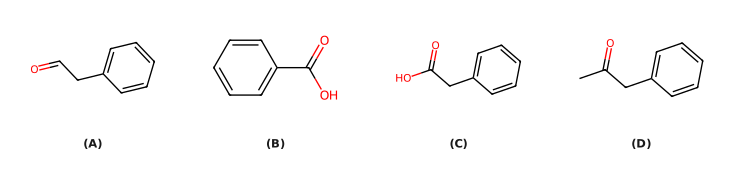
›Reveal solutionSolution
HVZ needs a carboxylic acid with at least one α-hydrogen. Benzoic acid has no α-H, and the aldehyde and ketone are not acids at all — leaving phenylacetic acid, option (C).
The concept first
The Hell–Volhard–Zelinsky (HVZ) reaction is the standard way to put a halogen on the carbon next to a −COOH group:
R-CH2-COOH (i) Cl2 or Br2 / red P(ii) H2O R-CHX-COOH
Why the red phosphorus? A carboxylic acid enolises very badly. Red P + X2 generates PX3, which turns a small amount of the acid into its acyl halide RCH2COX. That species enolises readily, and the enol is attacked by X2 at the α-carbon; hydrolysis then hands back the α-halo acid.
So HVZ has two non-negotiable requirements:
- the substrate is a carboxylic acid, and
- it possesses an α-hydrogen (no α-H ⇒ no enol ⇒ no reaction).
Step-by-step through the options
(A) C6H5CH2CHO, phenylacetaldehyde. It has α-hydrogens, but it is an aldehyde. Its α-halogenation is ordinary acid/base-catalysed halogenation — not HVZ. ✗
(B) C6H5COOH, benzoic acid. It is a carboxylic acid, but the carbon attached to −COOH is an aromatic ring carbon carrying no hydrogen at that site: there is no α-hydrogen. No enol can form, so HVZ fails. (With Br2/Fe benzoic acid would undergo ring bromination instead — an entirely different reaction.) ✗
(C) C6H5CH2COOH, phenylacetic acid. A carboxylic acid whose α-carbon is a CH2 — two α-hydrogens. Both conditions are satisfied:
C6H5CH2COOH (i) Br2/red P(ii) H2O C6H5-CHBr-COOH ✓
(D) C6H5CH2COCH3, phenylacetone. A ketone. It halogenates at the α-carbon under acid or base catalysis, but that is not the HVZ reaction. ✗
✓Final answerPhenylacetic acid is the only carboxylic acid here with α-hydrogens, so it alone undergoes the HVZ reaction — the correct option is (C).
ANSWER: C
- TG EAPCET 2025Set eng-2025-05-04-FN1 markMCQQ.A sample of water contains Mg(HCO3)2 and Ca(HCO3)2. On boiling this water, these hydrogen carbonates are removed as precipitates. The precipitates are (A) Mg(OH)2, Ca(OH)2 (B) MgCO3, Ca(OH)2 (C) MgCO3, CaCO3 (D) Mg(OH)2, CaCO3
›Reveal solutionSolution
On boiling, magnesium hydrogen carbonate decomposes to magnesium hydroxide (not carbonate) because Mg(OH)2 is less soluble than MgCO3, while calcium hydrogen carbonate gives calcium carbonate. The precipitates are Mg(OH)2 and CaCO3, so the correct option is (D).
The key here is understanding how the hydrogen carbonates of magnesium and calcium behave when heated. Both Mg(HCO3)2 and Ca(HCO3)2 are soluble in cold water, but boiling drives off carbon dioxide and water, leaving behind insoluble products. However, the exact product depends on the relative solubilities of the possible carbonates and hydroxides — and this is where magnesium and calcium differ.
For calcium, CaCO3 is far less soluble than Ca(OH)2, so the precipitate is calcium carbonate. For magnesium, the situation is reversed: Mg(OH)2 is much less soluble than MgCO3, so the precipitate is magnesium hydroxide. Let’s walk through the chemistry step by step.
- The decomposition reaction for a hydrogen carbonate When any hydrogen carbonate is heated, it decomposes to the carbonate, water, and carbon dioxide:
M(HCO3)2ΔMCO3+H2O+CO2
This is the general pattern. If this were the whole story, both Mg and Ca would give their carbonates. But magnesium carbonate itself can further react with water under these conditions.
- Why magnesium hydroxide forms instead MgCO3 is sparingly soluble, but Mg(OH)2 is even less soluble — its solubility product is about 5.6×10⁻¹², compared to 6.8×10⁻⁶ for MgCO3. In the hot aqueous environment, any MgCO3 that forms can undergo hydrolysis:
MgCO3+H2O→Mg(OH)2+CO2
The driving force is the precipitation of the much less soluble hydroxide. So the net reaction for magnesium hydrogen carbonate on boiling is:
Mg(HCO3)2ΔMg(OH)2+2CO2
(Water is also produced, but it’s part of the medium.)
- Calcium stays as carbonate For calcium, Ca(OH)2 is actually more soluble than CaCO3 (solubility product of CaCO3 is 3.4×10⁻⁹, while Ca(OH)2 is about 5.5×10⁻⁶). So the carbonate is the stable precipitate, and no further hydrolysis occurs. The reaction is simply:
Ca(HCO3)2ΔCaCO3+H2O+CO2
- Putting it together Boiling the water removes both hydrogen carbonates. The precipitates formed are Mg(OH)2 and CaCO3. This is a classic distinction in water hardness chemistry — temporary hardness due to calcium is removed as chalk (CaCO3), while magnesium temporary hardness gives a milky white precipitate of Mg(OH)2.
Watch outA common mistake is to assume both give carbonates because the general formula looks the same. Always check the relative solubilities of the carbonate vs. hydroxide for each metal ion — magnesium is the odd one out here.
TipYou can remember this by the mnemonic: "Calcium carbonate, magnesium hydroxide" — or think that Mg(OH)2 is the familiar "milk of magnesia", which is indeed very insoluble.
✓Final answerThe correct option is (D): the precipitates are Mg(OH)2 and CaCO3.
- TG EAPCET 2025Set ap-2025-04-29-AN1 markMCQQ.An isomer of C7H16 is X. This has five primary, one tertiary and one quaternary carbon. What is X? (A) 3-Ethylpentane (B) 3,3-Dimethylpentane (C) 2,2,3-Trimethylbutane (D) 2,4-Dimethylpentane
›Reveal solutionSolution
The key is to count the types of carbons (primary, tertiary, quaternary) in each isomer. Only 2,2,3-trimethylbutane has exactly five primary, one tertiary, and one quaternary carbon — so the answer is (C).
The question gives you a molecular formula C7H16 (a heptane isomer) and tells you the carbon classification: five primary carbons (bonded to only one other carbon), one tertiary carbon (bonded to three other carbons), and one quaternary carbon (bonded to four other carbons). That’s a total of seven carbons, which matches the formula. Your job is to find which of the four options fits this exact pattern.
Let’s walk through each option and count the carbon types.
-
Option (A): 3-Ethylpentane
Draw the structure: a pentane chain with an ethyl group on carbon 3.
- The chain carbons: C1, C2, C3, C4, C5. C3 is bonded to the ethyl group, so it’s tertiary (connected to three carbons: C2, C4, and the ethyl carbon).
- The ethyl group has two carbons: one attached to C3 (that’s a secondary carbon, bonded to two carbons) and a terminal CH₃ (primary).
- Count: primary carbons = the two terminal CH₃ on the main chain (C1 and C5) plus the CH₃ on the ethyl = 3 primary. Tertiary = 1 (C3). Quaternary = 0. That’s only 3 primary, not 5. So (A) is out.
-
Option (B): 3,3-Dimethylpentane
Structure: pentane chain with two methyl groups on carbon 3.
- C3 is bonded to C2, C4, and two methyl groups — that’s four bonds to carbon, so it’s quaternary.
- The two methyl groups on C3 are primary. The terminal CH₃ on C1 and C5 are primary. That gives 4 primary carbons.
- C2 and C4 are secondary (each bonded to two carbons). No tertiary carbon.
- Count: primary = 4, tertiary = 0, quaternary = 1. Not matching (needs 5 primary and 1 tertiary). So (B) is out.
-
Option (C): 2,2,3-Trimethylbutane
Structure: a butane chain (4 carbons) with three methyl substituents: two on carbon 2 and one on carbon 3.
- Let’s label the main chain: C1, C2, C3, C4.
- C1: bonded only to C2 and three H’s — primary.
- C2: bonded to C1, C3, and two methyl groups — that’s four carbon bonds, so quaternary.
- C3: bonded to C2, C4, and one methyl group — three carbon bonds, so tertiary.
- C4: bonded only to C3 and three H’s — primary.
- The two methyl groups on C2 are primary. The one methyl group on C3 is primary.
- Count primary carbons: C1, C4, the two methyls on C2, and the methyl on C3 = 5 primary.
- Tertiary: C3 = 1.
- Quaternary: C2 = 1.
- Perfect match! So (C) is the answer.
- Let’s label the main chain: C1, C2, C3, C4.
-
Option (D): 2,4-Dimethylpentane
Structure: pentane chain with methyl groups on carbons 2 and 4.
- C1 and C5 are primary. The methyl groups on C2 and C4 are primary — that’s 4 primary.
- C2 and C4 are tertiary (each bonded to three carbons). C3 is secondary.
- Count: primary = 4, tertiary = 2, quaternary = 0. Not matching. So (D) is out.
Watch outA common mistake is to forget that the carbon in a methyl substituent is itself a primary carbon. Count every CH₃ group, whether on the main chain or as a branch.
TipTo quickly check carbon types, draw the carbon skeleton and note the degree (number of carbon neighbours) of each carbon. Primary = degree 1, secondary = degree 2, tertiary = degree 3, quaternary = degree 4.
✓Final answerThe correct option is (C) 2,2,3-trimethylbutane.
-
- TG EAPCET 2025Set ap-2025-04-29-AN1 markMCQQ.Which of the following is an example of antifertility drug? (A) Bithionol (B) Sucralose (C) Novestrol (D) Terpineol
›Reveal solutionSolution
Antifertility drugs are chemical substances designed to prevent pregnancy. Among the given choices, Novestrol is a synthetic steroid hormone used as an antifertility drug, typically found in oral contraceptives. The correct option is (C).
Antifertility drugs, also known as contraceptives, are chemical substances used to prevent conception. Their primary role is in family planning, allowing individuals to control the timing and spacing of pregnancies. These drugs typically work by interfering with the female reproductive cycle, most commonly by inhibiting ovulation (the release of an egg from the ovary) or by altering the uterine environment to prevent the implantation of a fertilized egg.
Most antifertility drugs are synthetic derivatives of natural hormones like estrogen and progesterone. By mimicking or modulating the effects of these hormones, they disrupt the normal hormonal cascade required for pregnancy.
Let's examine each option:
-
Understanding Antifertility Drugs:
Antifertility drugs are substances that prevent pregnancy. They achieve this primarily by interfering with the hormonal regulation of the female reproductive cycle. The most common types are oral contraceptives, which contain synthetic estrogen and/or progestin derivatives. These synthetic hormones inhibit the release of gonadotropins (FSH and LH) from the pituitary gland, thereby preventing ovulation. They can also thicken cervical mucus, making it difficult for sperm to reach the egg, and alter the uterine lining to prevent implantation.
-
Analyzing Option (A) Bithionol:
Bithionol is an antiseptic. It is commonly added to soaps to reduce the growth of microorganisms on the skin. It has no role in preventing pregnancy.
-
Analyzing Option (B) Sucralose:
Sucralose is an artificial sweetener. It is a calorie-free sugar substitute derived from sucrose. It is used in various food and beverage products and has no medicinal or antifertility properties.
-
Analyzing Option (C) Novestrol:
Novestrol is a synthetic steroid hormone. While "Novestrol" itself might not be a universally recognized brand name, it represents a class of synthetic estrogen or progestin derivatives (like norethindrone, norgestrel, or ethinylestradiol) that are key components of oral contraceptive pills. These synthetic hormones are designed to prevent ovulation and alter the uterine environment, thus acting as antifertility drugs.
-
Analyzing Option (D) Terpineol:
Terpineol is an alcohol found in various plant essential oils. It is widely used in cosmetics, perfumes, and as a flavoring agent due to its pleasant aroma. It also has some antiseptic properties but is not an antifertility drug.
Based on this analysis, Novestrol is the only option that functions as an antifertility drug.
✓Final answerThe correct option is (C) Novestrol.
-
🎓Unlock everything free for 14 days
- ✓Full step-by-step solutions
- ✓Concept-first explanations
- ✓Methods, shortcuts & mistakes
- ✓PYQ mapping + timed mock tests
Full access for 14 days. No credit card required.